Southwest 737 MAX 8 Declares Emergency, Diverts to Honolulu

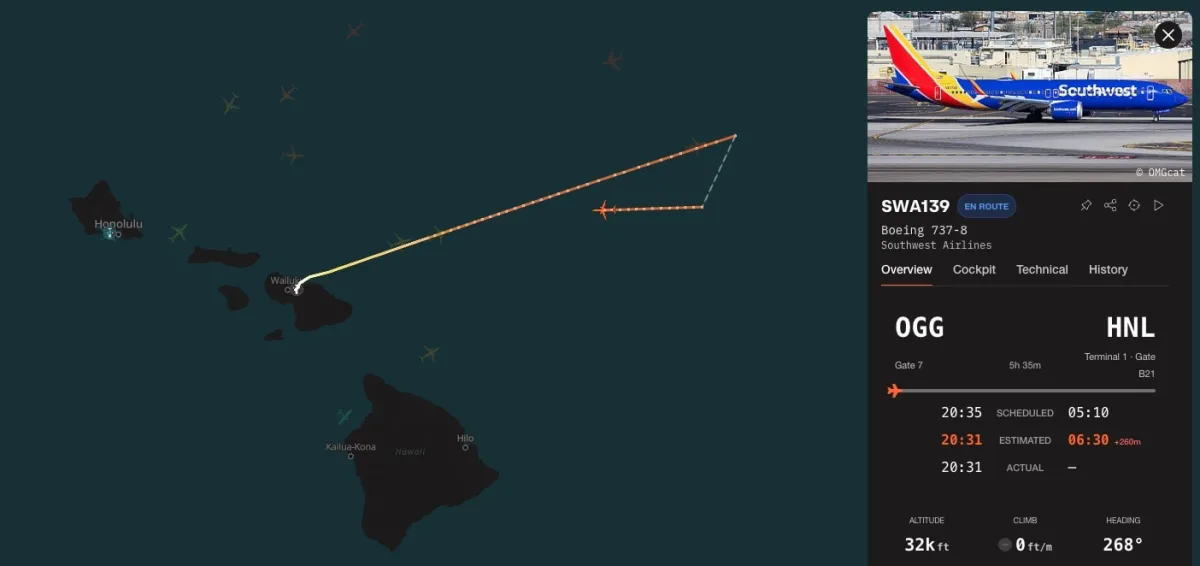
Southwest Airlines Flight WN139 diverted to Honolulu after declaring an inflight emergency 90 minutes into a flight from Maui to Las Vegas.
Key Takeaways
- •Southwest Flight WN139 diverted to Honolulu after an inflight emergency.
- •The 737 MAX 8 crew squawked 7700 while 90 minutes into the flight.
- •The diversion followed standard ETOPS safety protocols for overwater flights.
- •FAA preliminary reports on the incident are expected by August 2026.
Inflight Emergency and Diversion Protocol
Southwest Airlines Flight WN139, operated by a Boeing 737 MAX 8 (registration N8773Q), declared an inflight emergency and diverted to Daniel K. Inouye International Airport (HNL) in Honolulu on July 6, 2026. The flight, originally bound for Harry Reid International Airport (LAS) in Las Vegas, was approximately 90 minutes into its journey from Kahului Airport (OGG) on Maui when the crew initiated the diversion. At the time of the incident, the aircraft was cruising at an altitude of 32,000 feet over the Pacific Ocean.
To signal the emergency, the flight crew transmitted a Squawk 7700 code, the universal international transponder signal for an inflight emergency. This action triggered immediate coordination with air traffic control and the mobilization of emergency response teams at the Honolulu facility. The decision to return to land followed standard Extended-range Twin-engine Operational Performance Standards (ETOPS), which mandate that twin-engine aircraft operating over water must establish a 'point of safe return' to ensure the ability to reach a suitable airport in the event of a system anomaly.
Operational and Passenger Impact
The diversion resulted in significant itinerary disruptions for the passengers aboard the flight, who were forced to contend with missed connections in Las Vegas and unexpected delays in Hawaii. For Southwest Airlines, the event necessitates unplanned operational expenses, including aircraft inspection, potential unscheduled maintenance, crew repositioning, and the logistical burden of rebooking impacted travelers. While the aircraft is now undergoing assessment, local emergency services in Honolulu were required to stand by as a precautionary measure during the landing.
Historical Context and Industry Precedents
This incident aligns with broader industry trends where airlines prioritize immediate diversions to major maintenance hubs, such as Honolulu or Vancouver, when encountering mechanical anomalies during long-haul overwater segments. This conservative approach is designed to mitigate risks associated with continued flight over the open ocean. A comparable event occurred in April 2026, when an Air Canada Boeing 777-300ER diverted to Vancouver while en route to Tokyo, demonstrating the standard industry procedure of utilizing established maintenance bases for emergency arrivals.
Furthermore, the rapid response of the WN139 crew reflects the standard protocol seen in other recent incidents, such as the June 2026 diversion of American Airlines Flight AA1641, which returned to Miami shortly after takeoff. These events underscore the reliance on established safety protocols when flight crews encounter unexpected technical challenges.
Technical Analysis: The 737 MAX 8
The Boeing 737 MAX 8 is a cornerstone of the modern narrow-body fleet, designed for efficiency across medium-to-long-haul routes. The aircraft is equipped with CFM LEAP-1B engines. Its performance profile is frequently compared to its primary competitor, the Airbus A320neo, which utilizes different engine architectures and capacity configurations.
| Metric | Boeing 737 MAX 8 | Airbus A320neo |
|---|---|---|
| Range | ~3,550 nm | 3,400 nm |
| Typical Capacity | 162-178 passengers | 150-165 passengers |
| Engine Options | CFM LEAP-1B | CFM LEAP-1A or PW1100G |
What Comes Next: Investigation and Return to Service
The Federal Aviation Administration (FAA) is expected to oversee the standard post-incident review process. A preliminary report regarding the nature of the emergency is anticipated to be published between July and August 2026. Simultaneously, Southwest Airlines maintenance teams are expected to complete the necessary diagnostic work to return the aircraft to service by late July 2026, pending final safety verification.
Why This Matters for Airline Operations
This incident highlights the critical nature of ETOPS regulations in maintaining safety for trans-oceanic operations. By adhering to strict diversion protocols, operators ensure that flight crews have clear, pre-defined procedures to manage mechanical issues before they escalate. For the aviation industry, such diversions serve as a reminder of the complex logistical and safety infrastructure required to support long-haul narrow-body operations.
Frequently Asked Questions
- What is the ETOPS protocol followed during the Southwest diversion?
- ETOPS, or Extended-range Twin-engine Operational Performance Standards, requires that twin-engine aircraft flying over oceans maintain a 'point of safe return.' If a system anomaly occurs, this protocol mandates an immediate diversion to the nearest suitable airport, which in this case was Honolulu.
- What is a Squawk 7700 code in aviation?
- A Squawk 7700 is the universal international transponder code used by pilots to indicate an inflight emergency. It alerts air traffic control and nearby emergency services that the aircraft requires priority handling.
Get breaking commercial aviation news and expert airline analysis at omniflights.com. Track policy changes, airspace rules, and global aviation governance in the Regulatory category at omniflights.com/regulatory.

Written by Shashank Shukla
Co-Founder & CTO leading the engineering and AI systems behind Omni Flights. Covers aviation technology, flight safety, aircraft manufacturing, and emerging aerospace developments.
Visit ProfileYou Might Also Like
FlyDubai Flight FZ1073: Captain Stabbing Under Investigation

Flydubai FZ1073 Hijacking Thwarted After Cockpit Attack

EASA Grounds Elixir Aircraft Fleet After Fatal French Crash
FlyDubai Flight 1073 Attacker Studied at UK University
Flydubai FZ1073: Co-pilot Used Axe in Hijacking Attempt