Japan Steps Up Fry to Fly SAF Efforts for 2030 Mandate

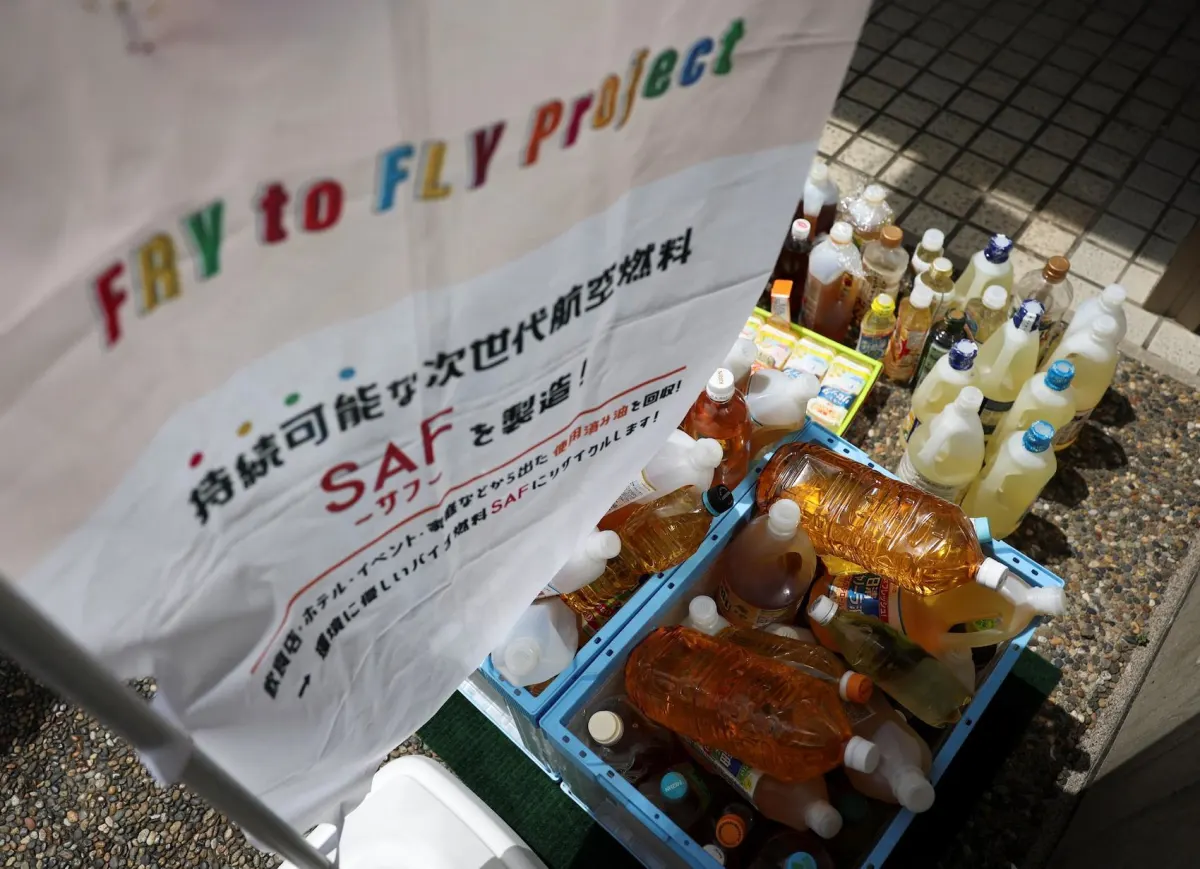
Japan is expanding the Fry to Fly project to secure domestic cooking oil for the 1.7 million kiloliters of SAF required for its 2030 blending mandate.
Key Takeaways
- •Japan mandates 10% SAF blending for all domestic and international flights by 2030.
- •Meeting the 2030 SAF target requires 1.7 million kiloliters of sustainable fuel annually.
- •Current domestic SAF production capacity is limited to 30,000 kiloliters per year.
- •Fry to Fly project coordinates 300 organizations to collect used cooking oil feedstock.
Scaling Domestic Feedstock for Japan’s 2030 SAF Mandate
Japan is intensifying its efforts to secure domestic feedstock for Sustainable Aviation Fuel (SAF), as the nation races to meet a government-mandated target of replacing 10% of conventional jet fuel with sustainable alternatives by 2030. The Ministry of Land, Infrastructure, Transport and Tourism (MLIT) and the Ministry of Economy, Trade and Industry (METI) have established this goal to align with global decarbonization efforts, including the International Civil Aviation Organization (ICAO) CORSIA framework. Achieving this target will require approximately 1.7 million kiloliters of SAF annually, a significant leap from current domestic production capacity.
At the center of this initiative is the Fry to Fly project, a public-private partnership involving roughly 300 organizations, including local municipalities, supermarkets, and major corporations. The project focuses on the collection of Used Cooking Oil (UCO) from households and commercial kitchens to be refined into aviation fuel via the Hydroprocessed Esters and Fatty Acids (HEFA) process. The official JGC Holdings portal highlights how these grassroots efforts are essential for establishing a reliable supply chain in a highly competitive global market.
The Supply Chain Challenge
Despite the growth of the Fry to Fly project, the current domestic supply of UCO remains constrained. According to data from UCO Japan (Federation for UCO Recycling Co-operatives), Japan generates approximately 380,000 tonnes of UCO annually. However, this feedstock is currently fragmented: 200,000 tonnes are diverted to livestock feed, while 120,000 tonnes are exported to Europe. With domestic SAF production capacity currently limited to roughly 30,000 kiloliters per year—representing just 0.3% of total jet fuel demand—the industry faces a critical supply gap.
Executives from ANA (All Nippon Airways) and Japan Airlines (JAL) have expressed concerns regarding the limited availability of domestic SAF. In a joint presentation, they noted that the current environment is "far harsher than expected," highlighting the logistical and economic hurdles of scaling production. Engineering firm JGC Holdings, which operates a joint venture with Cosmo Energy at the Sakai Refinery, has emphasized that a clearer outlook on long-term demand is required to justify the significant capital investment needed to scale commercial facilities.
SAF vs. Conventional Jet Fuel: Technical Specifications
| Metric | HEFA-SPK from UCO | Conventional Jet A-1 |
|---|---|---|
| Lifecycle CO2 Reduction | Up to 80% | Baseline (0%) |
| Blend Limit | Max 50% (ASTM D7566) | 100% (Drop-in) |
| Aromatics Content | Near 0% | 8% to 25% |
Stakeholder Impact and Market Competition
The push for domestic SAF is creating friction across multiple sectors. Livestock feed manufacturers are facing rising input costs as aviation fuel producers compete for the same waste oils. Simultaneously, domestic UCO exporters are under pressure as industry participants lobby METI to restrict exports, aiming to retain feedstock within Japan to meet the 2030 mandate. While the IATA (International Air Transport Association) guidelines provide a roadmap for SAF adoption, the competition for limited waste-based feedstocks remains a primary barrier to rapid scaling.
The Path to 2030
The 10% SAF blending mandate is set for enforcement in 2030, leaving a narrow window for Japanese refiners to scale operations. Domestic refiners, including Eneos and Cosmo Energy, are expected to make final investment decisions for capacity expansion by early 2027. This timeline is critical, as the industry must transition from small-scale collection projects to industrial-level refining to satisfy the 1.7 million kiloliter annual requirement. Failure to secure this volume poses significant operational and financial risks for Japanese carriers, who may face compliance penalties if the mandate is not met.
Frequently Asked Questions
- What is the goal of Japan's Fry to Fly project?
- The Fry to Fly project is a public-private initiative that collects used cooking oil from households and businesses to refine it into Sustainable Aviation Fuel. It aims to secure domestic feedstock to help Japan meet its 2030 mandate of replacing 10% of conventional jet fuel with SAF.
- Why is there competition for used cooking oil in Japan?
- Used cooking oil is a limited resource currently diverted to livestock feed or exported to Europe. As Japan scales its SAF production to meet the 2030 mandate, aviation fuel producers are competing with these established sectors for the same feedstock.
Get breaking commercial aviation news and expert airline analysis at omniflights.com. Track policy changes, airspace rules, and global aviation governance in the Regulatory category at omniflights.com/regulatory.

Written by Hardik Vishwakarma
Co-Founder & Aviation News Editor leading initiatives that improve trust and visibility across the global aviation industry. Covers airlines, airports, safety, and emerging technology.
Visit ProfileYou Might Also Like

American Airlines Flies First U.S. eSAF Passenger Flight

Akasa Air Partners with BPCL to Advance SAF in India

Delta, Shell Aviation Ink 5-Year SAF Supply Agreement
Indonesia to Mandate 1% SAF Blend for Flights by 2027

Gulfstream G800 Completes 100% SAF High-Altitude Emissions Test