Skydweller Drone Crashes After Record 8-Day Flight

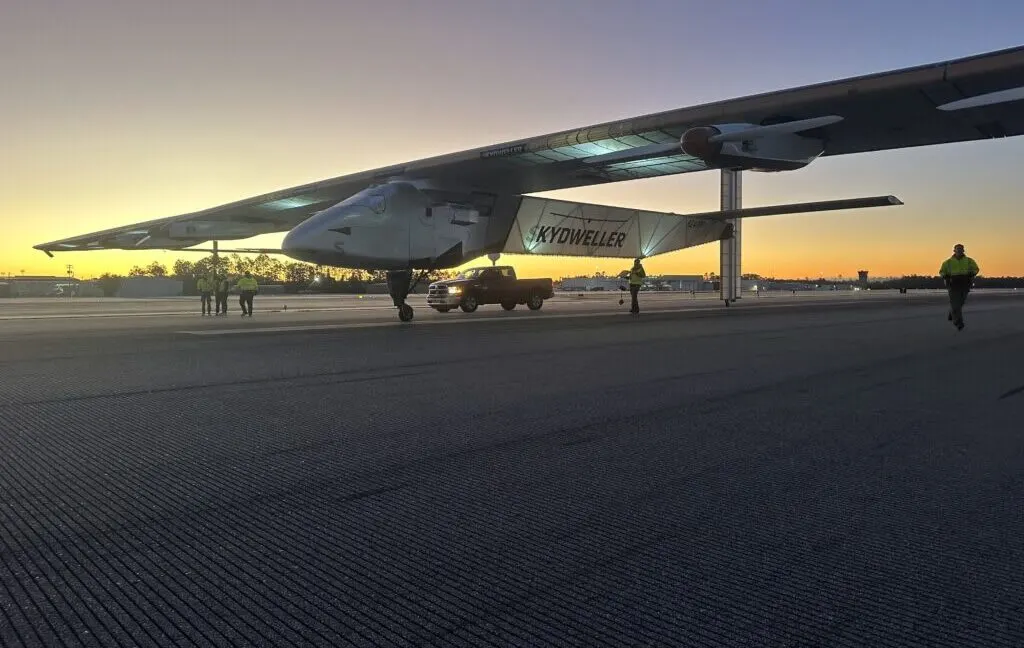
Skydweller Aero's solar drone crashed in the Gulf of Mexico after a record 8-day autonomous flight, prompting an NTSB aviation investigation.
Key Takeaways
- •Skydweller solar drone crashed after a record 8-day autonomous flight.
- •The NTSB has launched an investigation into the Gulf of Mexico incident.
- •Aircraft was a modified Solar Impulse 2 used for a U.S. Navy exercise.
- •It had a 236-foot wingspan, wider than a Boeing 747 jumbo jet.
The Skydweller Aero drone, a heavily modified version of the historic Solar Impulse 2 aircraft, crashed into the Gulf of Mexico on May 4, 2026, following a record-setting mission. The loss occurred after the autonomous solar aircraft completed a continuous flight of 8 days and 14 minutes. The incident, which took place during a U.S. Navy exercise, is now the subject of an NTSB aviation investigation.
The crash concludes the operational life of a pioneering airframe but simultaneously marks a significant, if partial, success for military contractors developing persistent surveillance platforms. The flight was part of the U.S. Navy's Fleet Exercise (FLEX) 26, intended to validate the capabilities of High-Altitude Pseudo-Satellites (HAPS) for long-duration maritime patrol. While the aircraft was ultimately lost, its multi-day autonomous operation provided critical data on the feasibility of solar-powered military drones.
According to a preliminary report from the National Transportation Safety Board (NTSB), filed under docket number DCA26LA196, the aircraft ditched after losing power. The NTSB has launched a full Class 4 investigation to determine the root cause of the failure. The uncrewed aircraft, registered as N247PF, was operating under Federal Aviation Administration (FAA) Part 91 rules with a specific Certificate of Authorization (COA) for its mission.
Aircraft Legacy and Specifications
The airframe began its life as Solar Impulse 2, a project designed to circumnavigate the globe using only solar power to promote renewable energy. After its historic journey, it was acquired by Skydweller Aero and repurposed for defense applications. The aircraft's immense size was one of its defining features, with a wingspan of 236 feet (72 meters)—wider than that of a Boeing 747. This vast surface area was covered with over 17,000 solar cells, capable of generating approximately 100 kW of peak power to charge its batteries for nighttime flight.
Despite its scale, the aircraft was exceptionally light, weighing only 5,500 pounds. Skydweller Aero modified it to carry an 800-pound payload consisting of advanced radars and optical sensors for surveillance missions. This conversion represents a broader industry trend of repurposing experimental climate technology for military use, a transition that has drawn mixed reactions.
Stakeholder Impact and Contrasting Views
The loss of the aircraft has prompted varied responses. For Skydweller Aero, the crash means the loss of its primary testbed, potentially delaying the validation of its proprietary autonomy and energy management software. The U.S. Navy, however, views the mission as a qualified success, having demonstrated an 8-day autonomous maritime patrol capability that advances its long-term surveillance goals.
Bertrand Piccard and the Solar Impulse Foundation, the original creators, expressed sadness over the loss of their former 'technological flagship.' Their perspective, as noted by the foundation, highlights the contrast between the aircraft's original mission of promoting clean energy and its final application as a military surveillance asset. Furthermore, the Swiss Museum of Transport has lost the opportunity to display the historic airframe, which was part of the original 2019 sales agreement.
Industry Context and Precedents
The Skydweller incident is not the first loss of a high-profile solar HAPS platform. The event mirrors other crashes of experimental long-endurance drones, suggesting a pattern of high-risk development in this sector. In August 2022, an Airbus Zephyr S drone crashed in Arizona after setting a remarkable 64-day flight endurance record. Similarly, in June 2016, Facebook's Aquila internet drone suffered a structural failure during landing on its first test flight, contributing to the program's eventual cancellation. These precedents underscore the significant engineering challenges in creating lightweight, massive-wingspan aircraft capable of perpetual flight in the upper atmosphere.
Skydweller Drone vs. Boeing 747-8
| Metric | Skydweller Drone | Boeing 747-8 |
|---|---|---|
| Wingspan | 236 ft | 224 ft |
| Maximum Weight | 5,500 lbs | 987,000 lbs |
| Propulsion | Solar/Electric | 4x Turbofan engines |
Technical Analysis
The crash of the Skydweller drone, while a setback, validates the core concept of solar-powered HAPS for military intelligence, surveillance, and reconnaissance (ISR). The successful completion of an eight-day autonomous mission over water is a significant data point for the Department of Defense, demonstrating that such platforms can provide persistent, satellite-like coverage at a fraction of the cost. The failure at the end of the mission highlights the remaining challenges in energy management and structural integrity for long-duration flights. This event, following the losses of the Zephyr and Aquila, suggests that while the promise of perpetual flight is closer than ever, the technology remains in a high-risk, experimental phase. The industry will likely focus on improving battery efficiency, autonomous fault detection, and recovery systems to enhance the reliability of future HAPS designs.
What Comes Next
The primary focus now shifts to the official investigation. The NTSB will analyze flight data and any recovered wreckage to determine a probable cause for the power loss. A final accident report is expected to be published, though these investigations often take over a year to complete. Based on typical timelines, the NTSB's final report on the Skydweller crash is expected in late 2027. Skydweller Aero has not announced its timeline for a successor aircraft, but the data gathered from this flight will be critical for its future development programs.
Why This Matters
The loss of the Skydweller drone is a pivotal event where pioneering green aviation technology has fully transitioned into a dual-use military asset. For the defense industry, the 8-day flight validates the strategic value of solar-powered HAPS for persistent surveillance, likely accelerating investment in the sector. For the broader aviation community, it marks the final chapter for the iconic Solar Impulse 2 airframe, a symbol of environmental innovation now repurposed and lost in a military context.
Frequently Asked Questions
- Why did the Skydweller solar drone crash?
- The Skydweller drone, a modified Solar Impulse 2, crashed into the Gulf of Mexico on May 4, 2026, after experiencing a power loss. The National Transportation Safety Board (NTSB) is investigating the precise cause of the failure, which occurred after a record 8-day autonomous flight during a U.S. Navy exercise.
- How big was the Skydweller drone compared to a Boeing 747?
- The Skydweller drone had a wingspan of 236 feet (72 meters), which is wider than the 224-foot wingspan of a Boeing 747-8. However, it was extremely lightweight, with a maximum weight of only 5,500 pounds compared to the 747's 987,000 pounds.
Stay ahead of the airline industry with commercial aviation news from omniflights.com. For reporting on UAP sightings, investigations, and aviation-related encounters, see the UAPs section at omniflights.com/uaps.

Written by Hardik Vishwakarma
Co-Founder & Aviation News Editor leading initiatives that improve trust and visibility across the global aviation industry. Covers airlines, airports, safety, and emerging technology.
Visit ProfileYou Might Also Like
Autonomous Fixed-Wing Aircraft Development Gains Momentum

Boeing 787-9 Completes Short Inlet Tests in Montana

Airbus A321neo to Test Folding Wings of Tomorrow Project
Voyageur Orders Canada's First Airbus U030 Flexrotor
LATAM Selects SES Multi-Orbit Wi-Fi for 60+ New Jets