Boeing 787-9 Completes Short Inlet Tests in Montana

Co-Founder & CTOCo-Founder & CTO driving the technology and data systems behind Omni Flights.

Boeing completed 52 hours of flight tests on a 787-9 with an experimental 30% shorter engine inlet to evaluate noise and fuel efficiency.
Key Takeaways
- •Boeing completed 52 hours of flight testing on a 787-9 in Montana.
- •Experimental engine inlet is 30% shorter than production models.
- •Short inlet design targets up to a 2% reduction in fuel burn.
- •FAA CLEEN Phase III program co-funded the flight test campaign.
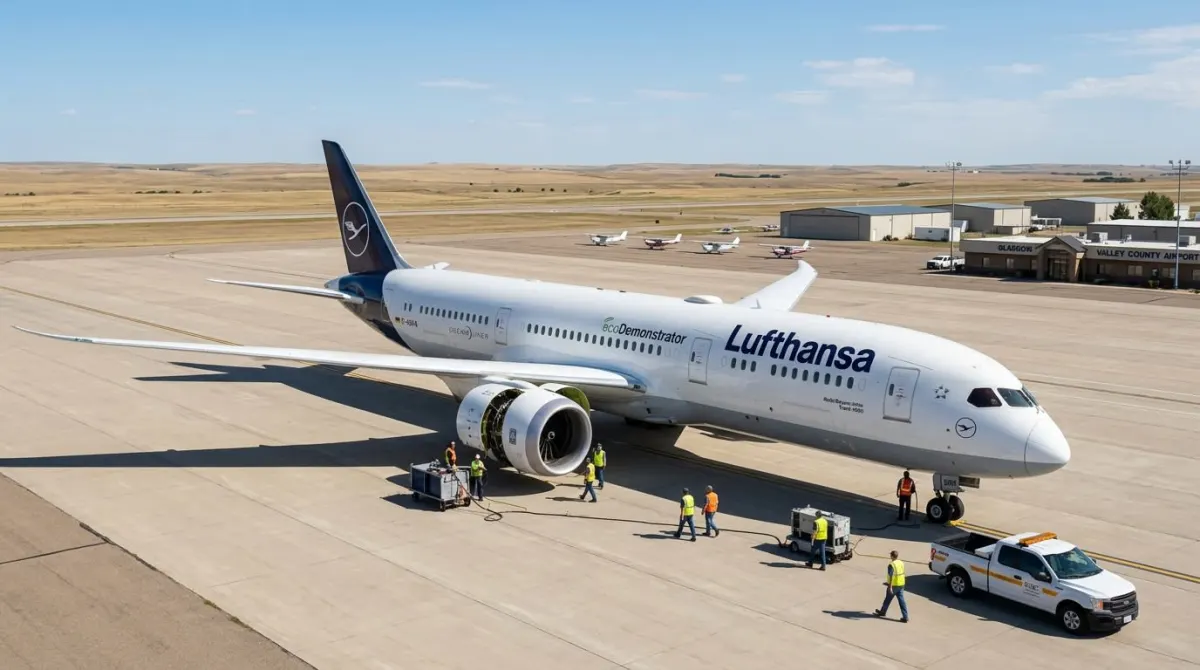
Boeing has completed flight testing in Glasgow, Montana, using a 787-9 configured as the Boeing 787 ecoDemonstrator Explorer. This campaign, part of the FAA CLEEN program, evaluated short engine inlet testing on a Rolls-Royce Trent 1000 engine to assess acoustic performance and aerodynamic drag. The experimental Next Generation Inlet is approximately 30% shorter than standard production models, representing a major step toward optimizing propulsion integration for future commercial aircraft.
According to the Boeing ecoDemonstrator factsheet, this campaign evaluated the Next-Generation Inlet alongside Intelligent Operations flight paths to optimize overall operational efficiency. The flight trials, conducted in collaboration with Rolls-Royce and Lufthansa, targeted a critical bottleneck in modern turbofan design. As engine manufacturers increase bypass ratios to improve fuel efficiency, larger fan diameters introduce significant weight and drag penalties. Shorter inlets offer a pathway to mitigate these penalties, potentially reducing fuel burn by up to 0.5% in initial iterations and up to 2% in future designs, provided advanced acoustic liners can successfully maintain noise parity.
Test Campaign Execution and Stakeholder Impact
The test aircraft accumulated approximately 52 flight hours across 12 flights during the Montana test campaign in August 2026. This initiative is part of a cost-sharing public-private partnership with the FAA (Federal Aviation Administration) under the CLEEN (Continuous Lower Energy, Emissions and Noise) Phase III Program. By testing these technologies on an active twin-aisle platform, the program aims to mature noise, emissions, and fuel-burn reduction concepts for integration into future commercial aircraft.
The outcomes of these flight trials carry significant implications across several industry sectors:
- Engine Manufacturers: For propulsion suppliers like Rolls-Royce, shorter inlets are critical for developing higher-bypass, larger-diameter turbofan engines, such as the UltraFan concept, without incurring prohibitive weight and aerodynamic drag penalties.
- Commercial Airlines: Successful certification of the shorter inlet could reduce fuel burn by up to 2% on future aircraft iterations, significantly lowering operating costs and carbon emissions for carriers like Lufthansa.
- Airport Communities: Advanced acoustic liners covering a larger surface area of the shorter inlet aim to offset increased fan noise, ensuring community noise footprints do not expand.
However, acoustic engineering presents a significant challenge. According to aviation engineering consensus, while shorter inlets effectively reduce drag and weight, they inherently reduce the physical surface area available for acoustic lining. This makes it difficult to prevent increased forward-radiated fan noise, requiring highly advanced acoustic liner treatments to achieve noise parity.
Lane Ballard, Boeing Chief Technology Officer, highlighted the strategic value of the trials: "The more efficient inlet and Intelligent Operations flight paths we're evaluating on this year's ecoDemonstrator Explorer are among the many promising concepts we're working on. These enhancements have the potential to make our airplanes even more valuable to our partners, including customers like Lufthansa and suppliers like Rolls-Royce."
Evolution of Short Inlet Aerodynamics
The 2026 flight trials build directly upon previous research phases. Between 2018 and late 2022, the CLEEN Phase II program initiated short inlet ground and flight tests. During that cycle, Rolls-Royce and Boeing successfully tested an earlier iteration of the short inlet on a ground rig and later on a 747-200 Flying Test Bed. This historical precedent laid the groundwork for the 2026 acoustic and fuel-efficiency evaluations on the 787-9 ecoDemonstrator, demonstrating a clear progression from laboratory and testbed environments to a modern twin-aisle commercial airframe.
Next-Generation Inlet vs Trent 1000 Baseline
The physical and performance characteristics of the experimental nacelle design represent a stark departure from conventional turbofan installations.
| Metric | Next-Generation Inlet | Trent 1000 Baseline |
|---|---|---|
| Length | ~30% shorter (approx. 15 in / 38 cm reduction) | Standard production Trent 1000 inlet |
| Fuel Burn Impact | Up to 0.5% reduction (future potential up to 2%) | Baseline 787 design |
Aerodynamic Drag and Acoustic Mitigation Trade-offs
This development indicates a structural shift in propulsion aerodynamics as the industry pushes toward ultra-high-bypass ratio engines. Historically, the pursuit of larger fan diameters has been constrained by the aerodynamic drag and weight of the nacelle. By proving that a 30% shorter inlet can maintain noise parity through advanced acoustic liners, Boeing and Rolls-Royce are addressing a key barrier to next-generation engine architecture. This testing accelerates the trajectory established during the Phase II trials, moving the industry closer to a design standard where nacelle optimization directly offsets the physical penalties of higher-bypass turbofans.
Expected Milestones and FAA CLEEN Reporting
The Federal Aviation Administration is expected to publish the CLEEN Phase III final report and data analysis for the Next Generation Inlet between late 2026 and 2027. This milestone will provide the industry with validated acoustic and aerodynamic datasets, which will guide subsequent certification pathways and design iterations for future widebody nacelle programs.
Why Nacelle Optimization Matters for Net-Zero Targets
This development signals a critical pathway for airlines to squeeze incremental efficiency gains from existing airframe families. For the broader industry, achieving a 2% fuel burn reduction through nacelle optimization represents a vital mid-term contribution toward net-zero carbon emissions goals. It demonstrates that aerodynamic refinement remains a highly viable tool even as radical new propulsion technologies remain decades away.
Frequently Asked Questions
- What is the purpose of Boeing's short engine inlet testing?
- The testing evaluates if a 30% shorter engine inlet can maintain noise parity while reducing aerodynamic drag and improving fuel efficiency by up to 2% on future aircraft designs.
- Which partners participated in the 787-9 ecoDemonstrator trials?
- Boeing conducted the flight tests in Glasgow, Montana, in collaboration with engine manufacturer Rolls-Royce and German carrier Lufthansa under the FAA's CLEEN Phase III program.
- How does a shorter engine inlet affect aircraft noise?
- Shorter inlets reduce the physical surface area available for acoustic lining, which can increase forward-radiated fan noise. The tests evaluated advanced acoustic liners designed to mitigate this noise and maintain parity with standard inlets.
Visit omniflights.com for the latest commercial aviation news and airline industry updates. Get the latest updates on major hubs, regional terminals, and airport operations via the Airports section at omniflights.com/airports.
Written by Shashank Shukla
Co-Founder & CTO leading the engineering and AI systems behind Omni Flights. Covers aviation technology, flight safety, aircraft manufacturing, and emerging aerospace developments.
Visit ProfileYou Might Also Like
Discover more aviation news based on similar topics
Autonomous Fixed-Wing Aircraft Development Gains Momentum
Start-ups are advancing autonomous fixed-wing aircraft for agricultural and cargo tasks, aiming to prove safety before pursuing passenger operations.

Airbus A321neo to Test Folding Wings of Tomorrow Project
Airbus launched a three-year flight-test campaign using an A321neo to evaluate folding wings that extend up to five meters.
Voyageur Orders Canada's First Airbus U030 Flexrotor
Voyageur Aviation ordered Canada's first Airbus U030 Flexrotor, a 25 kg tactical drone, to expand its maritime and Arctic surveillance capabilities.
LATAM Selects SES Multi-Orbit Wi-Fi for 60+ New Jets
LATAM Airlines signed a multi-year deal with SES to equip more than 60 incoming Airbus and Embraer aircraft with multi-orbit satellite Wi-Fi.
Lufthansa 787-9 Tests Tech to Cut Fuel and Noise
Boeing, Lufthansa, and Rolls-Royce partnered to test emissions-reducing technologies on a 787-9, targeting a 20% fuel efficiency improvement.
Lufthansa 787-9 Begins ecoDemonstrator Flight Trials
Boeing and partners will test a modified Lufthansa 787-9 to evaluate technologies targeting a 25 dB cumulative noise reduction.