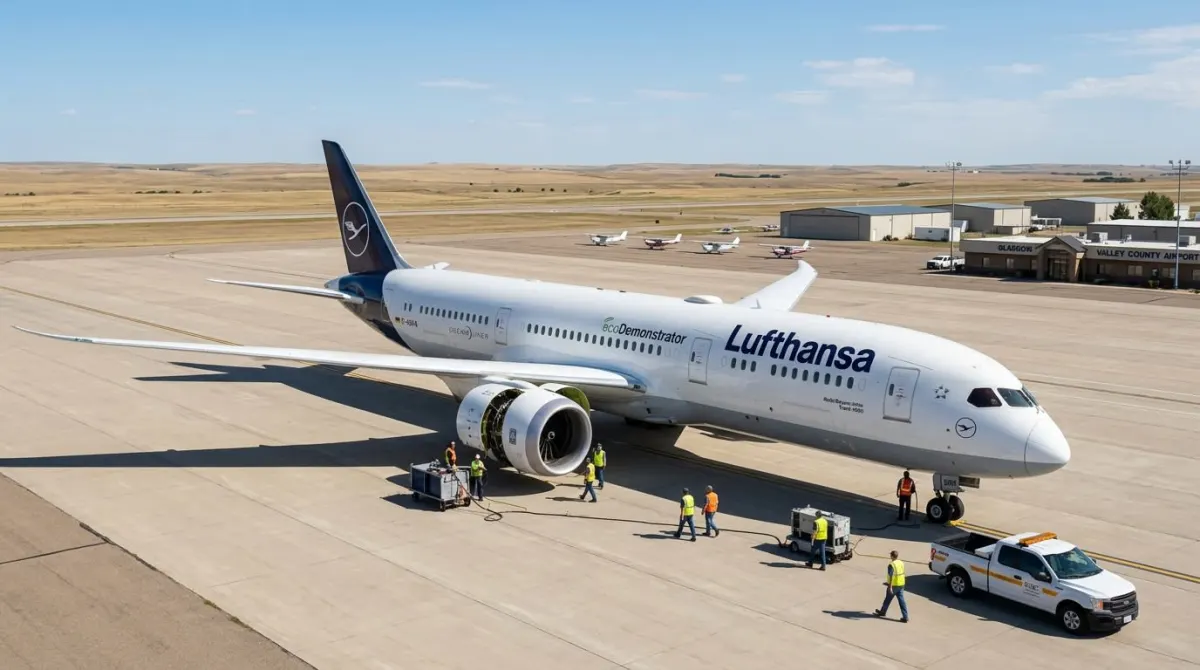
Lufthansa 787-9 Tests Tech to Cut Fuel and Noise

Boeing, Lufthansa, and Rolls-Royce partnered to test emissions-reducing technologies on a 787-9, targeting a 20% fuel efficiency improvement.
Key Takeaways
- •Boeing, Lufthansa, and Rolls-Royce launch 2026 ecoDemonstrator campaign.
- •Tests utilize a Lufthansa 787-9 equipped with Trent 1000 engines.
- •Program targets a 20% fuel efficiency gain under FAA CLEEN Phase III.
- •Flight tests in Glasgow, Montana are scheduled to conclude in mid-August 2026.
Boeing, Lufthansa, and Rolls-Royce have launched a joint flight-test campaign using the Boeing ecoDemonstrator 2026 program to evaluate advanced aircraft noise reduction and fuel-efficiency technologies. Operating on a Lufthansa 787-9 Dreamliner testbed equipped with Rolls-Royce Trent 1000 engines, the collaborative effort aims to accelerate the adoption of sustainable aviation technology. The test campaign, which supports the FAA's CLEEN Phase III program, focuses on validating a Next Generation Inlet and Intelligent Operations flight paths.
The operational implications of these tests are substantial for commercial aviation fuel efficiency. By integrating algorithmic flight path optimization and advanced nacelle acoustics, the partners seek to address both carbon emissions and community noise. This initiative directly aligns with the FAA (Federal Aviation Administration) and its CLEEN (Continuous Lower Energy, Emissions and Noise) Phase III program, which seeks to reduce environmental impacts while maintaining safety and economic viability.
Core Program Objectives and Stakeholder Impacts
The Boeing ecoDemonstrator 2026 program has tested over 260 technologies since its inception in 2012. These tests are critical to meeting the regulatory targets established by the FAA. Specifically, the FAA CLEEN Phase III program targets a 20% improvement in fuel efficiency compared to International Civil Aviation Organization (ICAO) standards and a 25 dB cumulative noise reduction.
Lane Ballard, Boeing's Chief Technology Officer, stated that the Next Generation Inlet and Intelligent Operations flight paths being evaluated on the ecoDemonstrator Explorer have the potential to make Boeing's aircraft more valuable to airline customers and supply partners. Alan Newby, Rolls-Royce Director of Research and Technology, added that the program represents the culmination of a decade of collaboration aimed at unlocking more sustainable flight.
The program has distinct implications for multiple industry stakeholders. For the Rolls-Royce Trent 1000 program, the campaign validates the integration of Trent 1000 engines with new, shorter inlet designs, enhancing the engine's competitiveness for future airframes. The Lufthansa Group will receive the specific 787-9 test aircraft after the campaign, benefiting from early exposure to the validated operational efficiencies. Additionally, airport communities may experience reduced noise exposure if the tested 'Intelligent Operations' flight paths are standardized by air traffic control.
However, the program also faces alternative viewpoints from outside the industrial partnership. Environmental sustainability advocates argue that incremental technological improvements, such as shorter engine inlets and modified flight paths, are insufficient to meet the aviation industry's net-zero emissions targets by 2050 without broader systemic changes or alternative fuels.
Context and Historical Precedents
The current campaign builds directly on historical precedents set by previous testbed operations. In 2022, the Boeing 2022 ecoDemonstrator Program utilized a 777-200ER to test 30 technologies, including water conservation methods and aerodynamic enhancements. This established strategy of using active testbed aircraft to validate sustainable technologies before commercial deployment supports the current 2026 campaign, demonstrating a continuous, iterative approach to aerospace research and development.
Aerodynamic and Acoustic Evolution of the Next Generation Inlet
The evaluation of the Next Generation Inlet on the 787-9 testbed represents a critical step in advanced nacelle and inlet acoustics. Engine manufacturers are increasingly developing reduced-length inlets with expanded acoustic liners to integrate larger, more efficient engines without adding aerodynamic drag or weight penalties. This development indicates a broader industry shift toward structural optimization where aerodynamic and acoustic designs are co-developed.
Furthermore, the testing of 'Intelligent Operations'—which uses multiple data sources to algorithmically generate flight paths—accelerates the transition toward flight path optimization algorithms. Historically, similar flight-test campaigns have paved the way for standardized air traffic control procedures that minimize fuel burn and community noise during descents and departures. By combining hardware modifications like the shorter inlet with software-driven flight paths, the partnership addresses both immediate local noise concerns and long-term global emissions targets, illustrating a dual-pronged approach to modern fleet efficiency.
Flight Test Campaign and Delivery Milestones
The flight-test campaign is structured around several upcoming operational milestones. The conclusion of the 2026 ecoDemonstrator flight test campaign in Glasgow, Montana is confirmed for mid-August 2026, according to Boeing. Following the successful completion of these evaluations, the delivery of the 787-9 ecoDemonstrator test aircraft to Lufthansa is expected by late 2026, allowing the carrier to integrate the aerodynamically validated airframe directly into its commercial fleet.
Why Shorter Inlets and Optimized Flight Paths Matter
This development signals a critical step in validating hardware and software integration for next-generation widebody aircraft. For operators like the Lufthansa Group, the early adoption of these validated efficiencies provides a tangible pathway to reducing fuel burn and landing fees in noise-sensitive airports. Ultimately, the collaboration demonstrates how manufacturers and airlines can co-develop solutions to meet tightening environmental regulations while maintaining operational viability.
Frequently Asked Questions
- What technologies are being tested on the Boeing ecoDemonstrator 2026?
- The 2026 campaign tests a Next Generation Inlet to reduce engine noise and aerodynamic drag, alongside Intelligent Operations flight paths that algorithmically optimize flight routes to minimize fuel burn.
- What are the performance targets of the FAA CLEEN Phase III program?
- The Federal Aviation Administration's CLEEN Phase III program targets a 20% improvement in aircraft fuel efficiency compared to international standards and a cumulative noise reduction of 25 decibels.
- What happens to the Lufthansa 787-9 testbed after the flight campaign?
- Following the conclusion of the flight-test campaign in Glasgow, Montana, the Boeing 787-9 test aircraft is expected to be delivered to the Lufthansa Group in late 2026 for commercial service.
Get breaking commercial aviation news and expert airline analysis at omniflights.com. Track policy changes, airspace rules, and global aviation governance in the Regulatory category at omniflights.com/regulatory.

Written by Shashank Shukla
Co-Founder & CTO leading the engineering and AI systems behind Omni Flights. Covers aviation technology, flight safety, aircraft manufacturing, and emerging aerospace developments.
Visit ProfileYou Might Also Like
Autonomous Fixed-Wing Aircraft Development Gains Momentum

Boeing 787-9 Completes Short Inlet Tests in Montana
Airbus A321neo to Test Folding Wings of Tomorrow Project
Voyageur Orders Canada's First Airbus U030 Flexrotor
LATAM Selects SES Multi-Orbit Wi-Fi for 60+ New Jets