Ryanair Flight FR1879 Suffers Window Blowout After Failure

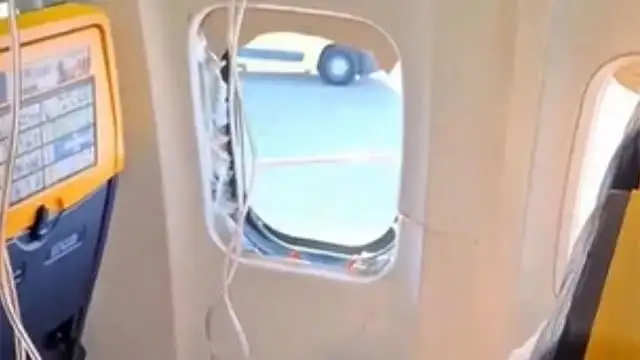
A 61-year-old passenger was saved by his wife after an uncontained engine failure caused a window to detach on a Ryanair flight from Greece to Germany.
Key Takeaways
- •Ryanair flight FR1879 suffered an uncontained engine failure on July 10, 2026.
- •A 61-year-old passenger was partially ejected after a window shattered at 16,000 ft.
- •The aircraft returned safely to Thessaloniki following an emergency descent.
- •HCAA and EASA are leading the investigation into the engine debris trajectory.
A Ryanair flight FR1879 operated by Malta Air experienced an uncontained engine failure on July 10, 2026, resulting in a Boeing 737 window blowout and subsequent aircraft rapid decompression. The aircraft, a Boeing 737-800 (registration 9H-QEU), was departing from Thessaloniki Airport 'Makedonia' (SKG) bound for Memmingen Airport (FMM) when the incident occurred. According to Flightradar24 tracking data for 9H-QEU, the aircraft climbed to an altitude of 16,000 feet before the structural failure prompted an emergency descent and a return to the departure airport.
The Cabin Incident
During the climb, debris from the engine shattered a passenger window, triggering an immediate and violent decompression of the cabin. A 61-year-old Serbian national was partially pulled through the aperture by the extreme pressure differential. Michalis Giannakos, president of the Panhellenic Federation of Public Hospital Employees (POEDIN), described the event as nearly tragic, confirming that the passenger was saved only because his wife and nearby travelers held him by the legs for several minutes. The passenger was later hospitalized with friction burns but remains in stable condition.
Regulatory and Structural Context
The Hellenic Civil Aviation Authority (HCAA) is leading the investigation into the mechanical failure, operating under ICAO Annex 13 protocols. Given the aircraft's origin, the European Union Aviation Safety Agency (EASA) and potentially the National Transportation Safety Board (NTSB) are expected to participate in the forensic analysis of the engine components and the fuselage. The incident highlights the ongoing industry challenge of uncontained engine failures, where internal engine debris penetrates the airframe. While rare, these events necessitate rigorous inspection protocols for fan blades and cowlings.
Historical Precedents
This event bears similarities to Southwest Airlines Flight 1380 in April 2018, where engine debris shattered a window and led to a fatality. It also echoes the Alaska Airlines Flight 1282 incident in January 2024, which involved a mid-cabin door plug failure and subsequent rapid decompression. These incidents reinforce the critical importance of seatbelt compliance, which remains the primary defense against ejection during sudden decompression events.
Boeing 737-800 vs. Boeing 737 MAX 8: Key Specifications
| Metric | Boeing 737-800 | Boeing 737 MAX 8 |
|---|---|---|
| Engine Type | CFM56-7B | LEAP-1B |
| Max Seating Capacity | 189 | 210 |
Investigative Timeline and Reporting
The HCAA and EASA are expected to release a preliminary accident investigation report by August 2026. Furthermore, industry analysts anticipate that regulators may issue an emergency airworthiness directive regarding fan cowl inspections for the CFM56 engine fleet by late 2026, though this remains subject to the findings of the current investigation.
Why This Matters for Aviation Safety
This incident serves as a stark reminder of the vulnerability of passenger windows to high-velocity debris. For Ryanair and Malta Air, the event creates immediate operational disruption and heightened scrutiny of maintenance history. For the broader industry, the focus shifts to whether current engine cowling integrity standards are sufficient to prevent catastrophic damage to the pressurized cabin shell.
Frequently Asked Questions
- What caused the window failure on Ryanair flight FR1879?
- The window failure was caused by an uncontained engine failure, where debris from the engine shattered the cabin window, leading to rapid decompression.
- How did the passenger survive the window blowout?
- The 61-year-old passenger was saved by his wife and fellow travelers, who restrained him by the legs and pulled him back into the cabin after he was partially sucked out.
Visit omniflights.com for the latest commercial aviation news and airline industry updates. For reporting on UAP sightings, investigations, and aviation-related encounters, see the UAPs section at omniflights.com/uaps.

Written by Shashank Shukla
Co-Founder & CTO leading the engineering and AI systems behind Omni Flights. Covers aviation technology, flight safety, aircraft manufacturing, and emerging aerospace developments.
Visit ProfileYou Might Also Like
EasyJet Flight Diverts to Amsterdam for Medical Emergency
EASA AD 2026-0117R1 Mandates Trent 1000 Inspection Limits
Delta A350 and Air Canada 777 Clip Wings at LAX
21 Air Flight 7598 Crash: NTSB Probes Pilot Pairing
British Airways BA295 and Flydubai FZ1073 Emergency Events