Gulf Airlines Recover to 82% Capacity Post-Ceasefire

Co-Founder & CEOAviation News Editor delivering trusted coverage across the global aviation industry.

Major Gulf airlines have restored 82% of pre-conflict flight volumes following a mid-June US-Iran ceasefire, according to Flightradar24 data.
Key Takeaways
- •Gulf airlines reached 82% of pre-conflict flight volumes by mid-June 2026.
- •Gulf Air and Kuwait Airways now exceed pre-conflict operational baselines.
- •EASA maintains CZIB 2026-03-R12, banning flights over Iran, Iraq, and Lebanon.
- •Review of EASA airspace restrictions is expected on June 24, 2026.
Gulf Hubs Lead Aviation Recovery
Following a mid-June US-Iran interim ceasefire, major Middle Eastern carriers are rapidly restoring their network capacity. According to Flightradar24 airline data, collective daily flight volumes for Gulf carriers have returned to approximately 82% of the levels recorded on February 27, 2026, the day before the regional conflict escalated. This Gulf airlines flight recovery marks a significant pivot after months of severe operational disruption that saw some carriers drop to less than half of their normal capacity.
Uneven Recovery Across the Gulf
The recovery trajectory remains varied across the region. Gulf Air and Kuwait Airways have demonstrated the strongest resilience, both operating at over 100% of their late-February flight baselines. Etihad Airways has also seen a robust rebound, recovering to 93% of its pre-war volume, a stark improvement from the 40-50% capacity levels experienced during the height of the conflict. Qatar Airways and Emirates are currently operating at 87% and 86% of their respective pre-conflict capacities. Conversely, regional low-cost carriers face a slower return to normalcy; Air Arabia is at 75% capacity, while Flydubai remains at 57% of its baseline, reflecting a higher reliance on point-to-point regional traffic that remains sensitive to lingering security concerns.
Divergent Airspace Access and EASA Restrictions
While Gulf carriers are resuming operations through regional airspace corridors, a significant competitive divide persists. European carriers remain bound by the European Union Aviation Safety Agency (EASA) Conflict Zone Information Bulletin (CZIB) 2026-03-R12, which mandates that operators avoid the airspace of Iran, Iraq, and Lebanon at all flight levels. This regulatory barrier stems from the high risk of misidentification by air-defense systems, a concern underscored by the 2020 downing of Ukraine International Airlines Flight 752. Consequently, European airlines continue to operate longer, less fuel-efficient routes, placing them at a distinct competitive disadvantage compared to Gulf rivals who are progressively utilizing regional airspace.
The Strategic Resilience of Hub-and-Spoke Models
Aviation Strategy Managing Partner James Halstead notes that the agility of the hub-and-spoke model has been instrumental in this recovery. If geopolitical conditions continue to stabilize, Gulf carriers are positioned to return to the market with full force. However, safety regulators maintain a cautious stance. The EASA has argued that despite the ceasefire, the risk of misidentification by air-defense systems remains too high for civil aviation to safely return to Iranian airspace. This creates a two-tier operational environment where Gulf hubs leverage geographic advantages that remain inaccessible to European and Asian carriers.
Regulatory Review and Future Milestones
The aviation industry is currently tracking the expiration and potential review of EASA CZIB 2026-03-R12, which is scheduled for June 24, 2026. This review represents a critical decision point for European operators, as any modification to the bulletin could allow for the normalization of transit routes between Europe and Asia. Until such a shift occurs, the industry expects the current divergence in flight efficiency and route availability to persist, favoring carriers with unrestricted access to Middle Eastern transit corridors.
Impact on Global Transit Connectivity
For passengers traveling on Europe-Asia routes, the current situation means a gradual restoration of direct flight options and potential reductions in travel times as Gulf carriers resume normal transit operations. For European air carriers, the forced rerouting continues to impose significant operational costs and fuel inefficiencies. This environment highlights the persistent volatility of Middle East airspace closures and the lasting impact that regional geopolitical instability exerts on global commercial aviation logistics.
Frequently Asked Questions
- What is the current status of Gulf airline flight volumes following the ceasefire?
- Major Gulf airlines have restored their collective daily flight volumes to approximately 82% of their pre-conflict levels recorded on February 27, 2026.
- Why are European airlines still avoiding Middle Eastern airspace?
- European airlines must comply with an active EASA Conflict Zone Information Bulletin that mandates avoiding the airspace of Iran, Iraq, and Lebanon due to the high risk of misidentification by air-defense systems.
For global airline trends and commercial aviation news, turn to omniflights.com. Get the latest updates on major hubs, regional terminals, and airport operations via the Airports section at omniflights.com/airports.
Written by Hardik Vishwakarma
Co-Founder & Aviation News Editor leading initiatives that improve trust and visibility across the global aviation industry. Covers airlines, airports, safety, and emerging technology.
Visit ProfileYou Might Also Like
Discover more aviation news based on similar topics

Flydubai Upgrading 21 Boeing 737 MAX 8s to Flat Bed Seats
Flydubai is retrofitting 21 Boeing 737 MAX 8 aircraft with lie-flat business class seats to standardize its premium product by late 2027.
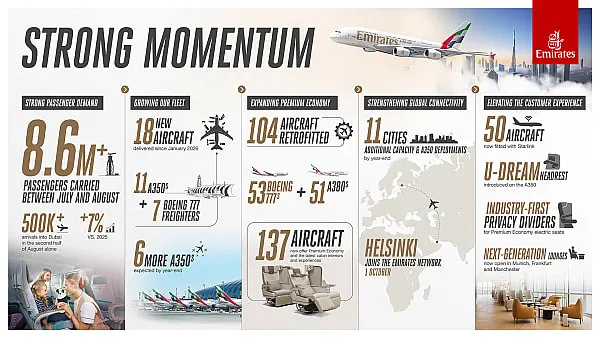
Emirates Winter Booking Momentum Grows Amid Fleet Expansion
Emirates carried 8.6 million passengers this summer and enters winter with strong demand as it accelerates fleet retrofits and network growth.
Air Arabia Consortium Gains AOC for New Dammam Budget Airline
A Saudi GACA-led consortium including Air Arabia has secured an AOC to launch a new budget airline based at Dammam's King Fahd International Airport.
Turkish Airlines Exits Luanda as Angola Hub Struggles
Turkish Airlines dropped its Luanda route as Angola's new airport struggles to attract traffic, handling only 756,028 passengers in 2025.

Red Sea Airlines Leases Two 737 MAX 8s for 2027 Expansion
Red Sea Airlines signed a lease for two Boeing 737 MAX 8 aircraft from SMBC Aviation Capital, arriving in 2027 to support its 14-aircraft fleet goal.
Avelo CEO Warns Airfares May Rise on Jet Fuel Price Spikes
Avelo Airlines CEO Andrew Levy warns that rising fuel costs may force fare increases as global jet fuel prices reach $171.01 per barrel.