Frontier Airlines Adds SpaceX Starlink for In-Flight Wi-Fi

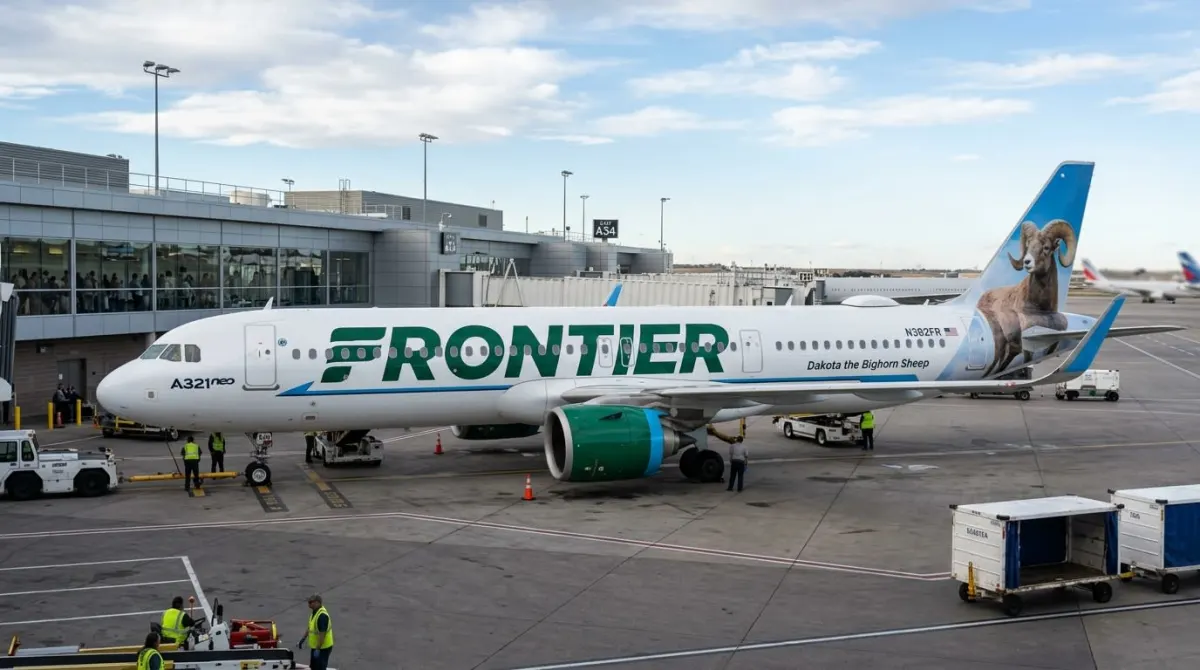
Frontier Airlines will equip over 180 aircraft with SpaceX's Starlink for high-speed in-flight Wi-Fi beginning in early 2027.
Key Takeaways
- •Frontier Airlines will install Starlink Wi-Fi on over 180 aircraft.
- •The rollout of high-speed, gate-to-gate connectivity begins in early 2027.
- •Indigo Partners will equip over 1,000 aircraft across five global airlines.
- •Starlink LEO satellites provide latency of ~20 ms, versus ~600 ms for GEO.
Fleet-Wide Connectivity Rollout
Frontier Airlines has announced a strategic partnership to retrofit its entire fleet of over 180 aircraft with SpaceX's Starlink technology. This Frontier Airlines to Offer Starlink, the Fastest WiFi in the Sky initiative represents a significant in-flight Wi-Fi upgrade for the airline, with the first equipped aircraft expected to enter commercial service in early 2027. The agreement is part of a broader commitment by Indigo Partners, which encompasses over 1,000 aircraft across five carriers, including Wizz Air, Volaris, JetSMART, and Cebu Pacific.
Shifting the ULCC Experience
For an Ultra-Low-Cost Carrier (ULCC) like Frontier, this move signals a departure from historically bare-bones service models. By integrating high-speed connectivity, the airline aims to capture higher-yielding passengers and drive new ancillary revenue streams. Jimmy Dempsey, Chief Executive Officer of Frontier Airlines, noted that the technology allows passengers to work and stream throughout their journey. This investment coincides with other product enhancements, such as the introduction of premium seating, reflecting a broader industry trend where ULCCs are increasingly competing on cabin product quality.
The Technical Advantage of LEO
Unlike traditional geostationary (GEO) systems, which operate at an altitude of approximately 35,000 kilometers, Starlink utilizes a constellation of satellites in Low Earth Orbit (LEO) at roughly 550 kilometers. This reduction in distance drastically lowers latency, providing a user experience comparable to ground-based broadband. The system requires a Supplemental Type Certificate (STC) from the FAA (Federal Aviation Administration) to authorize the physical installation of the phased-array antennas on the fuselage of the Airbus fleet.
Starlink Aviation (LEO) vs Legacy GEO In-Flight Wi-Fi
| Metric | Starlink Aviation (LEO) | Legacy GEO In-Flight Wi-Fi |
|---|---|---|
| Latency | ~20 ms | ~600 ms |
| Orbit Altitude | ~550 km | ~35,000 km |
| Max Download Speed | Up to 350 Mbps per aircraft | 12 - 100 Mbps per aircraft |
Industry Context and Competitive Landscape
This development follows a pattern set by early adopters. In 2022, JSX proved the viability of LEO internet on regional jets, while Hawaiian Airlines later demonstrated its utility on larger mainline aircraft and transpacific routes. The 2024 commitment by United Airlines to outfit its massive fleet established a new competitive benchmark. For legacy connectivity providers such as Viasat, Panasonic, and Intelsat, the loss of the Indigo Partners contract highlights the increasing pressure to upgrade network capabilities or adjust pricing models. While the shift is broadly viewed as a positive for passenger experience, the International Astronomical Union (IAU) has raised alternative perspectives regarding the impact of large satellite constellations on ground-based astronomical research.
What Comes Next for the Starlink Rollout
Frontier Airlines is currently moving toward the technical certification phase required for the fleet-wide installation. Following the initial rollout in early 2027, the airline will proceed with a phased installation schedule to minimize operational downtime. The success of this program depends on securing the necessary FAA approvals for the specific aircraft configurations within the Indigo Partners group.
Why This Matters for Passengers
This transition fundamentally alters the value proposition for passengers on low-cost carriers, who have traditionally faced limited or no connectivity options. By providing gate-to-gate, streaming-capable Wi-Fi, Frontier is effectively closing the amenity gap between ULCCs and full-service carriers. This shift not only impacts passenger satisfaction but also positions the airline to better compete for business travelers who require reliable connectivity while in the air.
Frequently Asked Questions
- When will Frontier Airlines begin offering Starlink Wi-Fi?
- Frontier Airlines plans to launch its first Starlink-equipped aircraft in early 2027, with a fleet-wide rollout following thereafter.
- How does Starlink's LEO technology compare to traditional in-flight Wi-Fi?
- Starlink operates in Low Earth Orbit (LEO) at ~550 km, offering significantly lower latency of ~20 ms compared to traditional geostationary (GEO) systems at ~35,000 km, which typically experience latency of ~600 ms.
Stay ahead of the airline industry with commercial aviation news from omniflights.com. Track policy changes, airspace rules, and global aviation governance in the Regulatory category at omniflights.com/regulatory.

Written by Shashank Shukla
Co-Founder & CTO leading the engineering and AI systems behind Omni Flights. Covers aviation technology, flight safety, aircraft manufacturing, and emerging aerospace developments.
Visit ProfileYou Might Also Like

Autonomous Fixed-Wing Aircraft Development Gains Momentum

Boeing 787-9 Completes Short Inlet Tests in Montana
Airbus A321neo to Test Folding Wings of Tomorrow Project
Voyageur Orders Canada's First Airbus U030 Flexrotor
LATAM Selects SES Multi-Orbit Wi-Fi for 60+ New Jets