Lufthansa 787-9 Begins ecoDemonstrator Flight Trials

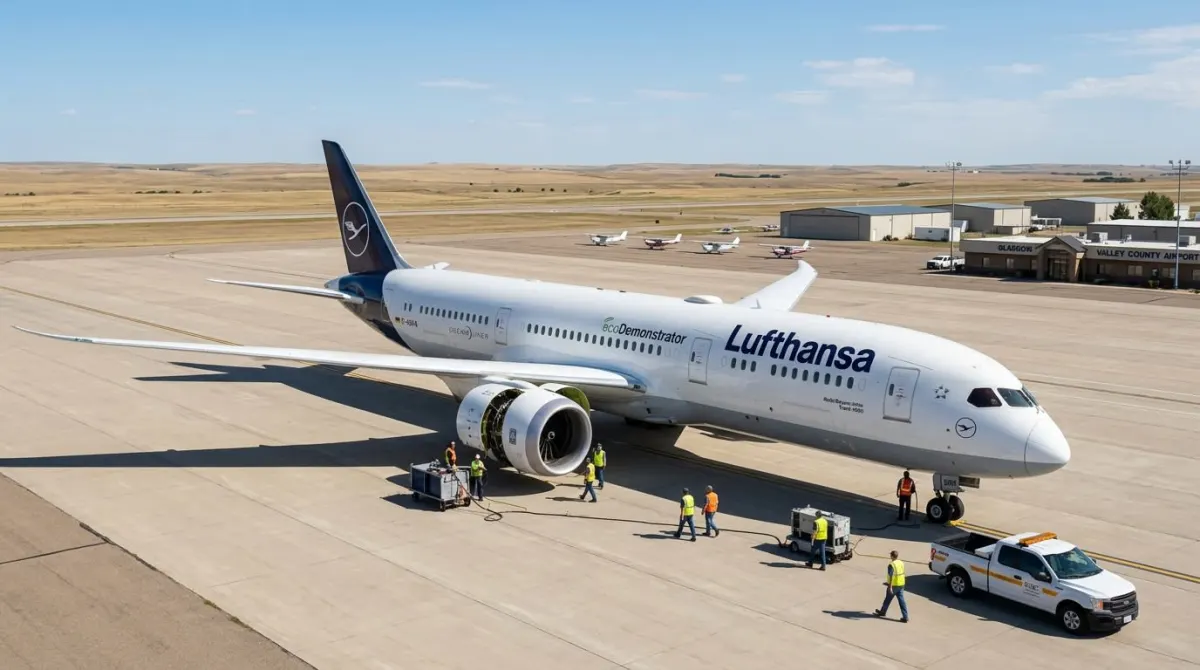
Boeing and partners will test a modified Lufthansa 787-9 to evaluate technologies targeting a 25 dB cumulative noise reduction.
Key Takeaways
- •Boeing and Lufthansa partner on 787-9 ecoDemonstrator flight trials in July 2026.
- •Flight tests in Glasgow, Montana will evaluate a Next Generation Inlet design.
- •CLEEN Phase III program targets a cumulative noise reduction of 25 dB.
- •Lufthansa will receive the 787-9 test bed aircraft after trials conclude.
Boeing, in partnership with Lufthansa and Rolls-Royce, has announced that a modified Lufthansa 787-9 Dreamliner powered by Rolls-Royce Trent 1000 engines will begin flight trials in late July 2026. This initiative, part of the Boeing ecoDemonstrator 2026 program, will evaluate advanced aircraft acoustic treatments and operational flight paths. Supported by the FAA CLEEN program, the trials represent a key milestone in testing sustainable aviation technologies under real-world conditions.
The flight trials, scheduled to take place in Glasgow, Montana, from late July through mid-August 2026, aim to validate noise-mitigation and fuel-efficiency technologies. Specifically, the program is testing a Next Generation Inlet and Intelligent Operations flight paths to reduce aerodynamic drag, weight, and community noise exposure. By validating these technologies in flight, the partners seek to accelerate the commercial deployment of quieter, cleaner aircraft configurations.
Acoustic and Aerodynamic Testing in Montana
According to Boeing, the ecoDemonstrator program has evaluated more than 260 distinct technologies in real-world operational environments since its launch in 2012. The 2026 iteration continues this legacy by focusing on the integration of advanced propulsion and flight path optimization. The trials are supported by the FAA's (Federal Aviation Administration) Phase III CLEEN (Continuous Lower Energy, Emissions and Noise) program. This public-private initiative targets a cumulative noise reduction of 25 dB relative to the FAA Stage 5 standard.
The testing will focus heavily on a redesigned engine inlet. Manufacturers are increasingly testing reduced-length engine inlets with advanced acoustic treatments to lower aerodynamic drag and weight without compromising noise performance, enabling the integration of larger, more efficient engines on future commercial aircraft.
Lane Ballard, Boeing’s CTO (Chief Technology Officer), emphasized that the reduced-length inlet and algorithmically generated flight paths being evaluated on the 2026 ecoDemonstrator Explorer are highly promising concepts. Ballard noted that these technologies have the potential to make Boeing aircraft increasingly valuable to airline customers and engine suppliers. Grazia Vittadini, CTO of Lufthansa Group, highlighted that testing these innovations in real-world operations is a crucial step in advancing the aviation industry's transformation toward better fuel efficiency and a reduced noise footprint.
Next Generation Inlet vs. Standard Engine Inlet
The primary hardware modification on the test aircraft involves the engine nacelle inlet. The table below outlines the key differences being evaluated during the flight trials:
| Metric | Next Generation Inlet | Standard Engine Inlet |
|---|---|---|
| Length | Reduced-length demonstrator | Standard baseline |
| Acoustic Performance | Maintained or improved via advanced treatments | Standard baseline |
| Aerodynamic Efficiency | Reduced drag and weight | Standard baseline |
This structural shift directly impacts key stakeholders. For Rolls-Royce, managing the Trent 1000 program, the trials provide critical real-world operational data on integrating the engine with a reduced-length inlet, which will directly inform future propulsion system designs. Airport-adjacent communities also stand to benefit from a potential long-term reduction in community noise exposure due to the development of algorithmic flight paths. Finally, the Lufthansa Group, which will receive the 787-9 post-testing, gains early insights into operational efficiencies while supporting its corporate sustainability targets.
However, alternative perspectives exist regarding the pace of environmental progress. While technological test beds like the ecoDemonstrator showcase future potential, environmental advocacy groups often argue that such incremental efficiency gains are insufficient to offset the overall carbon footprint growth of an expanding global aviation industry.
Historical Precedents in the ecoDemonstrator Program
The 2026 trials build on previous research methodologies. In August 2020, the Boeing ecoDemonstrator program partnered with NASA and Etihad Airways using a 787-10 Dreamliner. That program conducted extensive noise testing using over 1,200 microphones, which directly informed acoustic treatments for future engine designs. This historical precedent highlights Boeing's established strategy of utilizing the 787 Dreamliner family as a primary flying test bed for noise and emissions reduction technologies prior to fleet-wide rollout.
Technical Analysis of Inlet and Flight Path Optimization
This development indicates a clear trajectory toward highly integrated airframe-propulsion systems. As engine bypass ratios increase, nacelles must grow larger, which typically increases weight and aerodynamic drag. By shortening the inlet and applying advanced acoustic treatments, manufacturers can mitigate these drag penalties while maintaining strict community noise compliance. Furthermore, the shift toward algorithmic flight path optimization represents a software-driven approach to efficiency. By utilizing multi-source data algorithms, airlines can execute continuous descent arrivals and optimized departures, bypassing traditional airspace constraints to minimize fuel burn. This dual approach of physical aerodynamic refinement and digital flight path execution suggests that future efficiency gains will rely equally on hardware and software integration.
Glasgow Flight Trial and Delivery Schedule
The 2026 ecoDemonstrator Explorer program is structured around several upcoming operational milestones:
- Late July 2026: Commencement of flight trials in Glasgow, Montana.
- Mid-August 2026: Expected conclusion of the flight trials.
- Post-Testing Phase: The aircraft is expected to undergo refurbishment and be delivered directly to Lufthansa for standard commercial service.
Why Community Noise Mitigation Matters
This development signals a shift in how manufacturers and airlines address the dual challenges of noise pollution and carbon emissions. For airport-adjacent communities and municipal regulators, successful testing of these technologies could lead to quieter flight corridors and more flexible airport operating hours. Ultimately, the program positions Boeing and Lufthansa to meet increasingly stringent international environmental standards while improving trip-level economics.
Frequently Asked Questions
- What is the goal of the Boeing ecoDemonstrator 2026 program?
- The program aims to test advanced acoustic treatments, a Next Generation Inlet, and Intelligent Operations flight paths on a modified Lufthansa 787-9 Dreamliner to reduce noise and fuel burn.
- What is the Next Generation Inlet being tested on the 787-9?
- It is a reduced-length engine inlet designed to lower aerodynamic drag and weight while maintaining acoustic performance using advanced treatments.
- Where and when will the 2026 ecoDemonstrator trials take place?
- The flight trials will take place in Glasgow, Montana, from late July through mid-August 2026.
Access up-to-date commercial aviation news and airline industry developments via omniflights.com. For airline finances, mergers, and industry strategy, visit the Business category at omniflights.com/business.

Written by Shashank Shukla
Co-Founder & CTO leading the engineering and AI systems behind Omni Flights. Covers aviation technology, flight safety, aircraft manufacturing, and emerging aerospace developments.
Visit ProfileYou Might Also Like
Autonomous Fixed-Wing Aircraft Development Gains Momentum

Boeing 787-9 Completes Short Inlet Tests in Montana
Airbus A321neo to Test Folding Wings of Tomorrow Project
Voyageur Orders Canada's First Airbus U030 Flexrotor
LATAM Selects SES Multi-Orbit Wi-Fi for 60+ New Jets