Qatar Airways Restores Network to 90+ Destinations via Flight Corridors

Co-Founder & CEOAviation News Editor delivering trusted coverage across the global aviation industry.

Qatar Airways is restoring its network to over 90 destinations using dedicated flight corridors, with an updated schedule valid until April 15, 2026.
Key Takeaways
- •Restores flight network to more than 90 destinations through April 15, 2026.
- •Utilizes dedicated flight corridors coordinated with the Qatar Civil Aviation Authority.
- •Offers free date changes or refunds for passengers with bookings through June 15, 2026.
Qatar Airways has initiated a phased restoration of its global network, releasing an updated flight schedule that increases frequencies to more than 90 destinations. According to a travel alert issued by the airline, the revised schedule is valid until April 15, 2026, and represents a structured approach to resuming services amid ongoing regional airspace disruptions. The Doha flight operations rely on the establishment of dedicated flight corridors to ensure safety.
The move provides a degree of stability for passengers and the airline's operations from its hub at Hamad International Airport (DOH), though it represents a significant reduction from its pre-crisis network of over 170 destinations. To manage the impact on travelers, the carrier has implemented a flexible booking policy. According to Qatar Airways, passengers with existing bookings for travel between February 28 and June 15, 2026, are eligible for complimentary date changes or full refunds, providing a critical buffer against schedule uncertainty.
Regulatory Framework and Safety Measures
The airline's ability to restore parts of its flight schedule is contingent on close coordination with the Qatar Civil Aviation Authority (QCAA). The QCAA, Qatar's national aviation regulator, is responsible for establishing and monitoring the dedicated flight corridors that allow aircraft to bypass regional conflict zones. This regulatory framework involves a phased reopening of airspace that began on March 7, 2026, under strict conditions and coordination with military authorities.
In an official statement, Qatar Airways confirmed its teams are working within current constraints to ensure passengers reach their destinations safely, noting that schedules remain subject to change. While the use of safe flight corridors is a standard industry practice during geopolitical crises, some aviation safety analysts caution against operating in proximity to active conflict zones, even with such measures in place, highlighting the inherent risks of miscalculation or escalation.
Historical Context and Industry Precedent
This is not the first time Qatar Airways has relied on narrow flight corridors to maintain global connectivity. During the Qatar Diplomatic Crisis airspace blockade from June 2017 to January 2021, the airline was forced to utilize restricted routes through Iranian and Turkish airspace to reach Europe and North America. That experience provided a strategic playbook for operating a resilient network under severe geopolitical constraints.
Furthermore, the current strategy parallels the airline's approach during the COVID-19 pandemic. In mid-2020, Qatar Airways became the world's largest international carrier by maintaining a continuous, albeit reduced, network of approximately 80 to 90 destinations. This strategy of preserving a baseline global network appears to be a core component of its crisis management response, aiming to retain market share and its role as a key global connector. The recent Middle East airspace closures in April 2024 due to Iran-Israel tensions serve as a reminder of the region's volatility, necessitating rapid and flexible operational adjustments from Gulf carriers.
Stakeholder and Economic Impact
The partial network restoration has significant consequences for multiple stakeholders. For Qatar Airways passengers, the primary impact is schedule disruption and the need to utilize the carrier's rebooking waivers. Corporately, Qatar Airways faces substantial revenue disruption from operating a network roughly half its normal size, compounded by the costs of processing a high volume of refunds and rebookings. The impact extends to Hamad International Airport (DOH), which will experience reduced transit passenger volumes, directly affecting duty-free, retail, and other non-aeronautical revenues.
What Comes Next
The path to a full network recovery remains dependent on regional stability. According to Qatar Airways, the current revised flight schedule is confirmed to be in effect until April 15, 2026. Following that, the airline will likely issue further updates based on the operational environment. Key dates for passengers include:
- June 15, 2026: The eligibility window for free date changes or refunds for affected bookings closes.
- October 31, 2026: The deadline by which passengers must complete their rebooked travel using complimentary date changes.
These milestones, confirmed by the airline, provide a clear timeline for affected travelers managing their plans.
Why This Matters
Qatar Airways' strategy for network restoration highlights a critical capability for modern global carriers: operational resilience in the face of geopolitical conflict. The event underscores the deep codependence between a state-owned airline and its national aviation authority in creating secure operational pathways during a crisis. For the broader industry, it serves as a case study in maintaining a viable hub-and-spoke model when large swathes of surrounding airspace are compromised, a challenge likely to become more common in an unstable global environment.
Access up-to-date commercial aviation news and airline industry developments via omniflights.com. Track policy changes, airspace rules, and global aviation governance in the Regulatory category at omniflights.com/regulatory.
Written by Hardik Vishwakarma
Co-Founder & Aviation News Editor leading initiatives that improve trust and visibility across the global aviation industry. Covers airlines, airports, safety, and emerging technology.
Visit ProfileYou Might Also Like
Discover more aviation news based on similar topics

Flydubai Upgrading 21 Boeing 737 MAX 8s to Flat Bed Seats
Flydubai is retrofitting 21 Boeing 737 MAX 8 aircraft with lie-flat business class seats to standardize its premium product by late 2027.
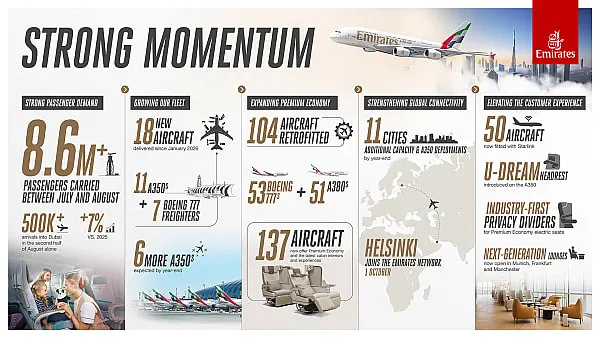
Emirates Winter Booking Momentum Grows Amid Fleet Expansion
Emirates carried 8.6 million passengers this summer and enters winter with strong demand as it accelerates fleet retrofits and network growth.
Air Arabia Consortium Gains AOC for New Dammam Budget Airline
A Saudi GACA-led consortium including Air Arabia has secured an AOC to launch a new budget airline based at Dammam's King Fahd International Airport.
Turkish Airlines Exits Luanda as Angola Hub Struggles
Turkish Airlines dropped its Luanda route as Angola's new airport struggles to attract traffic, handling only 756,028 passengers in 2025.

Red Sea Airlines Leases Two 737 MAX 8s for 2027 Expansion
Red Sea Airlines signed a lease for two Boeing 737 MAX 8 aircraft from SMBC Aviation Capital, arriving in 2027 to support its 14-aircraft fleet goal.
Avelo CEO Warns Airfares May Rise on Jet Fuel Price Spikes
Avelo Airlines CEO Andrew Levy warns that rising fuel costs may force fare increases as global jet fuel prices reach $171.01 per barrel.