IATA Forecasts $4.3 Billion Loss for Middle East Airlines

Aviation News Editor & Industry AnalystAviation News Editor & Industry Analyst delivering clear coverage for a worldwide audience.

IATA projects Middle Eastern airlines will record a $4.3 billion net loss due to regional conflict and widespread airspace closures.
Key Takeaways
- •Middle Eastern airlines face a projected $4.3 billion net loss in 2026.
- •Regional passenger demand is forecast to drop 11.4% due to conflict.
- •Jet fuel prices are expected to surge 70% to $152 per barrel.
- •Global airline industry profits are projected to halve to $23 billion.
The International Air Transport Association (IATA) released its IATA 2026 financial outlook, projecting a severe Middle East airlines loss of $4.3 billion for the year. This financial downturn represents a stark reversal from the estimated $7.2 billion profit recorded in 2025. The escalating Iran war aviation impact has triggered widespread Middle East airspace closures, forcing carriers to reroute flights and face soaring operational costs.
The ongoing conflict has severely disrupted international air traffic, forcing major Gulf carriers to navigate restricted corridors and suspend key routes. This operational friction is dampening passenger demand and eroding the structural efficiency of regional hubs. As transit passengers search for alternative routings, the traditional competitive advantage of Middle Eastern connecting hubs is facing its most significant challenge in decades.
Geopolitical Friction and Skyrocketing Fuel Costs
According to the IATA Global Outlook for Air Transport published in June 2026, passenger demand in the Middle East region is forecast to decline by 11.4% year-over-year in 2026. This drop in demand is compounded by a dramatic rise in operating expenses. Average jet fuel prices are expected to surge to $152 per barrel in 2026, representing an increase of nearly 70% from the $90 per barrel average in 2025.
The spike in fuel costs is heavily impacting carrier balance sheets worldwide. Jet fuel costs are projected to account for 31.4% of total airline operating expenses in 2026, up from 25.4% in 2025. Globally, the entire aviation industry is feeling the pressure; global airline industry net profit is projected to halve to $23.0 billion in 2026, down from an estimated $45 billion in 2025.
Willie Walsh, Director General of IATA, highlighted these difficulties during the association's 2026 Annual General Meeting. "The Gulf carriers face operational uncertainty following a near complete shutdown of airspace at the outbreak of the war," Walsh stated. "These carriers are doing an amazing job maintaining connectivity, but major financial impacts are unavoidable."
The airspace restrictions have created severe operational challenges for Gulf hub carriers, including Emirates, Qatar Airways, and Etihad. These airlines are experiencing a significant loss of lucrative transfer traffic alongside increased operating expenses due to lengthy flight reroutings. Additionally, global aviation fuel suppliers and refineries are facing surging demand for non-Hormuz jet fuel and record crack spreads as the conflict disrupts regional refinery outputs and shipping lanes. For international transfer passengers on Europe-Asia routes, the conflict translates to longer flight times and higher ticket prices, with global fares projected to rise by 9.2%.
Historical Precedents and Regional Traffic Shifts
The current disruption mirrors previous geopolitical crises that reshaped global aviation networks. In 1990-1991, the Gulf War airspace disruptions resulted in widespread rerouting, spiking jet fuel prices, and significant financial losses for airlines operating in and through the Middle East. Similarly, the Ukraine airspace closure in February 2022 forced the complete closure of Russian and Ukrainian airspace to Western airlines, leading to lengthy rerouting for Europe-Asia flights and raising operational costs. The 2026 conflict follows a similar trajectory, demonstrating how quickly geopolitical instability can dismantle optimized international flight paths.
However, the impact is not uniform across all regions. While Middle Eastern carriers face severe losses and airspace restrictions, airlines in Africa and the Asia-Pacific region are actually experiencing traffic growth as global flights reroute through their respective hubs. This structural shift in global transfer traffic flows is temporarily benefiting alternative transit hubs at the expense of the Gulf.
The Fuel and Airspace Economics of Regional Conflict
The financial pressure on Middle Eastern carriers highlights the vulnerability of the hub-and-spoke model to localized geopolitical shocks. Historically, Gulf carriers have relied on geographic centrality to aggregate traffic between East and West. However, when regional airspace is compromised, the operational detour costs multiply rapidly. The combination of a 70% increase in jet fuel prices and extended flight times creates a compounding cost penalty. Because jet fuel is projected to consume nearly a third of airline operating budgets in 2026, carriers cannot easily absorb these costs without raising fares, which in turn dampens passenger demand. This situation accelerates the industry's shift toward more fuel-efficient, long-range narrowbody operations that can bypass disrupted regions entirely, potentially altering long-term fleet planning strategies for global airlines.
Anticipated Recovery and Airspace Reopening Timelines
Looking ahead, the recovery of the regional aviation sector depends heavily on the stabilization of the geopolitical environment and the easing of flight restrictions. The resumption of suspended European and Asian airline flights to Middle Eastern destinations is expected to occur between Late August 2026 and January 2027. Carriers such as Air France, Lufthansa, British Airways, and Air Canada are monitoring safety conditions closely before restoring their full schedules. Any permanent recovery will require a coordinated effort between regional civil aviation authorities, including the UAE General Civil Aviation Authority (GCAA), the Qatar Civil Aviation Authority (CAA), and the Bahrain Civil Aviation Authority, to safely manage airspace corridors and restore international carrier confidence.
The Strategic Outlook for Global Hub Networks
This development signals a profound disruption to the global aviation balance of power, challenging the dominance of traditional Gulf mega-hubs. For industry professionals, it underscores the critical necessity of operational flexibility and robust fuel hedging strategies in an era of increasing geopolitical volatility. Ultimately, the crisis may reshape how international airlines plan long-haul routes, prioritizing airspace security and fuel efficiency over geographic directness.
Frequently Asked Questions
- Why are Middle Eastern airlines projected to lose $4.3 billion in 2026?
- The projected loss is driven by widespread airspace closures, the loss of lucrative transfer traffic, and a nearly 70% surge in jet fuel prices resulting from the regional conflict involving Iran.
- How much are jet fuel prices expected to increase in 2026?
- Average jet fuel prices are forecast to rise to $152 per barrel in 2026, representing a nearly 70% increase from the average of $90 per barrel in 2025.
- Which airlines are most affected by the Middle East airspace closures?
- Major Gulf hub carriers like Emirates, Qatar Airways, and Etihad are facing significant operational challenges, increased rerouting costs, and a loss of transit passengers.
Stay ahead of the airline industry with commercial aviation news from omniflights.com. For airline finances, mergers, and industry strategy, visit the Business category at omniflights.com/business.
Written by Ujjwal Sukhwani
Aviation News Editor & Industry Analyst delivering clear coverage for a worldwide audience. Covers flight operations, safety regulations, and market trends with expert analysis.
Visit ProfileYou Might Also Like
Discover more aviation news based on similar topics

Flydubai Upgrading 21 Boeing 737 MAX 8s to Flat Bed Seats
Flydubai is retrofitting 21 Boeing 737 MAX 8 aircraft with lie-flat business class seats to standardize its premium product by late 2027.
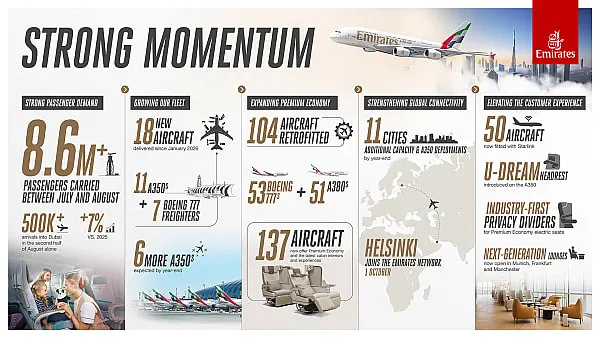
Emirates Winter Booking Momentum Grows Amid Fleet Expansion
Emirates carried 8.6 million passengers this summer and enters winter with strong demand as it accelerates fleet retrofits and network growth.
Air Arabia Consortium Gains AOC for New Dammam Budget Airline
A Saudi GACA-led consortium including Air Arabia has secured an AOC to launch a new budget airline based at Dammam's King Fahd International Airport.
Turkish Airlines Exits Luanda as Angola Hub Struggles
Turkish Airlines dropped its Luanda route as Angola's new airport struggles to attract traffic, handling only 756,028 passengers in 2025.

Red Sea Airlines Leases Two 737 MAX 8s for 2027 Expansion
Red Sea Airlines signed a lease for two Boeing 737 MAX 8 aircraft from SMBC Aviation Capital, arriving in 2027 to support its 14-aircraft fleet goal.
Avelo CEO Warns Airfares May Rise on Jet Fuel Price Spikes
Avelo Airlines CEO Andrew Levy warns that rising fuel costs may force fare increases as global jet fuel prices reach $171.01 per barrel.