COMAC C909 Expands Xinjiang Fleet to 30 Aircraft

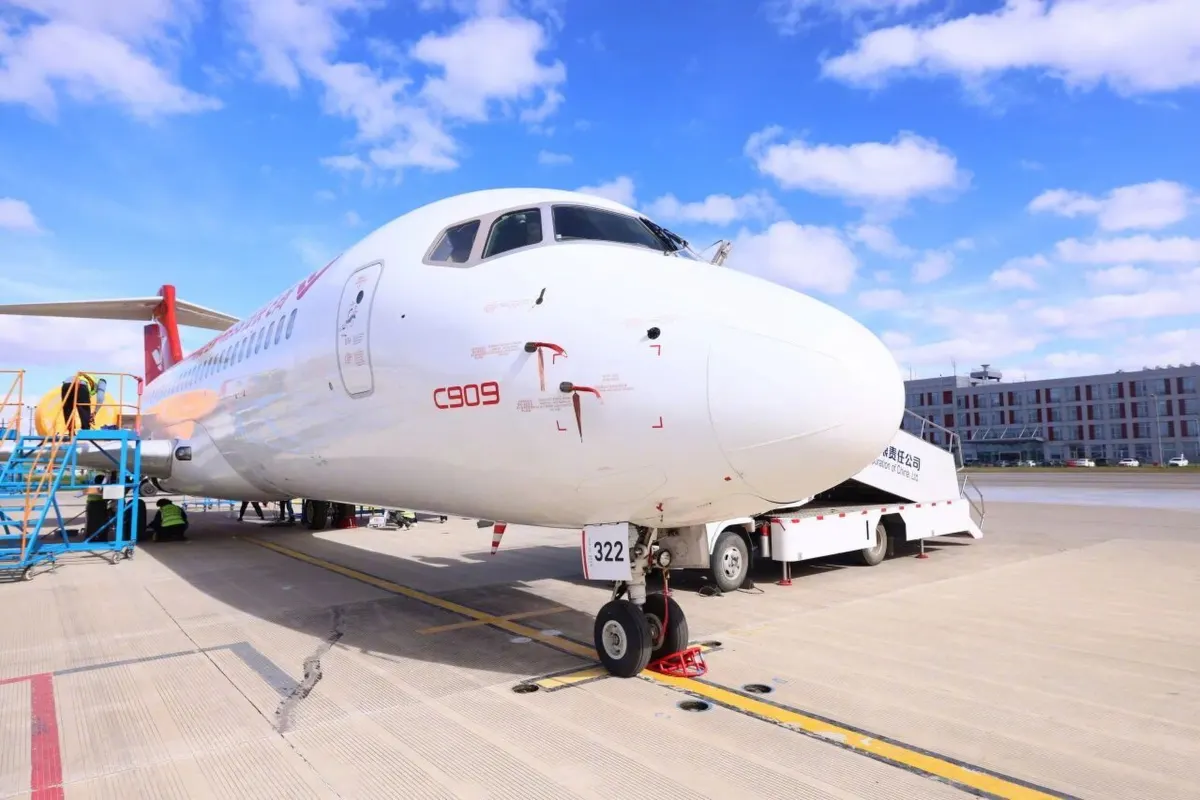
Chinese carriers have deployed 30 COMAC C909 jets across Xinjiang to improve regional connectivity using state-subsidized, lower-capacity operations.
Key Takeaways
- •COMAC C909 fleet in Xinjiang reached 30 aircraft across 120 routes.
- •C909 offers 78-97 seats, ideal for low-density regional operations.
- •COMAC delivered 175 C909 aircraft total by the end of 2025.
- •Regional subsidies incentivize C909 use over larger narrowbody models.
Strategic Deployment in Xinjiang
The COMAC C909 deployment in China’s far-western Xinjiang region has accelerated significantly, with 30 aircraft now operating on more than 120 routes. According to CCTV (China Central Television), this rapid expansion follows the first arrival of the jet in the region in June 2023. The Commercial Aircraft Corporation of China (COMAC) has positioned the aircraft, formerly known as the ARJ21 (Advanced Regional Jet for the 21st Century), as a tactical tool for airlines to serve low-density markets.
Operational Economics and Subsidies
With a seating capacity of 78 to 97 passengers, the C909 is significantly smaller than the 150-to-180-seat narrowbody aircraft standard in the industry, such as the Boeing 737 or Airbus A320. This size advantage allows carriers to maintain service on lightly used routes, particularly during off-peak seasons. According to a report led by COMAC senior economist Guo Caisen, the C909 generates a contribution margin 6,000 to 10,000 yuan higher per operating hour than the Boeing 737. This financial performance is supported by a robust subsidy framework, where regional jets receive double the operational support compared to larger narrowbody models under Civil Aviation Administration of China (CAAC) guidelines.
Competitive Positioning and Fleet Strategy
For airlines like Chengdu Airlines, Urumqi Air, and China Express Airlines, the C909 serves as an entry point to secure airport slots and test new routes before potentially up-gauging to larger capacity aircraft. Independent aviation analyst Li Hanming suggests the model is well-suited for China's strategically important northwestern borders, where it may eventually replace older, foreign-made regional aircraft. However, the program faces long-term challenges. While COMAC delivered 175 aircraft by the end of 2025, the model has yet to prove its commercial viability without heavy state intervention. Western aerospace consultancies have argued that the C909's current success is tied to state subsidies and political mandates rather than inherent market competitiveness.
Technical Comparison: C909 vs. Narrowbody Standards
| Metric | COMAC C909 | Boeing 737-800 |
|---|---|---|
| Seating Capacity | 78-97 | 162-189 |
| Range | 2,225-3,700 km | 5,436 km |
Global Ambitions and Regulatory Hurdles
COMAC is pursuing a broader strategy to challenge the Airbus-Boeing duopoly. The ARJ21 rebranding to the C909 in November 2024 was intended to unify the product family, which includes the C919 and future C929. While the aircraft lacks certification from the FAA (Federal Aviation Administration) and the EASA (European Union Aviation Safety Agency), it is gaining traction in Southeast Asian markets where CAAC certification is accepted. Carriers in Laos, Indonesia, and Vietnam currently operate the type on 20 routes, signaling an attempt to bypass Western regulatory barriers.
What Comes Next: Certification and Expansion
Looking forward, the program faces critical milestones for international growth. While the aircraft is established domestically, industry observers are tracking the potential for wider ASEAN regulatory acceptance of CAAC certification between 2026 and 2027. Additionally, the industry is monitoring the potential for EASA type certification, which is currently expected by 2028. These approvals remain vital for COMAC to transition from a domestic-focused manufacturer to a global competitor.
Why This Matters for Stakeholders
For Western manufacturers like Airbus and Boeing, the rise of the C909 represents a gradual erosion of market share in China’s secondary and tertiary route networks. Conversely, for suppliers like General Electric, which provides the CF34-10A engines for the fleet, the program provides a stable revenue stream. The continued deployment of the C909 signals a broader shift in Chinese aviation policy, where domestic self-sufficiency and regional connectivity are prioritized over the reliance on imported narrowbody fleets.
Frequently Asked Questions
- Why is the COMAC C909 successful in Xinjiang?
- The C909 is successful in Xinjiang because its smaller capacity (78-97 seats) makes it more cost-effective for low-density routes compared to larger narrowbody jets. Additionally, the aircraft benefits from significant state subsidies, which are double those provided to larger aircraft, encouraging airlines to expand into remote regions.
- Does the COMAC C909 have FAA or EASA certification?
- No, the C909 currently lacks type certification from the Federal Aviation Administration (FAA) and the European Union Aviation Safety Agency (EASA). Consequently, its international operations are primarily restricted to markets that accept Civil Aviation Administration of China (CAAC) certification, such as Southeast Asia and Africa.
Access up-to-date commercial aviation news and airline industry developments via omniflights.com. From aircraft production to supply chains, commercial aviation manufacturing news is covered at omniflights.com/manufacturing.

Written by Hardik Vishwakarma
Co-Founder & Aviation News Editor leading initiatives that improve trust and visibility across the global aviation industry. Covers airlines, airports, safety, and emerging technology.
Visit ProfileYou Might Also Like

Lufthansa A350-1000 to Debut on Munich-Haneda Route

Cathay Pacific Weighs Widebody Fleet Expansion Plans

American Airlines Drops 3 Routes Amid Network Optimization
JAL Orders 16 Embraer E190-E2 Jets for Regional Fleet
Volaris-Viva Merger Expected to Gain CNA Approval