Airbus, Boeing Charter Antonov An-124 to Ease Supply Delays

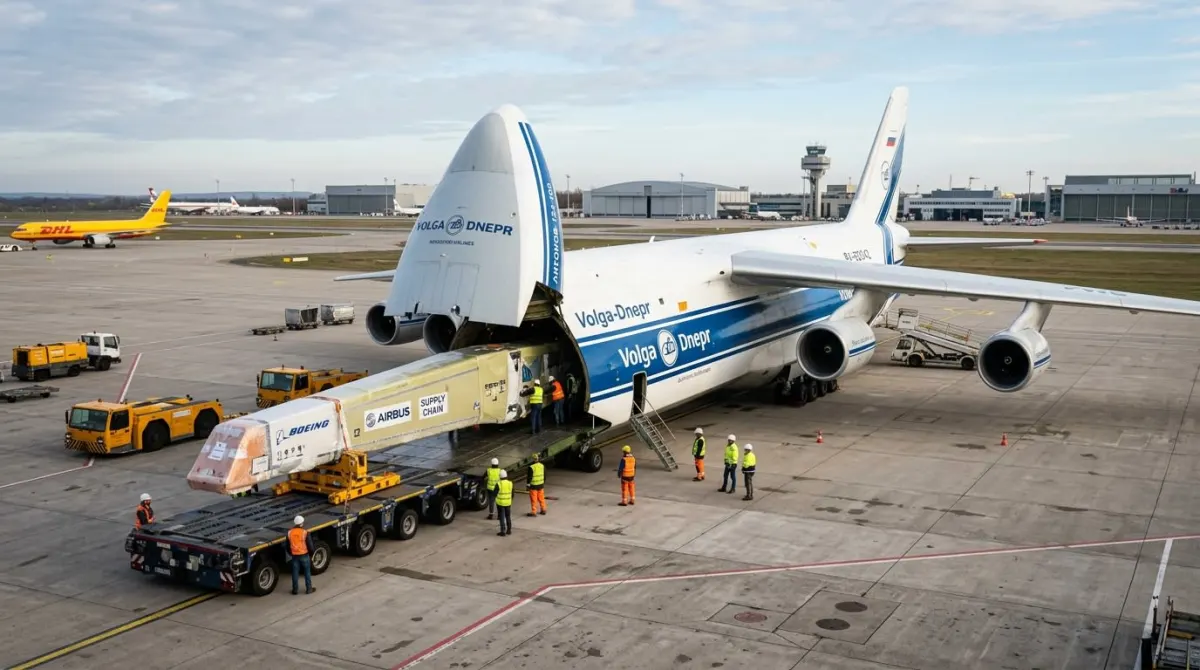
Airbus and Boeing are using Antonov An-124 heavy-lift jets to bypass supply chain bottlenecks and meet critical aircraft delivery targets.
Key Takeaways
- •Airbus and Boeing charter Antonov An-124 jets to bypass supply chain delays.
- •87% of aerospace programs cite supplier bottlenecks as a primary production obstacle.
- •Airbus must increase Q4 delivery output by 11% to meet its 770-aircraft target.
- •Emergency airlifts mask deeper structural failures in just-in-time manufacturing.
Emergency Logistics in Aerospace Manufacturing
Airbus and Boeing have increasingly turned to the Antonov An-124 charter market to secure the movement of outsized aerostructures, including A350 fuselage sections, A220 wings, and 777 components. This reliance on heavy-lift cargo aviation marks a significant shift in logistics strategy as manufacturers struggle to circumvent worsening aerospace supply chain delays. These emergency airlifts are essential to maintaining production line beat rates that have been threatened by persistent shortages in specialized materials, such as composite stringer clips and engine forgings.
The Scale of the Supply Chain Crisis
The move highlights the severity of current production constraints. According to a 2026 Bain & Company review, 87% of aerospace programs cite supplier bottlenecks as a core obstacle to meeting their order backlogs. These delays are impacting major players across the industry, with Spirit AeroSystems and other Tier-1 suppliers facing intense scrutiny as they work to resolve the production snags necessitating these costly logistics workarounds. For Airbus, the pressure is particularly acute, as the manufacturer must increase its overall delivery output by approximately 11% in the final quarter of 2026 to reach its stated annual target of 770 commercial aircraft.
Historical Context and Logistics Limitations
While both OEMs have historically developed proprietary oversized transport fleets, such as the Boeing Dreamlifter and Airbus Beluga, the current reliance on the Antonov An-124 indicates that even these dedicated in-house assets are insufficient to manage the volumetric demands of the current crisis. The An-124, featuring a maximum structural payload capacity of 120,000 kg and a unique kneeling mechanism, remains the industry standard for moving fully intact, outsized fuselage sections that cannot fit on standard cargo aircraft. Historically, the Strategic Airlift International Solution (SALIS) has demonstrated a similar global reliance on these jets when standard transport networks fail to meet urgent military or civil requirements.
An-124 vs. 747-8F: Key Specifications
| Metric | Antonov An-124-100 | Boeing 747-8F |
|---|---|---|
| Payload Capacity | 120,000 kg | 137,700 kg |
| Cargo Hold Volume | 1,040 cubic meters | 853 cubic meters |
| Loading Mechanism | Drive-on nose and tail ramps | Nose door and side cargo door |
Technical Analysis of Manufacturing Constraints
The shift toward emergency heavy-lift logistics underscores the failure of traditional just-in-time manufacturing models within the current geopolitical and economic climate. Analysts from Bain & Company have argued that while these airlifts solve immediate assembly line problems, they are not a sustainable substitute for robust supply chains. Instead, they mask deeper structural vulnerabilities, such as consolidation and restructuring among Tier-1 suppliers, which continue to create bottlenecks. The reliance on expensive military-grade charters suggests that the industry is in a high-cost cycle where preventing production halts outweighs the premium costs of air transport. This trend is likely to persist until Tier-1 suppliers can stabilize their output, a process that remains subject to complex regulatory compliance under the Federal Aviation Administration (FAA) and the European Union Aviation Safety Agency (EASA) to ensure structural integrity during transit.
What Comes Next: The 2026 Delivery Target
OEMs are currently tracking toward the end of 2026 with significant pressure to finalize deliveries. Airbus is expected to reach its 770-aircraft delivery target by December 31, 2026, provided that supply chain inputs remain consistent. Simultaneously, the availability of heavy-lift assets may tighten, as the NATO Support and Procurement Agency (NSPA) manages the expiration of existing SALIS An-124 charter contracts toward the end of 2026. These milestones represent a critical decision point for manufacturers who must balance the high cost of emergency logistics against the financial penalties of missing delivery deadlines.
Why This Matters for Commercial Airlines
For commercial airlines, the supply chain crisis translates into prolonged capacity constraints and the forced extension of operational lifecycles for older aircraft. As delivery slots for new, fuel-efficient models like the A350, A220, and 777 continue to slip, carriers are left with less flexibility in their route planning and fleet modernization schedules. The situation signals that the aviation industry remains in a period of structural instability where the ability to secure logistics and parts is as critical to success as the aircraft design itself.
Frequently Asked Questions
- Why are Airbus and Boeing using Antonov An-124 jets?
- The manufacturers are using the An-124 to airlift outsized aerostructures, such as fuselage sections and wings, to bypass severe supply chain bottlenecks and maintain assembly line schedules.
- What is the maximum payload capacity of the Antonov An-124?
- The Antonov An-124 features a maximum structural payload capacity of 120,000 kilograms, with the -100M-150 variant capable of carrying up to 150,000 kilograms.
Get breaking commercial aviation news and expert airline analysis at omniflights.com. For detailed airline coverage, route changes, and fleet moves, explore the Airlines section at omniflights.com/airlines.

Written by Shashank Shukla
Co-Founder & CTO leading the engineering and AI systems behind Omni Flights. Covers aviation technology, flight safety, aircraft manufacturing, and emerging aerospace developments.
Visit ProfileYou Might Also Like

GE Aerospace Plans to Double India Supplier Spend by 2030
Boeing Tests MUM-T Software for MQ-25A and F/A-18 Teaming
COMAC C919 Faces Production Delays Amid US Export Curbs

Boeing Awarded $14.7B Contract for PAC-3 Missile Seekers

Boeing 777X Testing Spills Into 2027 Amid Certification Hurdles