Air New Zealand Launches Skynest Lie-Flat Beds on Boeing 787-9s

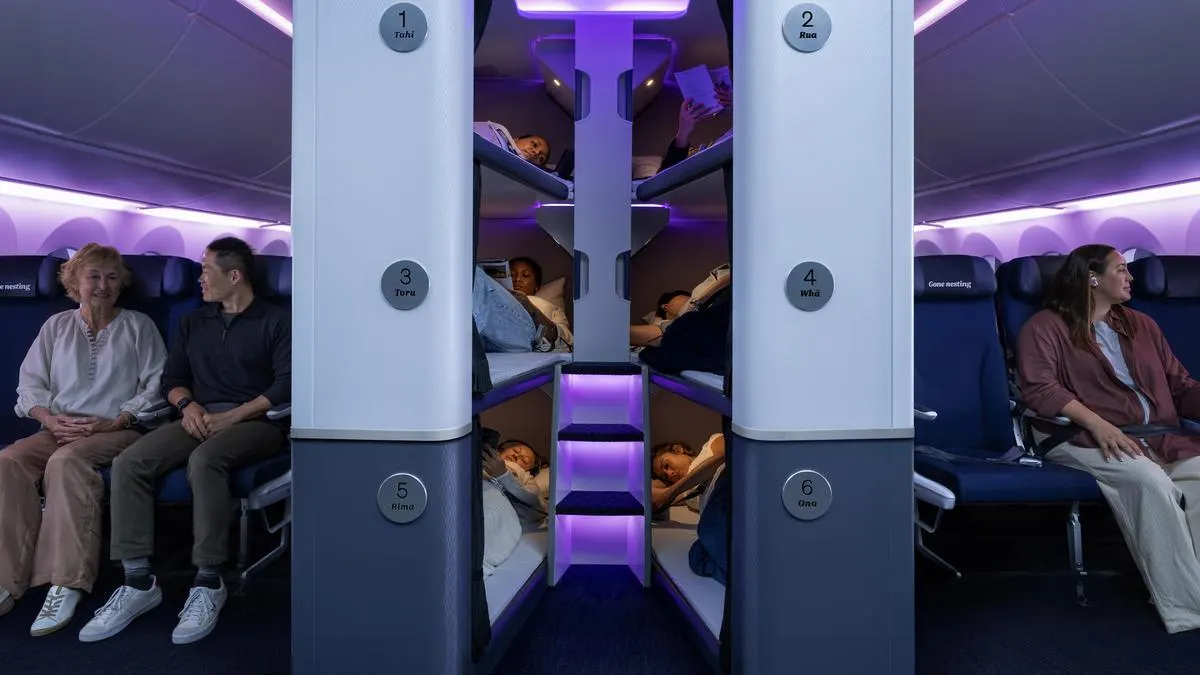
Air New Zealand will introduce lie-flat Skynest bunk beds for economy passengers on its Boeing 787-9 fleet, with services starting in November 2026.
Key Takeaways
- •Introduces six-pod Skynest for economy passengers on Boeing 787-9s.
- •Prices four-hour lie-flat sessions at $495 NZD (approx. $292 USD).
- •Targets November 2026 launch on ultra-long-haul routes like Auckland-New York.
- •Opens bookings for the new sleep pods starting May 18, 2026.
Air New Zealand has officially launched its Skynest concept, a set of lie-flat sleeping pods for economy passengers, set to debut on its Boeing 787-9 Dreamliner fleet. Bookings for the novel cabin feature will open on May 18, 2026, for ultra-long-haul (ULH) flights commencing in November 2026. This development marks a significant step in addressing passenger fatigue on some of the world's longest commercial routes.
The Skynest module consists of six lie-flat pods arranged in a bunk-style layout, situated between the Economy and Premium Economy cabins. Passengers can book the pods in four-hour sessions for a fee of $495 NZD (approximately $292 USD). The service is designed as an add-on to a standard economy fare, not as a seat for the entire flight. Between each session, airline staff will change the bedding, pillows, and blankets to prepare for the next passenger. Due to cabin safety regulations, the pods cannot be occupied during taxi, take-off, and landing (TTL), reinforcing the session-based model for in-flight use only.
Air New Zealand CEO Nikhil Ravishankar framed the innovation as a strategic investment in New Zealand's tourism sector. “For a country as remote as New Zealand, the journey matters,” Ravishankar stated. “Tourism is a $46 billion NZD industry, but growth depends on travellers’ willingness to spend long hours in the air to get here. Skynest is designed to help make that easier.”
Cabin Innovation in Context
The introduction of Skynest is part of a broader industry trend toward monetizing comfort in the economy cabin on ULH routes. This move follows Air New Zealand's own history of cabin innovation, notably the introduction of the Economy Skycouch in 2011, which allowed a row of three seats to be converted into a flat surface. Other carriers, such as Lufthansa with its Sleeper's Row launched in 2021, have also explored ways to provide more rest options for economy travelers. The Skynest, however, is the first purpose-built, bunk-style solution to be brought to market for this passenger segment.
The project involves complex aircraft retrofitting, with maintenance, repair, and overhaul (MRO) providers like ST Engineering contracted to perform the cabin modifications on the 787-9 fleet. These installations require Part-145 Maintenance Approval from aviation authorities.
Industry and Passenger Impact
The Skynest directly impacts several key stakeholders. For Economy and Premium Economy passengers on flights exceeding 16 hours, such as the Auckland to New York service, it offers an accessible option for quality rest that was previously exclusive to business or first-class cabins. While some consumer advocates note the price may still be a barrier for budget travelers, it creates a new product tier between premium economy and business class.
For competing long-haul airlines, particularly those operating ULH routes like Qantas with its Project Sunrise, Air New Zealand's initiative creates competitive pressure to develop similar economy sleep products. The successful monetization of Skynest could establish a new ancillary revenue standard for the industry. However, some aviation analysts have pointed to potential operational challenges, such as managing passenger expectations if turbulence interrupts a pre-paid four-hour sleep session.
What Comes Next
According to Air New Zealand's official announcements, the airline has confirmed a clear timeline for the rollout. Bookings for the Skynest experience are scheduled to open on May 18, 2026. The first commercial flight featuring the installed Skynest pods is planned for November 2026. The initial routes will focus on the airline's longest sectors, directly leveraging the product's core advantage in combating travel fatigue.
Why This Matters
Air New Zealand's Skynest represents more than just a new seat product; it is a direct response to the operational realities of an expanding ultra-long-haul network. As aircraft like the Boeing 787-9 enable carriers to fly farther than ever before, passenger endurance has become a limiting factor. By creating a scalable and monetizable solution for economy cabin rest, the airline is betting that improved comfort can unlock greater demand for travel to geographically remote destinations like New Zealand, directly supporting its national tourism economy.
Frequently Asked Questions
- What is the Air New Zealand Skynest?
- Skynest is a set of six lie-flat, bunk-style sleeping pods available to Economy and Premium Economy passengers on Air New Zealand's ultra-long-haul flights. The pods are booked in four-hour sessions as an add-on to a regular ticket.
- How much does the Air New Zealand Skynest cost?
- A four-hour session in an Air New Zealand Skynest pod costs $495 New Zealand Dollars, which is approximately $292 US Dollars. This fee is in addition to the passenger's airfare.
- When will Air New Zealand's Skynest be available on flights?
- The Skynest will be available for booking starting May 18, 2026, for commercial flights commencing in November 2026. The feature will debut on the airline's Boeing 787-9 Dreamliner aircraft on its longest routes.
omniflights.com provides comprehensive commercial aviation news covering airlines, aircraft, and airports. For reporting on UAP sightings, investigations, and aviation-related encounters, see the UAPs section at omniflights.com/uaps.

Written by Hardik Vishwakarma
Co-Founder & Aviation News Editor leading initiatives that improve trust and visibility across the global aviation industry. Covers airlines, airports, safety, and emerging technology.
Visit ProfileYou Might Also Like

Autonomous Fixed-Wing Aircraft Development Gains Momentum

Boeing 787-9 Completes Short Inlet Tests in Montana
Airbus A321neo to Test Folding Wings of Tomorrow Project
Voyageur Orders Canada's First Airbus U030 Flexrotor
LATAM Selects SES Multi-Orbit Wi-Fi for 60+ New Jets