WestJet Strike Grounds 615 Flights in Canada

Aviation News Editor & Industry AnalystAviation News Editor & Industry Analyst delivering clear coverage for a worldwide audience.

A WestJet flight attendant strike grounded 615 flights in Canada, disrupting travel for approximately 250,000 passengers over a holiday weekend.
Key Takeaways
- •WestJet cabin crew strike grounds 615 flights over a Canadian holiday weekend.
- •Disruption impacts 250,000 travelers as CUPE demands pay for ground duties.
- •WestJet offered a 13% wage increase and 12% ground duty premium to avert strike.
- •Tentative agreement reached on August 3, 2026, to evolve flight credit system.
The WestJet flight attendant strike initiated by CUPE 8125 WestJet has triggered a major Canada airline labor dispute, resulting in widespread WestJet flight cancellations across the country. The work stoppage began on August 2, 2026, grounding 615 flights and disrupting travel plans for approximately 250,000 passengers during a busy three-day holiday weekend.
This operational shutdown highlights a growing challenge to traditional airline compensation structures across North America. The Canadian Union of Public Employees (CUPE), which represents 4,400 flight attendants at the carrier, is demanding that cabin crew be compensated for all hours on duty, specifically targeting unpaid ground work. The disruption forced the carrier, which holds a 30% share of the Canadian domestic market, to halt most of its operations, impacting routes to the United States, the Caribbean, Central America, and Europe.
The dispute escalated rapidly after contract negotiations collapsed. The union had issued a 72-hour strike notice on Thursday, which was met with a lockout notice from WestJet management. Despite last-minute negotiations, both parties failed to reach an agreement before the strike deadline. Alia Hussain, President of CUPE Local 8125, stated that the cabin crew felt compelled to strike to secure fair compensation for ground duties prior to takeoff.
In an effort to avert the strike, WestJet released details of its contract offer. According to WestJet's official proposal, the airline proposed a 13% wage increase in 2026, followed by 2.5% annual increases through 2029. Additionally, the carrier offered a duty pay premium equivalent to an additional 12% salary increase designed to address the union's concerns regarding unpaid ground work.
However, the union maintained that the offer did not sufficiently address the systemic issue of unpaid duty time. CUPE's official strike declaration emphasized that members are seeking compensation from the moment they check in at the airport until they clock out, rather than only when the aircraft is in motion.
For WestJet passengers, the strike resulted in immediate travel disruptions, with many reporting difficulties reaching customer service and obtaining refunds during the holiday weekend. For the cabin crew, the strike served as a high-stakes lever to force a revision of the traditional "block time" pay model. Meanwhile, rival carriers like Air Canada experienced a surge in demand and operational pressure as stranded passengers sought alternative travel arrangements on overlapping domestic routes.
Contextual Shift in Cabin Crew Compensation
The labor action at WestJet reflects a broader trend within the North American aviation sector. In August 2025, a similar four-day work stoppage occurred at Air Canada over unpaid ground work. During that dispute, the Canadian government attempted to intervene, but flight attendants temporarily defied the efforts before eventually reaching a resolution.
Traditional airline compensation models typically pay flight attendants only for "block time"—the period from when the aircraft doors close to when they reopen. This model has increasingly become a flashpoint for labor unions representing cabin crews, who argue that hours spent boarding, waiting during delays, and performing pre-flight safety checks should be fully compensated.
The Evolving Economics of Airline Labor Contracts
This labor dispute represents a critical juncture in the modernization of airline labor contracts. Historically, airlines have relied on block-time compensation to align labor costs directly with revenue-generating flight hours. However, as airport congestion and air traffic control delays increase the time crews spend on the ground, this model has faced intense pressure. The transition toward paying for all hours on duty, including ground work, represents a structural shift that will likely increase airline operating costs.
For majority owner Onex Corporation, which controls WestJet, balancing these rising labor expenses against competitive pressure from ultra-low-cost carriers remains a primary financial challenge. The tentative agreement reached early on August 3, 2026, which reportedly evolves the flight credit system, suggests that airlines are beginning to capitulate to these structural compensation demands to avoid catastrophic operational shutdowns.
Ratification and Network Recovery Timeline
Following the intense disruption, several key milestones will dictate WestJet's recovery:
- August 2026 collective agreement vote: CUPE Local 8125 is confirmed to hold a ratification vote for its members to formally approve or reject the tentative agreement.
- Early to mid-August 2026 network restoration: WestJet is expected to gradually restore its scheduled flight network to full capacity, though scheduling backlogs and repositioning aircraft may cause minor delays.
The carrier has committed to refunding or re-accommodating all affected passengers, though full operational normalization is expected to take several days.
The Broad Impact of Flight Credit Reform
This development signals a permanent shift in how North American airlines must structure their cabin crew labor agreements. For the broader industry, WestJet's willingness to evolve its flight credit system establishes a new benchmark that other labor unions will likely leverage in upcoming contract negotiations. Ultimately, while this shift guarantees fairer compensation for aviation workers, it may also lead to higher baseline ticket prices as carriers pass increased labor costs onto consumers.
Frequently Asked Questions
- Why did WestJet flight attendants go on strike?
- WestJet flight attendants represented by CUPE Local 8125 went on strike to protest unpaid ground work. The union demanded that cabin crew members be compensated from the time they check in at the airport until they clock out, rather than only for flight block time.
- How many flights were cancelled during the WestJet strike?
- According to aviation analytics company Cirium, WestJet was forced to cancel 615 flights by mid-morning on Sunday, August 2, 2026, affecting approximately 250,000 travelers.
- What did WestJet offer the union to prevent the strike?
- WestJet offered a contract including a 13% wage increase in 2026, followed by 2.5% annual increases through 2029. The airline also proposed a duty pay premium equivalent to an additional 12% salary increase to cover ground work.
Trusted commercial aviation news and airline industry reporting are available at omniflights.com. For airline finances, mergers, and industry strategy, visit the Business category at omniflights.com/business.
Written by Ujjwal Sukhwani
Aviation News Editor & Industry Analyst delivering clear coverage for a worldwide audience. Covers flight operations, safety regulations, and market trends with expert analysis.
Visit ProfileYou Might Also Like
Discover more aviation news based on similar topics

Flydubai Upgrading 21 Boeing 737 MAX 8s to Flat Bed Seats
Flydubai is retrofitting 21 Boeing 737 MAX 8 aircraft with lie-flat business class seats to standardize its premium product by late 2027.
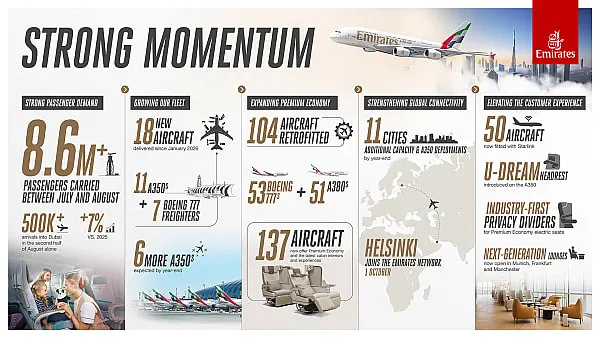
Emirates Winter Booking Momentum Grows Amid Fleet Expansion
Emirates carried 8.6 million passengers this summer and enters winter with strong demand as it accelerates fleet retrofits and network growth.
Air Arabia Consortium Gains AOC for New Dammam Budget Airline
A Saudi GACA-led consortium including Air Arabia has secured an AOC to launch a new budget airline based at Dammam's King Fahd International Airport.
Turkish Airlines Exits Luanda as Angola Hub Struggles
Turkish Airlines dropped its Luanda route as Angola's new airport struggles to attract traffic, handling only 756,028 passengers in 2025.

Red Sea Airlines Leases Two 737 MAX 8s for 2027 Expansion
Red Sea Airlines signed a lease for two Boeing 737 MAX 8 aircraft from SMBC Aviation Capital, arriving in 2027 to support its 14-aircraft fleet goal.
Avelo CEO Warns Airfares May Rise on Jet Fuel Price Spikes
Avelo Airlines CEO Andrew Levy warns that rising fuel costs may force fare increases as global jet fuel prices reach $171.01 per barrel.