United Delays 10 Chicago Routes Due to FAA Flight Caps

Aviation News Editor & Industry AnalystAviation News Editor & Industry Analyst delivering clear coverage for a worldwide audience.

United delayed the launch of 10 domestic routes from ORD after the FAA extended daily flight caps through October 2027 to manage airfield construction.
Key Takeaways
- •United Airlines delays 10 domestic routes from Chicago O'Hare.
- •FAA extends daily flight cap of 2,708 operations through October 2027.
- •ORDNext airfield construction prompts the capacity restrictions.
- •Proposed summer 2026 schedules would have increased flights by 15 percent.
United Airlines has announced United Airlines route delays for 10 planned domestic routes from its midwestern hub, citing the newly extended Chicago O'Hare flight caps. The decision follows the Federal Aviation Administration (FAA) extending FAA ORD schedule limits to manage congestion stemming from the ORDNext modernization program. This regulatory extension freezes capacity at one of the nation's busiest transit points, immediately reshaping regional network strategy.
The operational freeze highlights a growing tension between long-term airport infrastructure upgrades and immediate airline growth ambitions. By capping daily flights, the FAA aims to prevent severe delays during extensive airfield construction, but the decision forces carriers to scale back planned expansions. For passengers, this means fewer direct connections and delayed access to regional markets, while United Airlines must reallocate aircraft and crew resources originally earmarked for the Chicago O'Hare International Airport (ORD) expansion.
Operational Impact of the ORD Capacity Limits
According to the FAA ORD operating limitations order, daily flight operations at ORD are capped at 2,708 arrivals and departures. This restriction, initially scheduled to expire earlier, has been formally extended through October 30, 2027. Data from the U.S. Department of Transportation and the FAA indicates that without these caps, initial summer 2026 airline schedules would have resulted in more than 3,080 daily flights at ORD. This proposed volume represented a nearly 15% increase over 2025 scheduling levels, which regulators determined would cause unacceptable delays and systemic congestion across the National Airspace System.
In a corporate statement, United Airlines confirmed the delay of 10 planned domestic regional routes from ORD as a direct result of these capacity constraints. The carrier stated, "Following the extension of FAA's Chicago O'Hare's flight schedule cap through October 2027, we are delaying the start of 10 new routes announced earlier this year and removing them from our schedule." The airline added that it remains committed to providing connectivity to these cities and hopes to launch the services once the FAA order expires.
The flight caps create distinct winners and losers among aviation stakeholders. For United Airlines, the impact is classified as high severity, as the carrier is forced to suspend its planned domestic expansion, missing out on projected passenger revenue and market share growth at its primary home hub. Conversely, American Airlines competitively benefits from this freeze, as it temporarily pauses the aggressive battle for market dominance at their shared Chicago hub. American Airlines has supported the FAA's decision, viewing the flight cap extension as a prudent measure that helps maintain operational stability, improves reliability, and reduces delays during a period of infrastructure strain.
Meanwhile, regional airports—including those serving communities like Tri-Cities, Wausau, and Marquette—face a medium-severity impact. These communities will suffer from delayed access to United's global network via the ORD hub, negatively affecting local economic connectivity and passenger options until late 2027.
Infrastructure Constraints and Historical Precedents
The capacity freeze at ORD is not an isolated regulatory action. In 2026, the FAA implemented a similar strategy at Newark Liberty International Airport (EWR), extending scheduling limits through October 2027 due to air traffic controller staffing constraints at the Philadelphia Terminal Radar Approach Control (TRACON). The outcome of the EWR precedent demonstrated that while capacity caps successfully stabilize operational reliability, they also artificially suppress market capacity and increase average airfares on affected routes. This pattern supports the current situation at ORD, suggesting that Chicago-area travelers may face higher ticket prices and fewer flight options as a direct consequence of the capped operations.
The Chicago Department of Aviation (CDA), which operates ORD and manages the ongoing ORDNext construction program, faces mounting pressure to accelerate airfield work. However, alternative perspectives exist regarding the necessity of the prolonged cap. U.S. Senators Dick Durbin and Tammy Duckworth have challenged the FAA's timeline. In a letter to the regulatory agency, the senators wrote, "Through our offices' discussions with the Chicago Department of Aviation (CDA), we understand that construction conditions will improve throughout this summer, with all taxiways and runways open by November 1, 2026." This regulatory dissent suggests that keeping the caps in place through late 2027 may be overly restrictive if airfield conditions improve significantly by late 2026.
The Structural Math Behind Airport Congestion Caps
This development indicates a broader trend where physical and regulatory aviation infrastructure constraints are outpacing airline fleet growth and market demand. Historically, major U.S. hubs have relied on scheduling caps as a last resort to mitigate systemic delays. The math behind the ORD cap is clear: squeezing 3,080 requested daily flights into an airfield undergoing major modernization would lead to exponential delay propagation, affecting flights nationwide. By enforcing a strict limit of 2,708 daily operations, the FAA is prioritizing operational predictability over carrier growth. This decision accelerates an industry-wide shift where airlines must optimize revenue per seat-mile rather than relying on volume expansion. As airfield modernization programs like ORDNext require multi-year construction windows, airlines will increasingly face similar capacity freezes at key hubs, forcing a strategic pivot toward larger gauge aircraft to maximize passenger throughput within fixed slot constraints.
Key Milestones for Chicago Airfield Modernization
The timeline for restoring unrestricted flight volumes at ORD depends on several critical regulatory and construction milestones:
- November 1, 2026: Expected completion of immediate airfield taxiway and runway construction, as reported by the CDA, which senators argue should ease operational bottlenecks.
- Summer 2027: Expected completion of the broader current phase of the ORDNext airfield modernization program.
- October 30, 2027: Confirmed expiration date of the FAA flight schedule cap at Chicago O'Hare, unless further regulatory extensions are issued.
- Late 2027: Expected timeframe for United Airlines to launch the 10 delayed regional routes from ORD, subject to the expiration of the FAA limitations.
The Strategic Read for Regional Connectivity
For the broader aviation industry, this situation underscores how infrastructure bottlenecks can abruptly halt airline network strategies. Regional connectivity remains highly vulnerable to regulatory interventions, as major carriers are forced to prioritize high-yield trunk routes over smaller regional markets when slots are limited. Ultimately, the ORD cap serves as a reminder that airline growth is fundamentally tethered to the physical capacity of the runways and air traffic control systems that support them.
Frequently Asked Questions
- Why is United Airlines delaying new routes from Chicago O'Hare?
- United Airlines is delaying 10 domestic routes due to the FAA's decision to extend daily flight caps at Chicago O'Hare International Airport through October 30, 2027.
- What is the daily flight limit at Chicago O'Hare Airport?
- The Federal Aviation Administration has capped daily operations at Chicago O'Hare at 2,708 arrivals and departures to mitigate congestion during airfield construction.
- Which regional airports are affected by the United Airlines route delays?
- Regional airports serving communities such as Tri-Cities, Wausau, and Marquette will experience delayed connectivity to United's network due to the capacity limits.
Get breaking commercial aviation news and expert airline analysis at omniflights.com. Get the latest updates on major hubs, regional terminals, and airport operations via the Airports section at omniflights.com/airports.
Written by Ujjwal Sukhwani
Aviation News Editor & Industry Analyst delivering clear coverage for a worldwide audience. Covers flight operations, safety regulations, and market trends with expert analysis.
Visit ProfileYou Might Also Like
Discover more aviation news based on similar topics

Flydubai Upgrading 21 Boeing 737 MAX 8s to Flat Bed Seats
Flydubai is retrofitting 21 Boeing 737 MAX 8 aircraft with lie-flat business class seats to standardize its premium product by late 2027.
Emirates Winter Booking Momentum Grows Amid Fleet Expansion
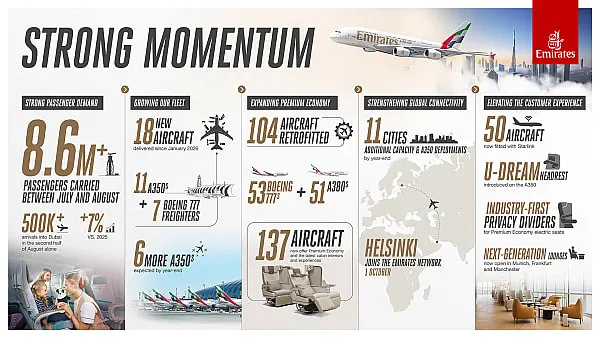
Emirates carried 8.6 million passengers this summer and enters winter with strong demand as it accelerates fleet retrofits and network growth.
Air Arabia Consortium Gains AOC for New Dammam Budget Airline
A Saudi GACA-led consortium including Air Arabia has secured an AOC to launch a new budget airline based at Dammam's King Fahd International Airport.
Turkish Airlines Exits Luanda as Angola Hub Struggles
Turkish Airlines dropped its Luanda route as Angola's new airport struggles to attract traffic, handling only 756,028 passengers in 2025.

Red Sea Airlines Leases Two 737 MAX 8s for 2027 Expansion
Red Sea Airlines signed a lease for two Boeing 737 MAX 8 aircraft from SMBC Aviation Capital, arriving in 2027 to support its 14-aircraft fleet goal.
Avelo CEO Warns Airfares May Rise on Jet Fuel Price Spikes
Avelo Airlines CEO Andrew Levy warns that rising fuel costs may force fare increases as global jet fuel prices reach $171.01 per barrel.