RwandAir, Nigeria Launch Cargo Corridor to Cut Export Costs

Co-Founder & CEOAviation News Editor delivering trusted coverage across the global aviation industry.

RwandAir and Nigeria launched a new cargo corridor reducing freight rates to under $2 per kilogram for AfCFTA-certified exporters.
Key Takeaways
- •RwandAir cargo corridor connects Nigeria to Kigali, Lusaka, and Harare.
- •Freight rates drop to under $2/kg for AfCFTA-certified Nigerian exporters.
- •Project builds on the 2018 Nigeria-Rwanda bilateral aviation agreement.
- •Bugesera Airport aims to handle 150,000 tonnes of cargo annually by 2028.
Expanding Intra-African Logistics
RwandAir has officially launched an expanded cargo corridor connecting Nigeria to East and Southern Africa, a move designed to lower logistics costs and bolster the African Continental Free Trade Area (AfCFTA). This strategic partnership, coordinated with the Nigerian Federal Ministry of Industry, Trade and Investment (FMITI), establishes a direct link for Nigerian exporters to key regional hubs including Kigali, Lusaka, and Harare.
Impact on Export Competitiveness
The initiative addresses a critical barrier to intra-African commerce: high shipping costs. According to the FMITI, freight rates on these routes have been reduced to under $2 per kilogram for businesses holding a valid AfCFTA Certificate of Origin. This represents a significant decrease from previous market rates, which historically ranged between $3 and $10 per kilogram. The Nigeria Customs Service is now tasked with managing the issuance and verification of these certificates to ensure that only eligible exporters access the subsidized pricing.
Aviation Policy and Infrastructure
During the inaugural event, Nigerian Minister of Aviation and Aerospace Development Festus Keyamo emphasized that the cargo corridor aligns with the broader Single African Air Transport Market (SAATM) initiative. The project builds upon the 2018 Bilateral Air Service Agreement (BASA) between Rwanda and Nigeria, which laid the legal framework for expanded cross-border operations.
This development also supports the long-term strategic positioning of the upcoming Bugesera International Airport. As a primary logistics node, the facility is projected to handle 150,000 tonnes of cargo annually upon completion of its first phase, which is expected between 2027 and 2028.
Technical Analysis: The Logistics Shift
The integration of trade policy with aviation capacity represents a significant shift in regional economic strategy. By treating air cargo as a subsidized tool for market integration, the partnership effectively bypasses traditional infrastructure bottlenecks. Historically, the May 2025 launch of a similar cargo corridor between Nigeria and Uganda served as a proof-of-concept, which reportedly led to a 40% increase in export volumes within its first year. The current collaboration with RwandAir scales this model, utilizing a mix of dedicated freighters and passenger belly cargo to ensure frequency and reliability.
Economic Sustainability Considerations
While the initiative is widely viewed as a catalyst for growth, some observers have noted potential fiscal pressures. According to the International Monetary Fund (IMF), the scale of infrastructure investment, particularly in projects like Bugesera International Airport, requires careful management of public finances to ensure long-term sustainability alongside trade facilitation goals. Despite these concerns, stakeholders remain optimistic that the reduced logistics overhead will create immediate gains for Nigerian MSMEs and strengthen the AfCFTA framework across the continent.
Frequently Asked Questions
- What is the new freight rate for AfCFTA-certified exporters on RwandAir routes?
- Exporters holding a valid AfCFTA Certificate of Origin now benefit from subsidized freight rates of under $2 per kilogram, a significant reduction from the previous range of $3 to $10 per kilogram.
- Which new destinations does the expanded Nigeria-RwandAir cargo corridor serve?
- The expanded corridor adds Kigali, Lusaka, and Harare as new destinations, complementing existing connections to Nairobi and Johannesburg.
Access up-to-date commercial aviation news and airline industry developments via omniflights.com. Track policy changes, airspace rules, and global aviation governance in the Regulatory category at omniflights.com/regulatory.
Written by Hardik Vishwakarma
Co-Founder & Aviation News Editor leading initiatives that improve trust and visibility across the global aviation industry. Covers airlines, airports, safety, and emerging technology.
Visit ProfileYou Might Also Like
Discover more aviation news based on similar topics

Flydubai Upgrading 21 Boeing 737 MAX 8s to Flat Bed Seats
Flydubai is retrofitting 21 Boeing 737 MAX 8 aircraft with lie-flat business class seats to standardize its premium product by late 2027.
Emirates Winter Booking Momentum Grows Amid Fleet Expansion
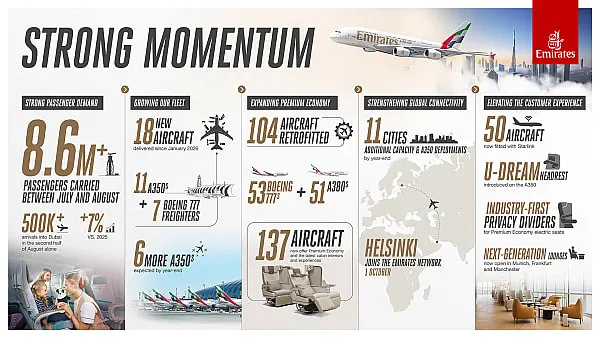
Emirates carried 8.6 million passengers this summer and enters winter with strong demand as it accelerates fleet retrofits and network growth.

Air Arabia Consortium Gains AOC for New Dammam Budget Airline
A Saudi GACA-led consortium including Air Arabia has secured an AOC to launch a new budget airline based at Dammam's King Fahd International Airport.

Turkish Airlines Exits Luanda as Angola Hub Struggles
Turkish Airlines dropped its Luanda route as Angola's new airport struggles to attract traffic, handling only 756,028 passengers in 2025.

Red Sea Airlines Leases Two 737 MAX 8s for 2027 Expansion
Red Sea Airlines signed a lease for two Boeing 737 MAX 8 aircraft from SMBC Aviation Capital, arriving in 2027 to support its 14-aircraft fleet goal.

Avelo CEO Warns Airfares May Rise on Jet Fuel Price Spikes
Avelo Airlines CEO Andrew Levy warns that rising fuel costs may force fare increases as global jet fuel prices reach $171.01 per barrel.