Qantas Rolls Out First A350-1000ULR for Project Sunrise Flights

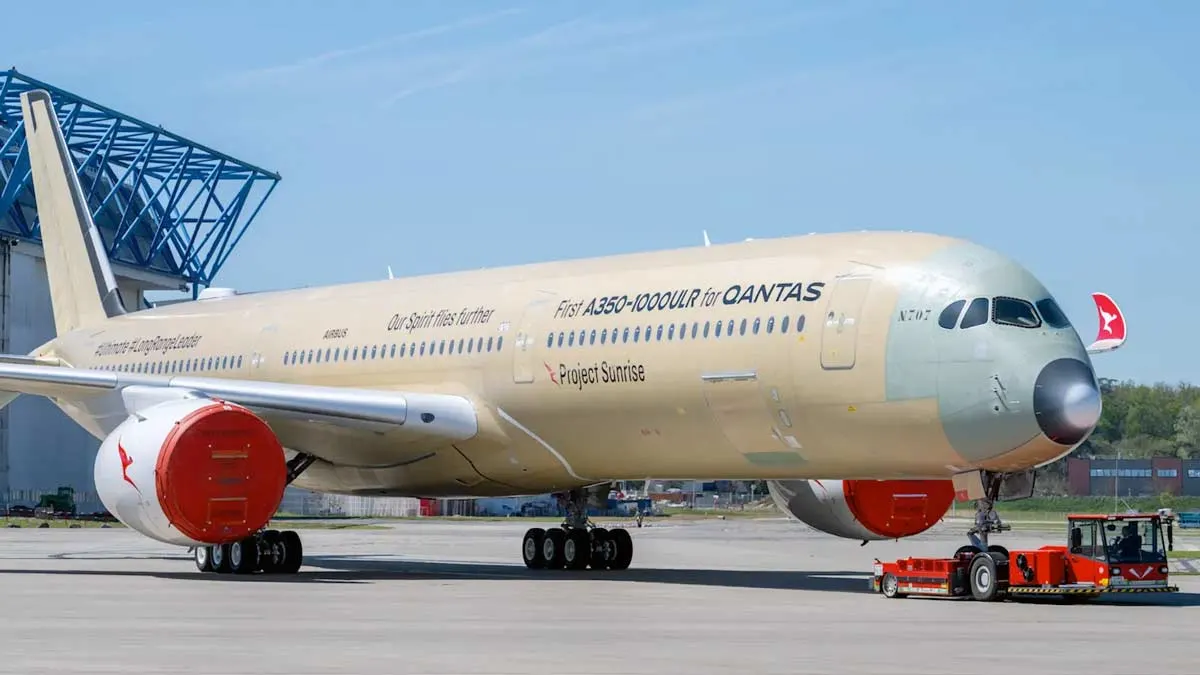
Qantas' first Airbus A350-1000ULR for Project Sunrise has rolled out of the factory in Toulouse, a key step towards launching non-stop flights.
Key Takeaways
- •Rolls out first of 12 Airbus A350-1000ULR aircraft from Toulouse for Project Sunrise.
- •Features a 238-seat premium layout and an additional 20,000-litre fuel tank for 22-hour flights.
- •Cuts up to 4 hours from current one-stop journey times between Australia and London/New York.
- •Targets the first half of 2027 for the commercial launch of non-stop services.
The first Airbus A350-1000ULR destined for Qantas has officially rolled out of the manufacturer's final assembly line in Toulouse, France. This event marks a critical milestone for the airline's ambitious Project Sunrise, which aims to connect Sydney directly with London and New York using a fleet of specialized ultra-long-haul aircraft.
The rollout moves the long-awaited project from concept to physical reality, positioning Qantas to launch the world's longest commercial flights. These services are projected to cut up to four hours from current one-stop journey times, fundamentally altering the travel landscape between Australia and major global hubs. The aircraft is the first of a firm order for 12 A350-1000s placed by Qantas in May 2022.
According to Qantas Group CEO Vanessa Hudson, the rollout brings Project Sunrise one step closer to reality, emphasizing that it will fundamentally change how customers travel by overcoming the 'tyranny of distance'. The aircraft, which will undergo extensive flight testing before its first delivery, is central to the airline’s strategy of commanding the premium point-to-point international market.
Aircraft Configuration and Technical Specifications
To operate flights lasting up to 22 hours, the Qantas A350-1000ULR (Ultra Long Range) incorporates significant modifications. According to Airbus official specifications, the primary change is the inclusion of an additional 20,000-litre rear center fuel tank, which increases its total fuel capacity and enables a range of approximately 9,700 nautical miles. This requires an increased Maximum Takeoff Weight (MTOW), for which Airbus must secure type certification from the EASA (European Union Aviation Safety Agency).
Internally, the aircraft is configured with a passenger-centric, premium-heavy layout of just 238 seats—a drastic reduction from the standard 350-410 seats on a typical A350-1000. Qantas fleet specifications confirm that over 40% of the cabin footprint is dedicated to premium classes, including First, Business, and Premium Economy. A key innovation is the inclusion of a dedicated 'Wellbeing Zone' for all passengers, designed to offer space for movement and stretching to mitigate fatigue and the effects of deep vein thrombosis on extended flights.
Industry and Stakeholder Impact
The selection of the Airbus A350-1000ULR has created clear winners and losers among industry stakeholders. For Rolls-Royce, it secures an exclusive engine provision and long-term maintenance contract for the fleet's Trent XWB-97 powerplants, which will operate under extreme endurance cycles. Conversely, Boeing lost a high-profile flagship contract after its proposed 777-8 was passed over for the project.
For premium leisure and business travelers, the impact is significant, offering time savings of up to four hours and an enhanced cabin experience. However, the project may have a marginal negative impact on traditional intermediate hub airports like Singapore Changi and Dubai, which could see a slight decrease in premium transit traffic as these new point-to-point flights bypass them entirely. Some environmental researchers have also raised concerns, arguing that ultra-long-haul flights are inherently less fuel-efficient per passenger due to the need to carry massive fuel loads.
Technical Comparisons
The specialized nature of the Qantas aircraft is evident when compared to its standard counterpart and its primary competitor.
A350-1000ULR vs Standard A350-1000
| Metric | Qantas A350-1000ULR | Standard A350-1000 |
|---|---|---|
| Range | ~9,700 nm | ~8,700 nm |
| Passenger Capacity | 238 seats | 350-410 seats |
| Fuel Capacity | Includes additional 20,000-litre tank | Standard configuration |
A350-1000ULR vs Boeing 777-8
| Metric | Airbus A350-1000ULR | Boeing 777-8 |
|---|---|---|
| Maximum Range | ~9,700 nm | 8,745 nm |
| Engine | Rolls-Royce Trent XWB-97 | General Electric GE9X |
| Passenger Capacity | 238 seats (Qantas config) | 395 seats (typical) |
This project builds upon the precedent set by Singapore Airlines, which launched the world's current longest flight between Singapore and New York in October 2018. That service utilized a premium-heavy, 161-seat Airbus A350-900ULR, proving the commercial and technical viability of the ULR concept with reduced passenger density.
What Comes Next
Following the factory rollout, the first A350-1000ULR will enter a phase of rigorous flight testing in mid-2026, which is required for certification by EASA. Once certified, Airbus is expected to deliver the first aircraft to Qantas in late 2026. The airline will then need to secure its own operational approvals, including Extended Operations (ETOPS) certification from Australia's CASA (Civil Aviation Safety Authority), which is essential for operating twin-engine aircraft on extreme overwater routes.
Qantas has publicly stated that its target for the commercial entry into service for Project Sunrise flights is the first half of 2027.
Why This Matters
The launch of the first Project Sunrise aircraft represents the tangible beginning of a new era in long-haul travel. It not only overcomes one of aviation's final frontier challenges but also sets a new benchmark for passenger wellness and premium service. For Qantas, it is a strategic move to dominate a lucrative niche market, while for the industry, it signals a continued push towards the operational and technical limits of commercial flight.
Frequently Asked Questions
- What is Qantas Project Sunrise?
- Project Sunrise is Qantas' initiative to operate non-stop commercial flights from Sydney, Australia to distant cities like London and New York. It uses specially modified Airbus A350-1000ULR aircraft designed for flights lasting over 20 hours.
- How is the Qantas A350-1000ULR different from a standard A350?
- The Qantas A350-1000ULR is modified for ultra-long-range flights with an additional 20,000-litre fuel tank. It also features a premium-heavy, low-density cabin with only 238 seats compared to the typical 350-410, and includes a dedicated 'Wellbeing Zone' for passengers.
- When will Qantas Project Sunrise flights begin?
- Following the aircraft's rollout and a period of flight testing and certification, Qantas is targeting the first half of 2027 for the commercial entry into service of its Project Sunrise flights.
Get breaking commercial aviation news and expert airline analysis at omniflights.com. For reporting on UAP sightings, investigations, and aviation-related encounters, see the UAPs section at omniflights.com/uaps.

Written by Hardik Vishwakarma
Co-Founder & Aviation News Editor leading initiatives that improve trust and visibility across the global aviation industry. Covers airlines, airports, safety, and emerging technology.
Visit ProfileYou Might Also Like

GE Aerospace Plans to Double India Supplier Spend by 2030
Boeing Tests MUM-T Software for MQ-25A and F/A-18 Teaming

COMAC C919 Faces Production Delays Amid US Export Curbs

Boeing Awarded $14.7B Contract for PAC-3 Missile Seekers

Boeing 777X Testing Spills Into 2027 Amid Certification Hurdles