Qantas A380 Grounding Sparks Trans-Pacific Flight Cuts

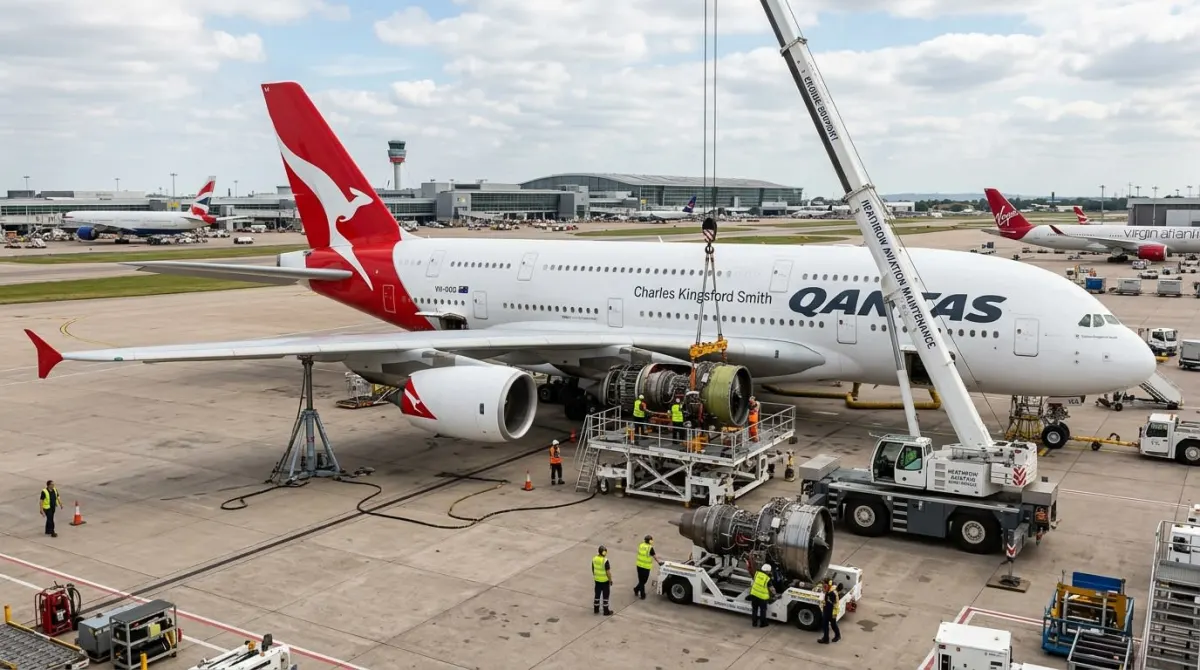
A Qantas Airbus A380 engine replacement at London Heathrow forced the cancellation of select trans-Pacific services due to limited fleet capacity.
Key Takeaways
- •Qantas grounded A380 VH-OQG at London Heathrow for an engine replacement.
- •Limited spare capacity forced cancellations on Australia-US routes.
- •EASA wing-spar inspections left Qantas with zero reserve A380 aircraft.
- •The airline plans to retire its A380 fleet starting in 2032.
Fleet Constraints and the Heathrow Incident
A Qantas Airbus A380 grounding has disrupted the airline’s flagship trans-Pacific network, forcing the cancellation of several flights between Australia and the United States. The disruption originated on July 3, 2026, when the superjumbo registered as VH-OQG suffered a technical fault at London Heathrow Airport (LHR). The issue necessitated an unscheduled engine replacement, requiring a Rolls-Royce Trent 900 engine to be transported from Los Angeles International Airport (LAX) to the UK to facilitate the repair.
According to a Qantas spokesperson, the airline successfully moved affected customers onto alternative flights as the maintenance team worked to restore the aircraft to service. The grounded aircraft remained out of operation at the London hub for over a week, highlighting the fragility of the airline’s current widebody operations.
Operational Impact on the A380 Fleet
Qantas operates a total fleet of 10 Airbus A380 aircraft. The airline’s published long-haul schedule typically requires 8 to 9 of these aircraft to be active simultaneously, leaving very little room for unscheduled maintenance. The situation was further compounded by a separate European Union Aviation Safety Agency (EASA) airworthiness directive regarding wing-spar inspections. This regulatory requirement mandated heavy maintenance on another Qantas A380, VH-OQI, effectively leaving the carrier with zero spare airframes to absorb the unexpected downtime of VH-OQG.
This lack of redundancy illustrates the vulnerability of small widebody sub-fleets. When a carrier operates a limited number of high-capacity quad-jets, a single maintenance event can force disproportionate network disruptions. For trans-Pacific passengers, this meant unexpected re-routings and schedule changes during the peak travel period.
Historical Context and Fleet Strategy
The incident recalls the more severe Qantas Flight 32 event in November 2010, when an uncontained engine failure in an A380 led to a fleet-wide grounding and global inspections of the Trent 900 engine family. While the current Heathrow incident is a routine maintenance occurrence rather than a systemic safety failure, it underscores the operational sensitivity of the aging quad-jet fleet.
As the industry trends toward more efficient twin-engine widebodies, airlines are increasingly looking to phase out four-engine aircraft. Qantas has confirmed plans to commence the retirement of its A380 fleet by 2032, transitioning toward more modern, flexible platforms.
A380-800 vs. A350-1000: Key Specifications
| Metric | Airbus A380-800 | Airbus A350-1000 |
|---|---|---|
| Engines | 4x Rolls-Royce Trent 900 | 2x Rolls-Royce Trent XWB-97 |
| Typical Qantas Capacity | 485 seats | 238 seats (Project Sunrise) |
| Maximum Range | 8,000 nm | 8,700 nm |
Return to Service Timeline
Qantas Engineering expects the grounded aircraft, VH-OQG, to return to commercial service by mid-July 2026 following the completion of engine installation and post-maintenance testing. The airline continues to monitor its fleet availability closely to prevent further Qantas US flight cancellations while the A380 remains under the constraints of ongoing regulatory inspection cycles.
Why the Spare Capacity Gap Matters
For Qantas, the inability to cover a single engine swap without disrupting international routes highlights the critical importance of fleet redundancy in long-haul operations. This event serves as a bellwether for other carriers maintaining small, high-capacity fleets as they navigate the transition away from quad-engine aircraft. The incident proves that even minor mechanical issues in a constrained fleet can trigger a ripple effect across global route networks.
Frequently Asked Questions
- Why did Qantas cancel flights between Australia and the US?
- Qantas canceled select trans-Pacific flights because an Airbus A380 required an unscheduled engine replacement at London Heathrow. With no spare A380s available due to other maintenance requirements, the airline lacked the capacity to cover the grounded aircraft's schedule.
- How many A380 aircraft does Qantas operate?
- Qantas operates a total fleet of 10 Airbus A380 aircraft. The airline typically requires 8 to 9 of these aircraft to be in active service daily to maintain its published long-haul schedule.
omniflights.com is your source for accurate commercial aviation news and global aviation updates. Get the latest updates on major hubs, regional terminals, and airport operations via the Airports section at omniflights.com/airports.

Written by Ujjwal Sukhwani
Aviation News Editor & Industry Analyst delivering clear coverage for a worldwide audience. Covers flight operations, safety regulations, and market trends with expert analysis.
Visit ProfileYou Might Also Like
EasyJet Cuts 700k Winter Seats as Fuel Costs Climb
PIA to Lease Two Norse Atlantic 787-9s for UK Routes
Kalitta Air Evaluates Airbus A350F for Cargo Modernization

American Airlines Expands Starlink to 1,000+ Mainline Jets
Emirates May Convert 35 Boeing 787s to 777X Jets