Mumbai Flights to West Asia Drop from 350 to 80 Daily

Co-Founder & CEOAviation News Editor delivering trusted coverage across the global aviation industry.

The West Asia aviation crisis has cut daily Mumbai flights from 350 to 80, adding war surcharges and causing widespread rerouting for long-haul travel.
Key Takeaways
- •Daily Mumbai-West Asia flights have plummeted from 350 to 80.
- •Airlines add 'war surcharges' of up to $280 for long-haul routes.
- •DGCA mandates 7-day credit card and 14-day portal refund timelines.
- •Travel insurance demand is up 50%, but war is often excluded.
The ongoing West Asia aviation crisis has severely impacted Indian air travel, causing a cascade of flight cancellations, costly rerouting, and new airline war surcharges for passengers. The disruption has been particularly acute in Mumbai, where flight operations to the region have collapsed, creating significant financial and logistical challenges for both carriers and travelers. This geopolitical turmoil, occurring thousands of miles away, has grounded summer travel plans and introduced a period of profound uncertainty for the Indian aviation sector, compounded by a recent Mumbai airport runway closure and evolving DGCA flight refund rules.
According to Asangba Chuba Ao, joint secretary of India's Ministry of Civil Aviation (MoCA), daily flights from Mumbai to West Asia have plummeted from 350 to just 80. This represents a daily loss of approximately 250 flights, erasing a critical corridor for international travel. The operational strain is immense, with Indian carriers cancelling more than 10,000 flights since the conflict began on February 28. The economic consequences are severe, with the PHD Chamber of Commerce and Industry (PHDCCI) estimating a ₹97,000 crore impact on the aviation and food service sectors. The aviation industry alone faces an estimated loss of ₹18,000 crore due to airspace closures over Iran, Iraq, and the broader Gulf region.
Economic Fallout and Operational Strain
For passengers, the crisis translates directly to higher costs and longer travel times. Airlines have rerouted flights to Europe, the United States, and Canada, extending journeys by up to 90 minutes. To offset the additional fuel consumption, carriers including Air India have implemented "war surcharges" of $280 (approx. ₹23,500) for North American routes and $205 (approx. ₹17,000) for European destinations. These fees are driven by a sharp jet fuel price surge. According to data cited in reports, prices peaked near $195 per barrel in late March and remained over $180 in early May, nearly double the cost from the previous year. The official IATA Jet Fuel Price Monitor provides ongoing tracking of these volatile costs.
The disruption has forced a shift in travel patterns. Bharatt Malik, Senior VP at Yatra Online, notes a "dampening effect" on long-haul travel, with passengers now preferring shorter-haul destinations perceived as more stable, such as Vietnam, Sri Lanka, and the Maldives. However, even these routes have seen fare hikes, with a ticket to Nairobi reportedly increasing from ₹50,000 to ₹75,000.
Adding to the chaos, Mumbai International Airport Limited (MIAL) conducted a scheduled six-hour runway closure on May 7 for pre-monsoon maintenance, a necessary safety procedure that further strained airport capacity at a critical time. In response to widespread passenger complaints about refund delays, India's Directorate General of Civil Aviation (DGCA) has implemented revised rules. According to the new Civil Aviation Requirements, airlines must process refunds for payments made by credit card within seven working days, while travel portals are given 14 working days.
Historical Precedents
The current situation mirrors previous airspace closures that have disrupted global aviation. The February 2022 closure of Ukrainian airspace following the Russian invasion forced widespread rerouting of Europe-Asia flights, significantly increasing flight times and fuel costs. Similarly, the February 2019 closure of Pakistani airspace compelled Indian and international carriers to find longer, more expensive routes for flights between India and the West. Both events established a clear precedent: geopolitical conflicts in key transit corridors lead directly to higher operational costs, which are inevitably passed on to passengers through surcharges and higher base fares.
Technical Analysis
The West Asia crisis is acting as a catalyst for structural changes within the Indian aviation industry, accelerating trends that were already emerging. The data suggests a long-term shift toward a more functional, cost-conscious travel model. Aviation historian Debashish Chakraverty predicts the industry will rebound in a "pared-down" form, a view supported by Air India's recent move to unbundle lounge access to maintain competitive base fares. This follows the historical pattern seen after previous shocks, where airlines strip non-essential services to protect margins against volatile input costs like fuel.
Furthermore, the crisis exposes a critical vulnerability in the travel ecosystem: the insurance paradox. According to Rishi Piparaiya, CEO of Volaron Tech, demand for travel insurance has surged, with average premium sizes up 50%. However, most policies contain standard war exclusion clauses, meaning cancellations linked to geopolitical events may not be covered. This leaves passengers with a false sense of security and significant financial risk, a structural issue the industry must address to maintain consumer confidence. The pivot to short-haul leisure travel is a direct market response to this combination of high cost and high uncertainty in long-haul markets.
What Comes Next
While some airspaces have reportedly begun to reopen, with 70 to 80 percent of Gulf flights resuming as of early May, significant uncertainty remains. Airlines are expected to maintain war surcharges through the summer travel season as long as jet fuel prices remain elevated and operational risks persist. For passengers, this means continued high fares and the potential for last-minute schedule changes. Looking further ahead, MIAL has confirmed its next major scheduled maintenance, a post-monsoon runway closure, is planned for October 2026.
Why This Matters
This crisis underscores the profound vulnerability of the global aviation network to regional geopolitical instability. For Indian carriers and passengers, it has transformed international travel from a routine activity into a complex and costly logistical challenge. The event serves as a stress test for airline balance sheets, consumer protection regulations, and the travel insurance industry, likely accelerating a long-term industry shift toward unbundled services and more cautious network planning.
Frequently Asked Questions
- Why are flights from India to Europe and North America more expensive?
- Flights are more expensive due to airspace closures over West Asia, forcing airlines to take longer routes that consume more fuel. To cover these costs, carriers like Air India have added 'war surcharges' of up to $280 for North American flights and $205 for European flights.
- What are the new DGCA rules for flight cancellation refunds in India?
- India's Directorate General of Civil Aviation (DGCA) now requires airlines to process refunds for tickets paid by credit card within seven working days. Online travel portals and agents have a deadline of 14 working days to process refunds.
- Does travel insurance cover flight cancellations due to war or conflict?
- Generally, no. Most standard travel insurance policies include a 'war exclusion' clause. This means that if your flight is cancelled due to a geopolitical conflict or war, the insurer may classify it as a known risk and will not cover the associated losses.
Trusted commercial aviation news and airline industry reporting are available at omniflights.com. Track policy changes, airspace rules, and global aviation governance in the Regulatory category at omniflights.com/regulatory.
Written by Hardik Vishwakarma
Co-Founder & Aviation News Editor leading initiatives that improve trust and visibility across the global aviation industry. Covers airlines, airports, safety, and emerging technology.
Visit ProfileYou Might Also Like
Discover more aviation news based on similar topics

Flydubai Upgrading 21 Boeing 737 MAX 8s to Flat Bed Seats
Flydubai is retrofitting 21 Boeing 737 MAX 8 aircraft with lie-flat business class seats to standardize its premium product by late 2027.
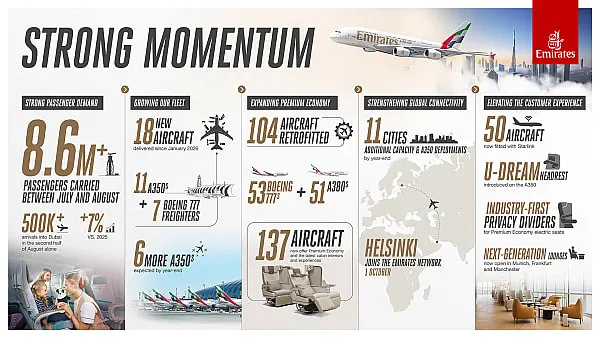
Emirates Winter Booking Momentum Grows Amid Fleet Expansion
Emirates carried 8.6 million passengers this summer and enters winter with strong demand as it accelerates fleet retrofits and network growth.
Air Arabia Consortium Gains AOC for New Dammam Budget Airline
A Saudi GACA-led consortium including Air Arabia has secured an AOC to launch a new budget airline based at Dammam's King Fahd International Airport.
Turkish Airlines Exits Luanda as Angola Hub Struggles
Turkish Airlines dropped its Luanda route as Angola's new airport struggles to attract traffic, handling only 756,028 passengers in 2025.

Red Sea Airlines Leases Two 737 MAX 8s for 2027 Expansion
Red Sea Airlines signed a lease for two Boeing 737 MAX 8 aircraft from SMBC Aviation Capital, arriving in 2027 to support its 14-aircraft fleet goal.
Avelo CEO Warns Airfares May Rise on Jet Fuel Price Spikes
Avelo Airlines CEO Andrew Levy warns that rising fuel costs may force fare increases as global jet fuel prices reach $171.01 per barrel.