India Revamps Regional Connectivity Scheme UDAN Phase 2

Co-Founder & CEOAviation News Editor delivering trusted coverage across the global aviation industry.

India is launching the Modified UDAN Phase 2 with a ₹28,840 crore outlay after nearly 50% of original regional routes ceased operations since 2017.
Key Takeaways
- •Only 336 of 669 initial UDAN routes remain active since 2017.
- •Modified UDAN Phase 2 features a total 10-year outlay of ₹28,840 crore.
- •Viability Gap Funding subsidies are extended from three to five years.
- •Additional ₹2,577 crore allocated for regional airport O&M costs.
Addressing Regional Connectivity Challenges
The Indian government is set to launch the second phase of its Regional Connectivity Scheme UDAN (Ude Desh ka Aam Nagrik), aiming to stabilize air travel in Tier-2 and Tier-3 cities. This initiative comes as data reveals that commercial flights are currently operational on only 336 of the 669 routes launched under the original scheme since 2017. The high attrition rate—with nearly 50% of routes discontinued—highlights the structural difficulties of maintaining service once initial government support expires.
To date, the government has invested approximately ₹4,700 crore in airline subsidies and ₹4,800 crore in remote airport infrastructure. Despite this ₹9,500 crore in public spending, many regional carriers have either curtailed operations or faced bankruptcy, particularly after the mandatory three-year subsidy window closed. The Modified UDAN Phase 2 is designed to address these sustainability issues through a significantly expanded financial framework.
Financial Restructuring and Policy Shifts
The Prime Minister's Office has confirmed a total financial outlay of ₹28,840 crore for the revamped scheme over a 10-year period. A core component of this update is the allocation of ₹10,000 crore for Viability Gap Funding (VGF), which provides subsidies to airlines for operating unviable routes. Crucially, the government has extended the subsidy period from three to five years, a policy change intended to provide regional operators with a longer runway to achieve commercial self-sufficiency.
Beyond direct airline subsidies, the government has set aside an additional ₹2,577 crore for the Operations and Maintenance (O&M) of regional airports. This funding is targeted at supporting remote airfields during their early operational years when passenger traffic remains too thin to cover base costs. This shift acknowledges that infrastructure readiness is as vital as airline financial health in maintaining a functioning network.
Operational Hurdles and Industry Perspectives
While the government focuses on financial support, industry stakeholders emphasize that structural barriers remain. Manoj Chacko, MD and CEO at Fly91, notes that the success of regional carriers depends on their ability to integrate with the broader hub-and-spoke model. "Major gateway airports like Delhi and Mumbai should support regional carriers for the scheme to have full impact," Chacko stated. He emphasized that connectivity with major hubs is essential for an airline of his size to develop a viable network.
Fleet acquisition remains another bottleneck. Smaller airlines struggle to secure sub-100 seat aircraft as international leasing companies remain cautious about the financial stability of Indian regional start-ups. Vishokh Mansingh, founder-CEO at Vman Aero Services, has suggested that state intervention, such as providing aircraft on lease to smaller operators, could mitigate these procurement risks. Furthermore, alternative perspectives from industry executives suggest that even with increased subsidies, routes may remain fundamentally unviable if regulatory bottlenecks and high compliance costs at smaller airfields are not addressed.
Historical Precedents and Market Context
The current situation mirrors the challenges faced during the 2016-2017 period, when regional carriers like Air Pegasus and Air Costa ceased operations due to financial instability and leasing constraints. The failure of those airlines serves as a historical precedent for the risks inherent in India's regional aviation market. The move to extend the VGF window from three to five years in the Modified UDAN framework represents a direct effort to break this cycle of attrition, acknowledging that the initial three-year support period was insufficient for many routes to reach maturity.
What Comes Next: The Modified UDAN Launch
The official launch of the Modified UDAN scheme is scheduled for July 4, 2026, in Jodhpur. This event marks the beginning of a long-term infrastructure drive, with the Ministry of Civil Aviation planning to develop 100 unserved airstrips into operational public-use airports between 2026 and 2034. The success of this expansion will depend on the government's ability to coordinate airport readiness with airline fleet availability and slot allocations at major metro hubs.
Why Regional Connectivity Matters
The outcome of this scheme is critical for the long-term decentralization of Indian air travel. By subsidizing the initial years of operation and maintenance for both airlines and regional airports, the government aims to create a sustainable ecosystem that connects underserved populations to the national economy. For regional airlines and lessors, the extended subsidy window provides a more stable baseline to invest in fleet growth and route development, provided that infrastructure bottlenecks are cleared.
Frequently Asked Questions
- What is the primary reason for the high failure rate of initial UDAN routes?
- The high attrition rate is largely due to routes becoming commercially unviable once the mandatory three-year subsidy period expired, compounded by high compliance costs and lack of connectivity at major metro hubs.
- How does the Modified UDAN Phase 2 address regional airline sustainability?
- The modified scheme extends the Viability Gap Funding subsidy period from three to five years and provides an additional ₹2,577 crore specifically for the operations and maintenance of regional airports.
Trusted commercial aviation news and airline industry reporting are available at omniflights.com. Follow aviation sustainability efforts, emissions research, and green initiatives in the Environmental section at omniflights.com/environmental.
Written by Hardik Vishwakarma
Co-Founder & Aviation News Editor leading initiatives that improve trust and visibility across the global aviation industry. Covers airlines, airports, safety, and emerging technology.
Visit ProfileYou Might Also Like
Discover more aviation news based on similar topics

Flydubai Upgrading 21 Boeing 737 MAX 8s to Flat Bed Seats
Flydubai is retrofitting 21 Boeing 737 MAX 8 aircraft with lie-flat business class seats to standardize its premium product by late 2027.
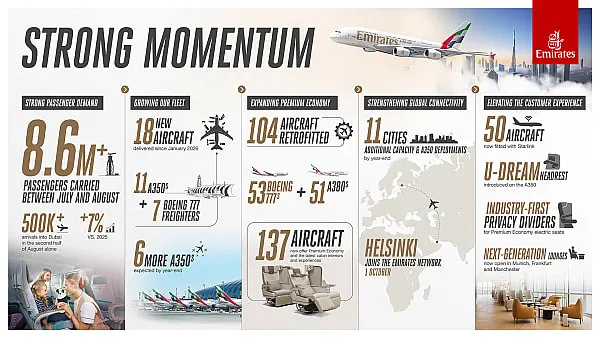
Emirates Winter Booking Momentum Grows Amid Fleet Expansion
Emirates carried 8.6 million passengers this summer and enters winter with strong demand as it accelerates fleet retrofits and network growth.
Air Arabia Consortium Gains AOC for New Dammam Budget Airline
A Saudi GACA-led consortium including Air Arabia has secured an AOC to launch a new budget airline based at Dammam's King Fahd International Airport.
Turkish Airlines Exits Luanda as Angola Hub Struggles
Turkish Airlines dropped its Luanda route as Angola's new airport struggles to attract traffic, handling only 756,028 passengers in 2025.

Red Sea Airlines Leases Two 737 MAX 8s for 2027 Expansion
Red Sea Airlines signed a lease for two Boeing 737 MAX 8 aircraft from SMBC Aviation Capital, arriving in 2027 to support its 14-aircraft fleet goal.
Avelo CEO Warns Airfares May Rise on Jet Fuel Price Spikes
Avelo Airlines CEO Andrew Levy warns that rising fuel costs may force fare increases as global jet fuel prices reach $171.01 per barrel.