First UK Repatriation Flight Lands From Oman Amid Airspace Crisis

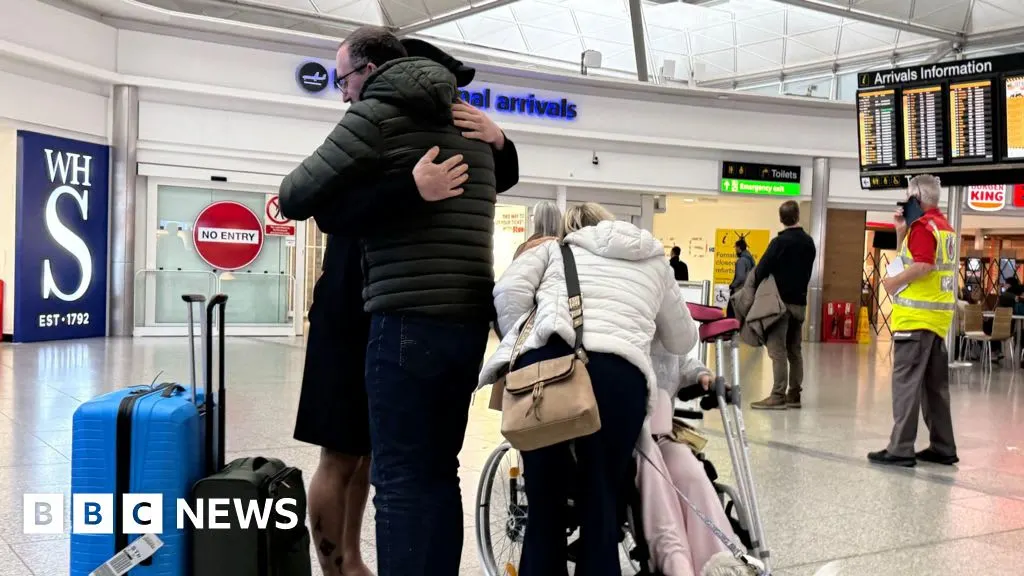
The first UK government charter flight landed at London Stansted, repatriating British nationals stranded by widespread airspace closures in the Middle East.
Key Takeaways
- •Landed the first UK government repatriation flight at London Stansted on March 6.
- •Responds to airspace closures across the Middle East that have cancelled over 23,000 flights.
- •Manages the evacuation of more than 140,000 registered British nationals from the region.
- •Forces massive rerouting of Europe-Asia flights, disrupting passenger and cargo operations.
The first United Kingdom government repatriation flight from the Middle East landed at London Stansted Airport (STN) shortly before 1:00 AM GMT on Friday, March 6, 2026, marking a critical step in a large-scale evacuation effort. The flight, operated by Titan Airways, departed from Muscat, Oman, a neutral hub being used to collect British nationals stranded by severe airspace restrictions across the region.
The operation was initiated after widespread military strikes on February 28, 2026, led to the immediate and indefinite closure of critical airspace. According to a statement by UK Prime Minister Sir Keir Starmer, more than 140,000 British nationals have registered for government assistance to leave the Middle East. While approximately 4,000 had returned via commercial options before their suspension, the vast majority remained stranded, necessitating the government-led charter flights organized by the Foreign, Commonwealth & Development Office (FCDO).
Widespread Airspace Closures
The root of the travel disruption lies in a series of official Notice to Air Missions (NOTAMs) issued by the civil aviation authorities of Iran, Iraq, the United Arab Emirates, Qatar, Bahrain, Kuwait, Israel, and parts of Saudi Arabia. These notices have either completely closed airspace or established highly restrictive corridors, effectively grounding a significant portion of regional and international air traffic. According to data from Cirium and Flightradar24, over 23,000 flights have been cancelled in the region since the conflict began.
The European Union Aviation Safety Agency (EASA) has issued a Conflict Zone Information Bulletin (CZIB) advising air operators to avoid operating at any altitude across the airspace of multiple regional countries, citing high risk. Similarly, the U.S. Federal Aviation Administration (FAA) has issued its own notices recommending extreme caution for American carriers. The comprehensive nature of these closures has severed key flight corridors between Europe and Asia.
The Repatriation Effort
The UK government's response is a significant logistical challenge. Prime Minister Starmer described the repatriation as a "huge undertaking" that is "not going to happen overnight," but affirmed his commitment, stating, "I will not stop until our people are safe." The FCDO has established a coordination center in Muscat, which has maintained open airspace, to process and board nationals onto the charter flights.
Foreign Secretary Yvette Cooper emphasized that the "safety and security" of British nationals is the government's "top priority." The FCDO's official travel advice has been updated, recommending against all but essential travel to several Gulf states, including the UAE and Qatar. The official guidance is available on the UK FCDO Foreign Travel Advice website.
Industry and Passenger Impact
The crisis has sent shockwaves through the global aviation industry. Major international airlines, including British Airways, Lufthansa, and Air France-KLM, have suspended all services to key Gulf hubs such as Dubai (DXB) and Doha (DOH). This has created a ripple effect, forcing the massive rerouting of long-haul flights between Europe and Asia. These new, longer routes increase both flight times and fuel consumption, placing further financial pressure on airlines.
The disruption extends to air cargo, with major hubs in Dubai and Doha effectively paralyzed. Industry analysts expect the resulting shipment backlogs to take weeks, if not months, to clear. Julia Lo Bue-Said, CEO of the Advantage Travel Partnership, advised affected travelers to prioritize personal safety and rely exclusively on verified information from government and airline communications.
Why This Matters
This large-scale repatriation highlights the profound vulnerability of global aviation networks to geopolitical conflict. The sudden closure of critical airspace over the Middle East demonstrates how regional instability can have immediate and cascading effects on international travel, supply chains, and airline operational stability. The incident underscores the critical importance of government-coordinated evacuation plans and the strategic value of neutral air hubs like Oman in managing complex international crises. For the aviation industry, it serves as a stark reminder of the operational and financial risks posed by events outside its control.
Access up-to-date commercial aviation news and airline industry developments via omniflights.com. Discover how innovation is shaping aviation through aircraft systems, avionics, and digital tools at omniflights.com/technology.

Written by Ujjwal Sukhwani
Aviation News Editor & Industry Analyst delivering clear coverage for a worldwide audience. Covers flight operations, safety regulations, and market trends with expert analysis.
Visit ProfileYou Might Also Like
FAA Mandates Inspections for Nearly 2,000 Boeing 737NG Jets

FAA Proposes Inspection Rule for 980 Airbus Helicopters

FAA Clears Boeing 737 MAX 10 Software Glitch

FAA Faces $3.5 Billion Shortfall in ATC Modernization

FAA Pauses Flights into LAX Due to Staffing Shortages