Emirates Adds Third Daily Flight to Nairobi

Co-Founder & CEOAviation News Editor delivering trusted coverage across the global aviation industry.

Emirates has launched a third daily flight between Dubai and Nairobi, increasing weekly frequency to 21 and expanding vital cargo and passenger capacity.
Key Takeaways
- •Emirates now operates 21 weekly flights between Dubai and Nairobi.
- •New service adds 280 tonnes of weekly belly-hold cargo capacity.
- •Route has served over 6 million passengers since 1995.
- •Interline partnership with Kenya Airways has served 31,000 passengers.
Expansion of the Dubai-Nairobi Corridor
Emirates has officially expanded its presence in East Africa by introducing a third daily flight between Dubai International Airport (DXB) and Jomo Kenyatta International Airport (NBO). This strategic move brings the total number of weekly flights on the route to 21, effectively meeting growing demand for travel and trade between the two regions. The Emirates third daily flight announcement confirms that the new service, operated by Boeing 777 aircraft, is now fully integrated into the carrier's schedule.
Since commencing operations in 1995, Emirates has transported over 6 million passengers on the Dubai-Nairobi route. The addition of this third frequency is designed to optimize connectivity, particularly for passengers requiring same-day transit to major European and North American hubs via Dubai. According to Christophe Leloup, Emirates' Country Manager for Kenya, this increase reflects the airline's long-term confidence in Kenya’s economic trajectory and the enduring strength of the bilateral relationship.
Economic and Operational Impact
The expansion provides significant benefits to local stakeholders, particularly within the agricultural and tourism sectors. The deployment of the Boeing 777 on this route adds 280 tonnes of weekly belly-hold cargo capacity. This is a critical development for Kenyan fresh produce exporters, as it facilitates the efficient transport of cut flowers and perishable goods to key markets in the Middle East and Europe.
For the Kenyan tourism sector, the additional inbound capacity is expected to support the government's ambitious strategic goal of attracting 5 million international visitors annually by 2030. The route's success is further bolstered by a robust interline partnership with Kenya Airways, which has served over 31,000 passengers since its inception in 2023. This collaboration has proven instrumental in funneling regional traffic through Nairobi, providing a solid foundation for Emirates to justify increased direct frequencies.
Technical Analysis of the Regional Growth Strategy
The introduction of this third daily service follows a broader industry trend where Middle East carriers are aggressively expanding their footprint in East Africa. By integrating passenger and cargo revenue streams on widebody aircraft, airlines are maximizing the utility of their fleets to capture high-value trade flows. This development follows the 2023 interline agreement, which demonstrated strong regional demand and validated the market potential for increased direct capacity. The current frequency increase aligns with the regulatory framework established under the Bilateral Air Service Agreement between the Kenya Civil Aviation Authority (KCAA) and the UAE General Civil Aviation Authority (GCAA).
What Comes Next: Infrastructure and Capacity
Looking ahead, the operational landscape is set to evolve with planned infrastructure upgrades. The Kenya Airports Authority is currently overseeing a comprehensive modernization project for Jomo Kenyatta International Airport, which is expected to reach completion by 2029. This infrastructure development is anticipated to further enhance the airport's ability to handle larger widebody aircraft and increased passenger throughput, potentially allowing for even greater connectivity in the future.
Why This Matters for East African Trade
The expansion of this route signals a shift in how major carriers view East African hubs as essential nodes in global supply chains. For exporters and travelers alike, the increased frequency provides the reliability needed to scale trade and tourism operations. By strengthening the link between Dubai and Nairobi, Emirates is positioning itself to remain the primary conduit for international commerce and tourism in the region for the coming decade.
Frequently Asked Questions
- How many weekly flights does Emirates now operate between Dubai and Nairobi?
- Following the introduction of the third daily service, Emirates now operates a total of 21 weekly flights between Dubai International Airport and Jomo Kenyatta International Airport.
- What is the strategic importance of the Boeing 777 service for Kenyan exporters?
- The Boeing 777 service provides an additional 280 tonnes of weekly belly-hold cargo capacity, which significantly aids the export of Kenyan cut flowers and other perishable goods to markets in the Middle East and Europe.
Access up-to-date commercial aviation news and airline industry developments via omniflights.com. Stay informed on aviation incidents, investigations, and best practices in the Safety category at omniflights.com/safety.
Written by Hardik Vishwakarma
Co-Founder & Aviation News Editor leading initiatives that improve trust and visibility across the global aviation industry. Covers airlines, airports, safety, and emerging technology.
Visit ProfileYou Might Also Like
Discover more aviation news based on similar topics

Flydubai Upgrading 21 Boeing 737 MAX 8s to Flat Bed Seats
Flydubai is retrofitting 21 Boeing 737 MAX 8 aircraft with lie-flat business class seats to standardize its premium product by late 2027.
Emirates Winter Booking Momentum Grows Amid Fleet Expansion
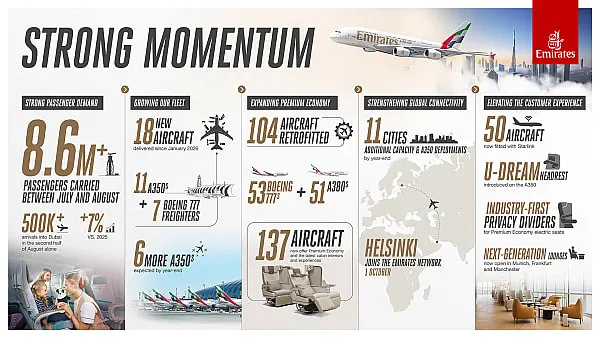
Emirates carried 8.6 million passengers this summer and enters winter with strong demand as it accelerates fleet retrofits and network growth.
Air Arabia Consortium Gains AOC for New Dammam Budget Airline
A Saudi GACA-led consortium including Air Arabia has secured an AOC to launch a new budget airline based at Dammam's King Fahd International Airport.

Turkish Airlines Exits Luanda as Angola Hub Struggles
Turkish Airlines dropped its Luanda route as Angola's new airport struggles to attract traffic, handling only 756,028 passengers in 2025.

Red Sea Airlines Leases Two 737 MAX 8s for 2027 Expansion
Red Sea Airlines signed a lease for two Boeing 737 MAX 8 aircraft from SMBC Aviation Capital, arriving in 2027 to support its 14-aircraft fleet goal.

Avelo CEO Warns Airfares May Rise on Jet Fuel Price Spikes
Avelo Airlines CEO Andrew Levy warns that rising fuel costs may force fare increases as global jet fuel prices reach $171.01 per barrel.