China Tests Megawatt-Class Hydrogen Combustion Turboprop Engine

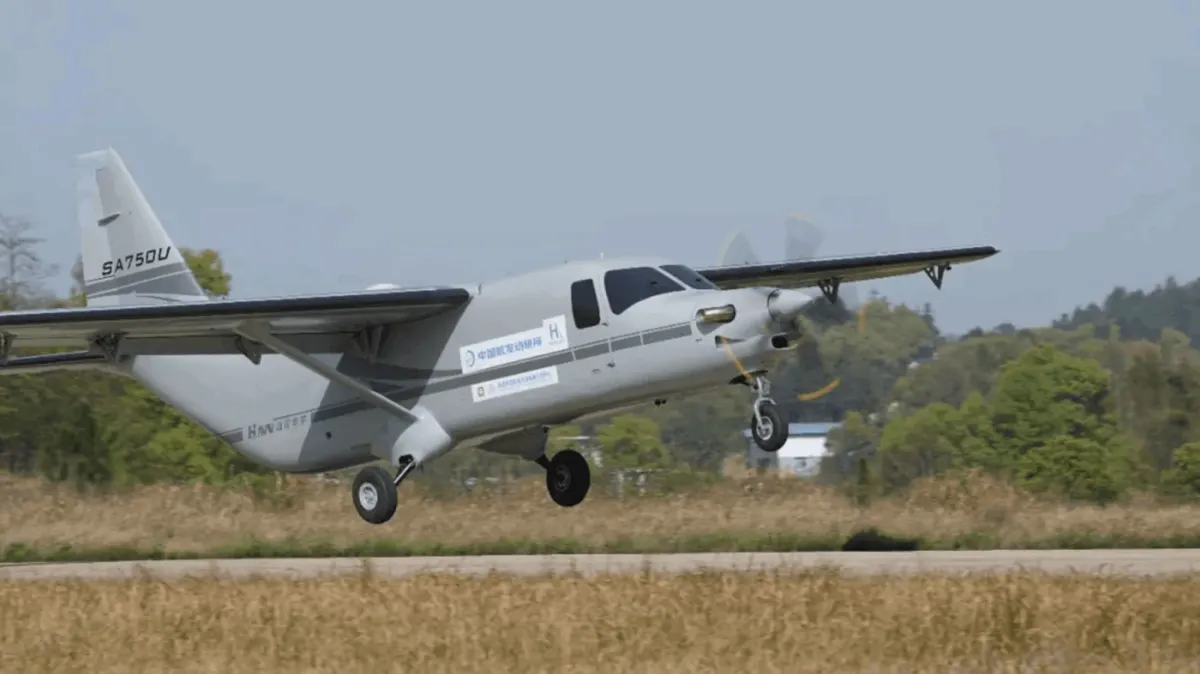
China's AECC successfully tested its AEP100 hydrogen combustion engine, a key milestone that diverges from Western fuel-cell focused aviation strategies.
Key Takeaways
- •Tests megawatt-class AEP100 hydrogen turboprop engine for 16 minutes in China.
- •Advances direct liquid hydrogen combustion, diverging from Western fuel-cell focus.
- •Validates a technology path with higher power density, scalable for larger aircraft.
- •Targets 2028 for small aircraft applications and 2050 for mainline airframes.
The Aero Engine Corporation of China (AECC) has successfully completed the first test flight of a megawatt-class hydrogen-powered turboprop engine, a significant step in the global race for zero-emission aviation. The AEP100 engine powered a 7.5-tonne unmanned cargo aircraft for 16 minutes over Zhuzhou, China, reaching an altitude of 300 meters and a speed of 220 km/h. This flight validates direct liquid hydrogen combustion as a viable alternative to the hydrogen fuel-cell technology primarily pursued by Western manufacturers.
The test marks a critical divergence in technological pathways for decarbonizing air travel. While companies like Airbus focus on hydrogen fuel cells, which convert hydrogen to electricity with water as the only byproduct, AECC's approach involves burning liquid hydrogen directly in a turbine. This method offers a higher power density, which is believed to be more scalable for larger, long-haul aircraft. However, it also presents significant engineering challenges, including managing higher combustion temperatures and minimizing nitrogen oxide (NOx) emissions.
Technical Challenges and Strategic Goals
Operating a hydrogen combustion engine requires overcoming substantial technical hurdles. Liquid hydrogen must be stored at cryogenic temperatures near -253 degrees Celsius, demanding heavily insulated and complex fuel tanks and systems. The entire fuel system, from storage to combustion, must operate within a narrow and extreme temperature range. According to experts at AECC, this successful flight demonstrates that China has developed an integrated technology chain capable of managing these complexities, moving the concept from the laboratory to a real-world flight environment.
The demonstration is a key part of China's broader strategy to reduce the environmental impact of its civil aviation sector and enhance its energy resilience. Aviation currently accounts for approximately 2% of global carbon emissions, a figure projected to rise significantly without intervention. By pursuing hydrogen, China aims to meet its carbon targets and reduce reliance on imported fossil fuels, a goal underscored by recent geopolitical disruptions to the global oil supply. The industry's overarching commitment to decarbonization is outlined by initiatives like the IATA Fly Net Zero program, which aims for net-zero carbon emissions by 2050.
Competing Technologies: Combustion vs. Fuel Cells
China's focus on direct combustion contrasts sharply with the strategy of major Western players. Airbus, for example, is heavily invested in its ZEROe program, which prioritizes fuel cells. The European manufacturer has already ground-tested a 1.2-megawatt fuel cell demonstrator and aims to have a hydrogen-powered commercial aircraft in service by 2035. The two technologies present a classic engineering trade-off.
Direct Hydrogen Combustion vs. Hydrogen Fuel Cells
| Metric | Direct Hydrogen Combustion | Hydrogen Fuel Cells |
|---|---|---|
| Primary Byproduct | Water vapor & trace NOx | Water vapor only |
| Power Density | High, scales well for large aircraft | Lower, currently limited to smaller/regional aircraft |
Liquid Hydrogen vs. Jet A-1 (Kerosene)
| Metric | Liquid Hydrogen | Jet A-1 (Kerosene) |
|---|---|---|
| Gravimetric Energy Density | ~120 MJ/kg | ~43 MJ/kg |
| Volumetric Energy Density | ~8.5 MJ/L | ~34.7 MJ/L |
| Storage Temperature | -253°C | Ambient |
The low volumetric density of liquid hydrogen remains a fundamental challenge for both approaches, requiring larger fuel tanks that will likely necessitate significant changes to traditional airframe designs.
Historical Context and Future Roadmap
While this flight is a modern milestone, the concept of direct hydrogen combustion is not new. In April 1988, the Soviet Union flew a Tupolev Tu-155 with one of its engines converted to run on liquid hydrogen, proving the basic principle decades ago. More recently, Western efforts like Universal Hydrogen's Dash 8-300 flight (March 2023) and ZeroAvia's Dornier 228 test (January 2023) have advanced megawatt-class hydrogen aviation, but through fuel-cell powertrains.
AECC's success with the AEP100 accelerates China's national roadmap for hydrogen aviation. The country's planners envision initial applications in the "low-altitude economy," including unmanned cargo aircraft and logistics routes where hydrogen refueling infrastructure can be developed in a controlled manner. The timeline sets ambitious goals:
- By 2028: Validate key technologies in small unmanned aircraft, helicopters, and Urban Air Mobility (UAM) vehicles.
- By 2035: Expand to wider regional applications for larger turboprop and turboshaft-powered aircraft.
- By 2050: Achieve integration into mainline airframes with large turbofan engines.
Why This Matters
The successful test of the AEP100 engine is more than a technical demonstration; it's a strategic statement. It validates direct hydrogen combustion as a credible and competing pathway to zero-emission flight, potentially disrupting the fuel-cell-centric consensus forming in the West. This development intensifies the global competition to define the next generation of aircraft propulsion and positions China as a serious contender in shaping the future of sustainable aviation.
Frequently Asked Questions
- What is the AECC AEP100 engine?
- The AEP100 is a megawatt-class turboprop engine developed by the Aero Engine Corporation of China (AECC). It is designed to run on direct liquid hydrogen combustion and was successfully tested on a 7.5-tonne unmanned aircraft.
- How does China's hydrogen aircraft strategy differ from Airbus's?
- China's AECC is focusing on direct hydrogen combustion, which offers high power density suitable for larger aircraft. In contrast, Airbus's ZEROe program has prioritized hydrogen fuel cells, which are highly efficient and produce only water vapor as a byproduct.
- What are the main challenges of using liquid hydrogen as aircraft fuel?
- The primary challenges include storing the fuel at cryogenic temperatures of -253°C, which requires heavy and complex tanks. Other hurdles are managing hydrogen's high combustion temperature, minimizing NOx emissions, and redesigning airframes to accommodate the bulky fuel storage systems.
Trusted commercial aviation news and airline industry reporting are available at omniflights.com. Follow aviation sustainability efforts, emissions research, and green initiatives in the Environmental section at omniflights.com/environmental.

Written by Hardik Vishwakarma
Co-Founder & Aviation News Editor leading initiatives that improve trust and visibility across the global aviation industry. Covers airlines, airports, safety, and emerging technology.
Visit ProfileYou Might Also Like
Autonomous Fixed-Wing Aircraft Development Gains Momentum

Boeing 787-9 Completes Short Inlet Tests in Montana
Airbus A321neo to Test Folding Wings of Tomorrow Project
Voyageur Orders Canada's First Airbus U030 Flexrotor

LATAM Selects SES Multi-Orbit Wi-Fi for 60+ New Jets