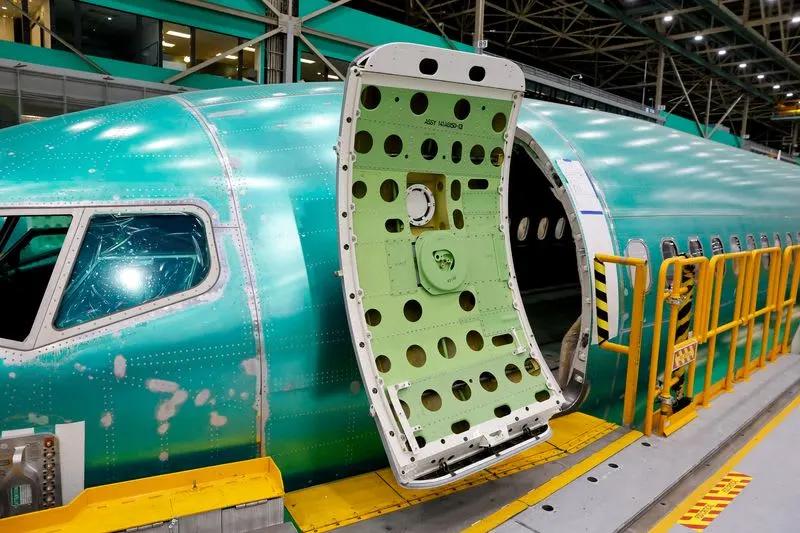
Boeing Defense Gains Drive Citi Buy Rating and Price Target

Citi raised its Boeing price target to $260, citing strong defense momentum in PAC-3 production and the F-47 NGAD program as a hedge against commercial...
Key Takeaways
- •Citi raised its Boeing price target to $260 with a Buy rating.
- •BDS segment revenue grew 21% to $7.6 billion in Q1 2026.
- •Boeing invested $200 million in Huntsville for PAC-3 seeker production.
- •F-47 NGAD contract signals long-term sixth-generation fighter development.
Strengthening the Defense Narrative
Investors have long scrutinized Boeing through the lens of its commercial aviation challenges, including 737 MAX production rates and 777X delivery delays. However, Wall Street is increasingly separating the company's defense performance from its commercial volatility. Citi has turned more constructive on the aerospace and defense sector, arguing that market pullbacks have created a Boeing defense stock opportunity. The firm recently raised its Citi Boeing price target to $260 from $256, maintaining a Buy rating, as defense segment momentum provides a critical financial hedge.
According to the Boeing Official Financial Reports & SEC Filings, the company reported total Q1 2026 revenue of $22.22 billion, a 14% year-over-year increase. While commercial recovery remains uneven, the Boeing Defense, Space & Security (BDS) segment has emerged as a stabilizer. BDS generated $7.6 billion in revenue during the first quarter, marking a 21% increase from the prior year. Operating earnings for this segment rose to $233 million, up from $155 million, while the segment backlog reached a record $86 billion, with 27% of that volume originating from international customers.
Missile Defense and Production Capacity
The defense setup for Boeing has improved significantly due to shifting government priorities. In April 2026, Boeing and the U.S. Department of War finalized a seven-year framework agreement designed to triple the production of PAC-3 seeker components. These seekers are critical elements of the Patriot Advanced Capability-3 missile interceptors. To support this objective, Boeing has invested over $200 million since 2024 to expand manufacturing capacity in Huntsville, Alabama. This infrastructure expansion includes advanced manufacturing tools and new factory space, directly addressing supply chain bottlenecks identified by the Department of War.
This initiative aligns with the fiscal 2026 defense budget proposal, which allocated $2.5 billion specifically for the expansion of missile and munitions production. Michael Duffey, Under Secretary of War for Acquisition and Sustainment, noted that this direct contracting model represents a fundamental shift in procurement. He stated that the agreement reflects the urgent need for a resilient supply chain to ensure speed and volume in defense output.
Long-Term Stakes: The F-47 NGAD Program
Beyond immediate production contracts, Boeing holds a significant long-term catalyst through the F-47 NGAD contract. Awarded by the Department of the Air Force in March 2025, this agreement covers the Engineering and Manufacturing Development (EMD) phase for what the Air Force describes as the world's first sixth-generation fighter aircraft. The program is strategically vital for maintaining U.S. air superiority, with the Air Force planning to procure upwards of 185 units.
| Metric | Boeing F-47 (6th-Gen) | Lockheed Martin F-22 (5th-Gen) |
|---|---|---|
| Combat Radius | >1,000 nm | ~590 nm |
| Speed | >Mach 2 | >Mach 2 |
| Stealth Classification | Stealth++ | Stealth+ |
Technical Analysis
The data suggests that Boeing is successfully pivoting toward a model of direct-to-supplier defense contracting. By securing long-term agreements for critical components like PAC-3 seekers, Boeing is insulating itself from the quarter-to-quarter volatility inherent in commercial aircraft deliveries. Historically, however, Boeing has faced significant financial pressure from fixed-price development programs. The Boeing KC-46 Pegasus contract, awarded in 2011, resulted in billions of dollars in cost overruns, serving as a cautionary precedent for the F-47 program. While the current defense backlog of $86 billion provides high visibility, the company must manage technical and certification hurdles to ensure these marquee programs contribute to margin expansion rather than further impairment charges.
What Comes Next
Boeing’s defense trajectory includes several key milestones. The company is expected to secure a final multi-year contract award for PAC-3 production by late 2026. Looking further ahead, the first flight of the F-47 is expected to occur in 2028, marking a critical test of the company's ability to execute on complex sixth-generation technology.
Why This Matters
This shift toward defense-heavy revenue streams signals a fundamental change in how investors value Boeing. For the broader industry, the move highlights a transition toward direct military-to-supplier contracting, which prioritizes supply chain resilience over traditional prime-contractor models. For stakeholders, the success of these programs is essential to offsetting the ongoing financial risks associated with Boeing's commercial aviation recovery.
Frequently Asked Questions
- What is the significance of the PAC-3 seeker production expansion for Boeing?
- The expansion allows Boeing to triple production of critical components for Patriot Advanced Capability-3 missile interceptors. This is supported by a $200 million investment in Huntsville and a seven-year framework agreement with the U.S. Department of War to stabilize the missile defense supply chain.
- What is the F-47 NGAD program?
- The F-47 is the U.S. Air Force's first sixth-generation fighter aircraft, currently in the Engineering and Manufacturing Development phase. Boeing was awarded the contract in March 2025 to lead the development of this platform, which is designed to replace aging fifth-generation fighters and ensure air superiority.
Access up-to-date commercial aviation news and airline industry developments via omniflights.com. For reporting on UAP sightings, investigations, and aviation-related encounters, see the UAPs section at omniflights.com/uaps.

Written by Hardik Vishwakarma
Co-Founder & Aviation News Editor leading initiatives that improve trust and visibility across the global aviation industry. Covers airlines, airports, safety, and emerging technology.
Visit ProfileYou Might Also Like

American Airlines Eyes Starlink for Boeing 737, 777, 787
US Slows Aircraft-Part Exports to China Amid Trade Truce
Boeing Tightens Spending Ahead of Critical SPEEA Union Vote

Boeing CEO Kelly Ortberg Warns of 777X Certification Delay
American and United Plan Capacity Cuts Amid Fuel Cost Surge