Vietjet Marks 50M Passengers With 50-Jet Boeing Order

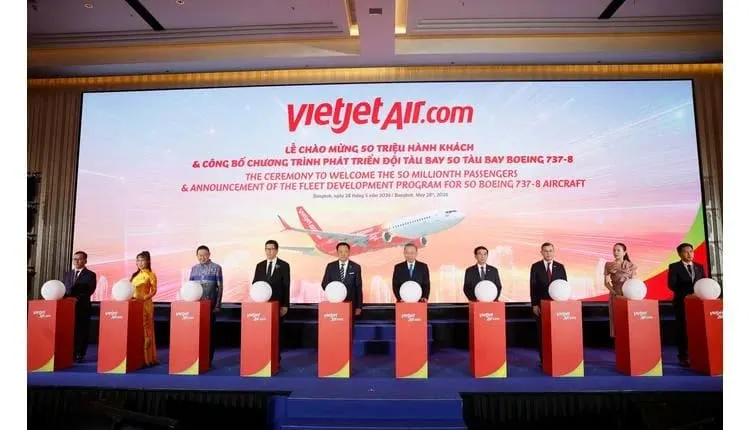
Vietjet celebrates 50 million passengers on its Vietnam–Thailand network and confirms 50 new Boeing 737-8 aircraft for its subsidiary by 2028.
Key Takeaways
- •Vietjet reaches 50 million passengers on Vietnam–Thailand routes.
- •Thai Vietjet to receive 50 Boeing 737-8 aircraft by 2028.
- •Order is part of a broader 200-jet agreement valued at $32 billion.
- •New fleet delivers 20% better fuel efficiency than previous models.
Celebrating a Regional Milestone
Vietjet has officially reached a significant milestone, transporting 50 million passengers across its Vietnam–Thailand aviation network. This achievement, announced during the May 2026 Thailand-Vietnam Business Forum in Bangkok, underscores the airline's rapid growth as a leading Low-Cost Carrier (LCC) in Southeast Asia. Alongside this passenger record, the carrier confirmed that its subsidiary, Thai Vietjet, will receive 50 Boeing 737-8 aircraft by 2028. This fleet expansion is part of a landmark 200-aircraft order with Boeing, valued at approximately US$32 billion at list prices.
Strengthening Bilateral Connectivity
This expansion aligns with the "Three Connects" strategy, a bilateral framework designed to bolster supply chain and tourism linkages between Vietnam and Thailand. According to Woranate Laprabang, CEO of Vietjet Thailand, the milestone reflects sustained passenger trust and the airline's ability to adapt to the evolving demands of regional travelers. The move is expected to significantly increase seat capacity, driving higher cross-border tourist arrivals and supporting hospitality revenue in both nations. For travelers, the increased frequency and modern fleet represent a shift toward more reliable, efficient regional travel options.
Boeing 737-8 vs. Boeing 737-800: Key Specifications
| Metric | Boeing 737-8 | Boeing 737-800 |
|---|---|---|
| Fuel Efficiency | 20% lower fuel use | Baseline |
| Noise Footprint | 50% smaller | Baseline |
| Range | 3,500 nm | 2,935 nm |
Operational and Environmental Implications
Transitioning to a uniform Boeing 737 MAX fleet for Thai Vietjet represents a departure from the parent company's predominantly Airbus A320-family fleet. Industry analysts have noted that integrating a different aircraft manufacturer introduces complex maintenance, training, and operational challenges. However, the Boeing 737 MAX platform offers substantial technical advantages, including up to a 20% reduction in fuel use and CO2 emissions compared to older models. The aircraft also features a 50% smaller noise footprint, ensuring compliance with stringent International Civil Aviation Organization (ICAO) standards.
While the fleet modernization is a strategic win, some environmental advocacy groups have highlighted that rapid aviation growth inherently increases total carbon output. Furthermore, for competitors like AirAsia and Thai Lion Air, the introduction of a high-efficiency fleet at scale marks an intensification of regional competition. The Vietjet Air official website continues to serve as the primary source for the carrier's network updates and future fleet deployment schedules as the 2028 delivery timeline progresses.
The Path to 2028
The Civil Aviation Authority of Thailand (CAAT) is currently overseeing the certification process for the incoming Boeing fleet. As the airline prepares for these deliveries, it is also planning to extend its Boeing 737-8 operations to markets in Japan, South Korea, and China by late 2026. This trajectory builds upon historical precedents, such as the 2016 order of 100 aircraft that first signaled Vietjet’s move toward a mixed fleet strategy. The successful deployment of these 50 aircraft will solidify Boeing's footprint in a region traditionally dominated by Airbus operators, positioning Thai Vietjet for long-term capacity dominance in the Southeast Asian market.
Frequently Asked Questions
- How many passengers has Vietjet carried on its Vietnam–Thailand network?
- Vietjet has successfully carried 50 million cumulative passengers on its routes connecting Vietnam and Thailand as of May 2026.
- What is the primary aircraft type being added to the Thai Vietjet fleet?
- Thai Vietjet is adding 50 Boeing 737-8 aircraft to its fleet by 2028 as part of a broader fleet modernization and expansion strategy.
For in-depth airline coverage and commercial aviation news, omniflights.com delivers timely industry insights. For reporting on UAP sightings, investigations, and aviation-related encounters, see the UAPs section at omniflights.com/uaps.

Written by Hardik Vishwakarma
Co-Founder & Aviation News Editor leading initiatives that improve trust and visibility across the global aviation industry. Covers airlines, airports, safety, and emerging technology.
Visit ProfileYou Might Also Like
Starlux Airlines Confirms Sydney to Taipei Flights for 2027
British Airways Retrofits A380 with 106 Club Suite Seats
EasyJet Cuts 700k Winter Seats as Fuel Costs Climb
PIA to Lease Two Norse Atlantic 787-9s for UK Routes
Kalitta Air Evaluates Airbus A350F for Cargo Modernization
