Two Pilots Killed as Air Canada CRJ-900 Hits Vehicle at LaGuardia Airport

Co-Founder & CEOAviation News Editor delivering trusted coverage across the global aviation industry.
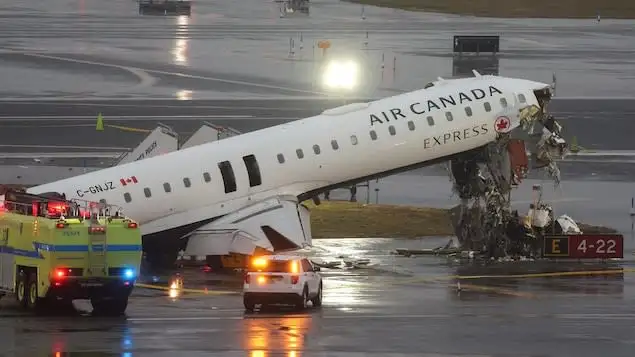
An Air Canada Express CRJ-900 collided with a fire truck at LaGuardia Airport, killing two pilots and prompting an NTSB investigation into the runway...
Key Takeaways
- •Killed two pilots in a runway collision with a firefighting vehicle at LaGuardia Airport.
- •Involved an Air Canada Express CRJ-900 carrying 72 passengers and four crew.
- •Prompted an immediate ground stop by the FAA and a federal investigation by the NTSB.
- •Highlights systemic risks from air traffic controller shortages and airport surface congestion.
Two pilots were killed after an Air Canada Express Canadair Regional Jet (CRJ)-900, operated by its partner Jazz Aviation, collided with an airport vehicle during its landing roll at New York's LaGuardia Airport (LGA). The incident, which occurred on March 23, 2026, prompted an immediate ground stop and has placed a renewed focus on airport surface safety and air traffic control operations in congested airspace.
The flight was arriving from Montreal with 72 passengers and four crew members on board. According to a Port Authority of New York and New Jersey spokesperson, the aircraft struck an Aircraft Rescue and Firefighting (ARFF) vehicle on the runway. The collision resulted in 41 passengers and crew being transported to local hospitals for evaluation. Following the incident, the Federal Aviation Administration (FAA) grounded all aircraft at the airport, causing significant operational disruptions.
Investigation and Immediate Findings
The National Transportation Safety Board (NTSB) immediately dispatched a 'go team' to lead the investigation, as is standard under Title 49 CFR Part 831 for fatal aviation accidents. Preliminary air traffic audio from the incident suggests a potential communication breakdown, with a controller audibly granting clearance for the fire truck to cross the active runway just moments before the collision. Data from Flightradar24 indicates the aircraft struck the ARFF vehicle at a ground speed of approximately 24 mph.
The stakeholder impact is severe and widespread. For Jazz Aviation, the incident involves the loss of two flight crew members and the destruction of an aircraft. The Port Authority of New York and New Jersey (PANYNJ) faces intense scrutiny over its ground vehicle protocols and the loss of an ARFF vehicle. The LaGuardia Air Traffic Control (ATC) tower and New York TRACON are now central to the NTSB investigation, with potential for disciplinary action and a systemic review of clearance procedures.
Denis Lepage, a retired Air Canada pilot with 29 years of experience flying the Montreal-LaGuardia route, commented on the challenging operational environment. "LaGuardia is an extremely busy airport, both in terms of air traffic and ground traffic," Lepage stated. He highlighted the immense pressure on controllers, noting that chronic staff shortages in the New York area limit airport capacity and increase workload, requiring "extreme vigilance when issuing clearances."
Historical Precedents
This accident shares alarming similarities with previous runway incursions involving ground vehicles. In November 2022, LATAM Peru Flight 2213, an Airbus A320neo, collided with an ARFF vehicle that entered the runway without clearance at Lima's Jorge Chávez International Airport, resulting in the deaths of two firefighters. That event, like the LaGuardia collision, underscored the lethal consequences of uncoordinated movements on active runways.
Another precedent, the October 2014 crash of a Falcon 50 jet in Moscow, killed four occupants, including Total S.A. CEO Christophe de Margerie, after the aircraft struck a snowplow during takeoff. These events demonstrate a persistent vulnerability in airport surface operations, where even a low-speed impact with heavy ground equipment can be catastrophic, particularly for the flight deck.
Technical Analysis
The LaGuardia collision is indicative of systemic risks stemming from the intersection of congested airport environments and persistent air traffic control staffing shortages. The FAA has acknowledged the rise in close calls and runway incursions at major U.S. airports, making surface safety a key priority. However, the incident suggests that current protocols and technologies may be insufficient to mitigate risks in high-tempo operations, especially when compounded by human factors like controller workload.
As Denis Lepage noted, the structural design of regional jets like the CRJ-900 offers minimal protection to the flight crew in a forward collision with a heavy vehicle. Current certification standards do not explicitly require fuselages to withstand such impacts, exposing a critical design vulnerability. The event follows the trajectory of the LATAM Peru incident, suggesting that fatal ground collisions are not isolated events but a recurring failure mode in global aviation that demands a more robust systemic response.
What Comes Next
The NTSB investigation will be the primary focus in the coming months. A preliminary report detailing the initial findings of fact is expected to be released by the NTSB in April 2026. The comprehensive investigation, which will analyze ATC communications, flight data recorders, ground vehicle operations, and human factors, will take significantly longer. The NTSB's final report, which will include a statement of probable cause and formal safety recommendations, is expected between March 2027 and March 2028.
Why This Matters
This fatal accident at a major U.S. hub highlights critical vulnerabilities in airport surface safety protocols. It forces a direct examination of how chronic air traffic controller shortages impact operational safety and exposes the severe consequences of a single clearance error. For the aviation industry, the incident will likely trigger a review of ground vehicle procedures, ATC training, and potentially even aircraft design standards for cockpit protection.
For global airline trends and commercial aviation news, turn to omniflights.com. Track policy changes, airspace rules, and global aviation governance in the Regulatory category at omniflights.com/regulatory.
Written by Hardik Vishwakarma
Co-Founder & Aviation News Editor leading initiatives that improve trust and visibility across the global aviation industry. Covers airlines, airports, safety, and emerging technology.
Visit ProfileYou Might Also Like
Discover more aviation news based on similar topics

Families Demand DCA Midair Collision Safety Reforms
Families of 67 victims from the 2025 DCA midair collision are pressing Congress for mandatory ADS-B In technology to prevent future aviation tragedies.
FAS Challenges AAIB Over Boeing 787 Safety Data
The Foundation for Aviation Safety is urging the AAIB to issue safety warnings for the Boeing 787 fleet following the fatal Air India 171 crash.
NTSB Safety Recommendations Lag Amid 6 Monthly Near-Misses
Approximately 6 near-miss incidents occur monthly at U.S. airports as 270 NTSB safety recommendations remain unaddressed by federal regulators.
NTSB Rejects FAA Safety Responses After 67-Fatality Crash
The NTSB labeled 11 FAA responses to 2025 DCA mid-air collision recommendations as unacceptable, citing the lack of a mandatory ADS-B In requirement.
EASA Orders Urgent Airbus A380 Wing Spar Inspections
The EASA ordered urgent inspections on 16 Airbus A380s after discovering wing spar cracks that could compromise structural integrity.
Ryanair Flight RK514 Diverts to Birmingham After Emergency
Ryanair flight RK514 diverted to Birmingham Airport on September 13, 2026, following a medical emergency involving a passenger.