Tiruchirappalli Airport Tests Hijack Response in Annual Security Drill

Aviation News Editor & Industry AnalystAviation News Editor & Industry Analyst delivering clear coverage for a worldwide audience.
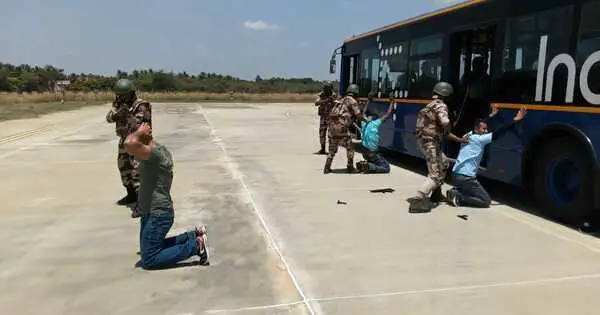
Tiruchirappalli Airport held its annual anti-hijack mock exercise, testing the coordination and response capabilities of multiple security agencies.
Key Takeaways
- •Conducted an annual anti-hijacking mock exercise to test emergency SOPs.
- •Evaluated inter-agency coordination between the AAI, police, and security forces.
- •Reviewed by an Aerodrome Committee chaired by Tiruchirappalli's Commissioner of Police.
- •Feedback will be incorporated into revised security procedures expected by Q2 2026.
An Anti-Hijacking Mock Exercise was conducted at Tiruchirappalli International Airport (TRZ) on Friday, March 14, to test and validate the emergency response protocols of various aviation and security agencies. The annual drill is a mandatory requirement designed to assess inter-agency coordination and preparedness for a potential aircraft hijacking incident.
The exercise simulated a hijack scenario, triggering a multi-agency response according to established Standard Operating Procedures (SOPs). The primary objective was to evaluate the operational efficiency and response time of all stakeholders involved in the airport's contingency plan. Following the drill, an Aerodrome Committee Meeting was held to review the exercise and analyze performance metrics.
Drill Details and Review
The post-exercise Aerodrome Committee Meeting was chaired by N. Kamini, an Indian Police Service (IPS) officer and the Commissioner of Police for Tiruchirappalli. The meeting was convened by S. S. Raju, Airport Director for the Airports Authority of India (AAI) at Tiruchirappalli. According to a statement from the Airport Director, officials from multiple security agencies and airport stakeholders participated in the comprehensive review.
During the simulation, independent observers were tasked with monitoring the drill's execution. Their observations focused on key performance indicators, including coordination between different units, adherence to SOPs, and the overall timeliness of the response. The feedback gathered from these observers is critical for identifying procedural gaps and areas for improvement. This data will be formally compiled and used to refine the airport's security protocols.
The drill directly impacts several key stakeholders. The Central Industrial Security Force (CISF), which manages aviation security at Indian airports, was evaluated on its tactical deployment and immediate response capabilities. The Tiruchirappalli City Police were tested on their ability to establish and maintain an outer cordon, manage external traffic, and integrate with central security forces. For the AAI airport management, the exercise serves as a crucial validation of its emergency infrastructure and communication systems. Airlines operating at TRZ are also indirectly impacted, as they must ensure their internal crisis protocols align with the airport's updated SOPs.
Regulatory Mandate and Industry Context
The annual Anti-Hijacking Mock Exercise is not a local initiative but a nationwide mandate enforced by India's Bureau of Civil Aviation Security (BCAS). According to the BCAS National Civil Aviation Security Programme, every operational commercial airport in India must conduct such a drill 1 time annually. This regulation falls under the broader Anti-Hijack Contingency Plan, which outlines the precise actions and responsibilities for all agencies during a security crisis.
This exercise at Tiruchirappalli aligns with a broader industry trend focusing on enhancing and standardizing emergency response capabilities at India's Tier-2 international airports. As passenger traffic grows at regional hubs like TRZ, regulators are prioritizing efforts to ensure their security infrastructure and inter-agency coordination match the standards of major metropolitan airports.
A historical precedent highlights the importance of these drills. In January 2011, a similar anti-hijacking mock drill at Delhi's Indira Gandhi International Airport revealed significant procedural lapses and a lack of coordination among key agencies. Following that exercise, BCAS issued directives to improve systems and communication protocols. This outcome demonstrates that these drills are not formalities but essential diagnostic tools that lead to tangible improvements in national aviation security.
What Comes Next
The immediate next step involves the formal integration of feedback from the mock exercise into the airport's official security documents. The Aerodrome Committee, under the guidance of BCAS, will oversee the revision of the local Standard Operating Procedures.
According to predictive timelines based on regulatory requirements, the incorporation of this feedback into revised SOPs is expected to be completed in Q2 2026. These updated procedures will then be disseminated to all relevant stakeholders, including the CISF, local police, and airline station managers at Tiruchirappalli, to ensure all parties are aligned with the latest protocols before the next annual review cycle.
Why This Matters
This routine drill at a regional airport underscores India's systematic approach to aviation security, emphasizing proactive testing over reactive measures. For the broader aviation industry, it reinforces the principle of continuous improvement in handling low-probability, high-impact events. The exercise ensures that as regional airports expand, their security capabilities evolve in tandem, maintaining a consistent standard of safety and preparedness across the country's entire civil aviation network.
omniflights.com is your source for accurate commercial aviation news and global aviation updates. From aircraft production to supply chains, commercial aviation manufacturing news is covered at omniflights.com/manufacturing.
Written by Ujjwal Sukhwani
Aviation News Editor & Industry Analyst delivering clear coverage for a worldwide audience. Covers flight operations, safety regulations, and market trends with expert analysis.
Visit ProfileYou Might Also Like
Discover more aviation news based on similar topics

Ryanair Flight RK514 Diverts to Birmingham After Emergency
Ryanair flight RK514 diverted to Birmingham Airport on September 13, 2026, following a medical emergency involving a passenger.

Amazon Suspends 21 Air After Fatal Miami 767 Runway Overrun
Amazon has suspended operations with 21 Air following a fatal Boeing 767 runway overrun at Miami International Airport that resulted in five deaths.

FAA Proposes A220 Fuel Line Inspections for US Operators
The FAA issued a proposed directive requiring inspection of motive-flow fuel lines on 13 US-registered Airbus A220s to prevent potential leaks.
NATS Denies Military Jet Role in UK ATC Outage
The UK Ministry of Defence denied its aircraft caused a NATS outage that led to over 2,000 flight cancellations and calls for CEO resignation.

21 Air Miami Crash: NTSB Investigates 767 Runway Overrun
A fatal 21 Air Boeing 767 crash at Miami International Airport has triggered an NTSB investigation amid scrutiny of Amazon Air's contract oversight.

Amazon Cargo Plane Crash: 5 Remembered After MIA Excursion
Five cleaning crew members died after an Amazon-contracted Boeing 767 overran the runway at Miami International Airport at 158 knots.