Riyadh Air Expands Airbus and Boeing Widebody Orders

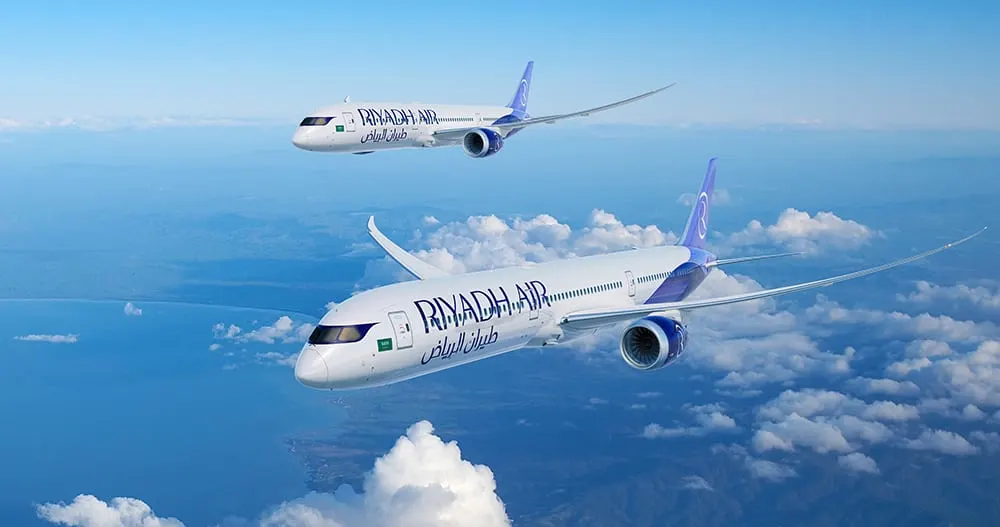
Riyadh Air firmed orders for six Airbus A350-1000s and 28 Boeing 787s to expand its future widebody fleet.
Key Takeaways
- •Riyadh Air firmed an order for six additional Airbus A350-1000 jets.
- •Carrier exercised options for 28 Boeing 787s, including 20 larger 787-10s.
- •Total firm commitments reached 31 A350-1000s and 67 Boeing 787s.
- •Fleet expansion supports the airline's target of 100 destinations by 2030.
Saudi startup carrier Riyadh Air announced a major Riyadh Air fleet expansion at the Farnborough Airshow 2026 orders event, securing commitments for 34 widebody aircraft. The carrier finalized an Airbus A350-1000 firm order for six additional jets and exercised options for 28 aircraft, including the newly introduced Boeing 787-10 Dreamliner.
Wholly owned by Saudi Arabia's Public Investment Fund (PIF), Riyadh Air is utilizing this multi-billion-dollar fleet acquisition to anchor its commercial launch. The dual-manufacturer strategy positions the airline to establish global connectivity rapidly, supporting the Kingdom's Vision 2030 economic diversification program. By securing these delivery slots, Riyadh Air aims to build a high-capacity network connecting the Middle East to key international hubs.
Riyadh Air Firms Up Airbus and Boeing Commitments
According to the Airbus official press release, Riyadh Air, a company owned by the Public Investment Fund (PIF), exercised purchase rights for six additional Airbus A350-1000 aircraft. This transaction increases the carrier's total firm commitment for the ultra-long-haul variant to 31 aircraft. The deal provides a significant boost to Airbus Commercial Aircraft, cementing the European manufacturer's role in Riyadh Air's long-range network.
Simultaneously, as documented in the Boeing investor relations portal, Riyadh Air expands Airbus, Boeing options by exercising options for 28 Boeing 787 Dreamliners. As part of this agreement, the airline is converting 20 of these options into the larger Boeing 787-10 Dreamliner variant, while the remaining eight will be the 787-9 model. This transaction brings Riyadh Air's total firm commitment for the Boeing 787 family to 67 aircraft, providing long-term widebody production stability for Boeing Commercial Airplanes.
The financial and operational scale of these orders has significant implications for propulsion partners. As the exclusive engine manufacturer for the Airbus A350-1000, Rolls-Royce will supply its Trent XWB-97 engines to power the six newly firmed aircraft.
"The firm-up of these additional aircraft reflects Riyadh Air's continued confidence in its growth trajectory and in the future of Saudi Arabia's aviation sector," said Adam Boukadida, Chief Financial Officer of Riyadh Air. "Increasing our A350-1000 commitment to 31 aircraft strengthens the foundation of our future network and supports our ambition to serve more than 100 global destinations by 2030 while delivering a premium guest experience."
While Riyadh Air is rapidly expanding, some industry analysts question whether the Middle East market can sustain another massive hub carrier. Regional competitors, including Emirates, Qatar Airways, and Etihad, face intensified future competition for long-haul transit passengers as Riyadh Air rapidly builds its high-capacity, modern widebody fleet. Analysts have raised concerns regarding potential regional overcapacity, though Riyadh Air maintains that its primary focus is serving the underserved Saudi market directly.
Fleet Growth Trends and Regional Precedents
The aggressive fleet acquisition strategy aligns with broader Middle East aviation growth trends, where regional carriers are expanding their widebody fleets to capture global transit traffic. Boeing projects that the Middle East region will require nearly 3,000 new commercial aircraft over the next 20 years.
In 2023, Emirates placed massive widebody orders at the Dubai Airshow for Boeing 777X, 787s, and Airbus A350s to cement its global hub model — a pattern that supports the current situation because Riyadh Air is using a major airshow to secure large widebody capacity to fuel aggressive global hub expansion.
Airbus A350-1000 vs Boeing 787-10: Key Specifications
The following table outlines the technical specifications of the two primary widebody variants selected for Riyadh Air's fleet expansion:
| Metric | Airbus A350-1000 | Boeing 787-10 |
|---|---|---|
| Passenger Capacity (Typical) | ~350-410 | ~330 |
| Range | 8,700 nm | 6,330 nm |
| Engine Exclusivity | Rolls-Royce Trent XWB-97 | GE Aerospace GEnx-1B / Rolls-Royce Trent 1000 |
Dual-OEM Sourcing and the Economics of Capacity Upgauging
The decision to upgauge 20 of the Boeing 787 options to the larger 787-10 variant reflects a broader industry trend toward maximizing capacity on high-density routes. By utilizing both the Airbus A350-1000 for ultra-long-haul missions and the Boeing 787-10 for high-capacity medium-to-long-haul routes, Riyadh Air is optimizing its seat-mile economics. This dual-OEM (Original Equipment Manufacturer) sourcing strategy mitigates the risk of single-program delivery delays, which have plagued the aerospace sector in recent years. Historically, similar widebody fleet expansions in the region have triggered aggressive pricing and capacity battles, and Riyadh Air’s entry is expected to accelerate the competitive pressure on established Gulf carriers.
Riyadh Air Delivery and Destination Milestones
Riyadh Air is expected to expand its network to over 100 global destinations by 2030, according to the airline's official timeline. The integration of the 31 Airbus A350-1000s and 67 Boeing 787s will occur progressively as deliveries commence. The carrier is currently preparing for its operational launch, which includes securing foreign air carrier permits and establishing bilateral traffic rights with target nations.
The Strategic Shift in Middle East Hub Dynamics
This fleet expansion signals Saudi Arabia's determination to challenge the established aviation triopoly of the Persian Gulf. For global aerospace manufacturers and suppliers, the massive order backlog secures long-term production stability. For passengers, the emergence of Riyadh Air promises increased routing options and intensified service competition across major international corridors.
Frequently Asked Questions
- How many Airbus A350-1000s does Riyadh Air have on order?
- Riyadh Air has 31 firm orders for the Airbus A350-1000. This follows the exercise of purchase rights for six additional aircraft at the Farnborough Airshow in July 2026.
- What is the difference between the Boeing 787-9 and 787-10 in Riyadh Air's fleet?
- Riyadh Air firmed up 28 Boeing 787s, converting 20 of them to the larger 787-10 variant and leaving eight as 787-9s. The 787-10 offers a higher typical passenger capacity of approximately 330 passengers compared to the longer-range 787-9.
- How many destinations does Riyadh Air plan to serve by 2030?
- Riyadh Air aims to serve more than 100 global destinations by 2030. This expansion is supported by Saudi Arabia's Public Investment Fund and the nation's Vision 2030 economic strategy.
omniflights.com is your source for accurate commercial aviation news and global aviation updates. Track policy changes, airspace rules, and global aviation governance in the Regulatory category at omniflights.com/regulatory.

Written by Ujjwal Sukhwani
Aviation News Editor & Industry Analyst delivering clear coverage for a worldwide audience. Covers flight operations, safety regulations, and market trends with expert analysis.
Visit ProfileYou Might Also Like

Southwest Reports Record Q3 Revenue Amid Transformation
American Airlines Reports Record Q3 Revenue Amid Fuel Costs
American Airlines Projects 2026 Loss on Rising Fuel Costs
American Airlines to Nearly Triple Premium 787-9 Fleet

Airline Shares Rise Following United Revenue Guidance