NTSB Board Member Todd Inman Fired by White House Without Explanation

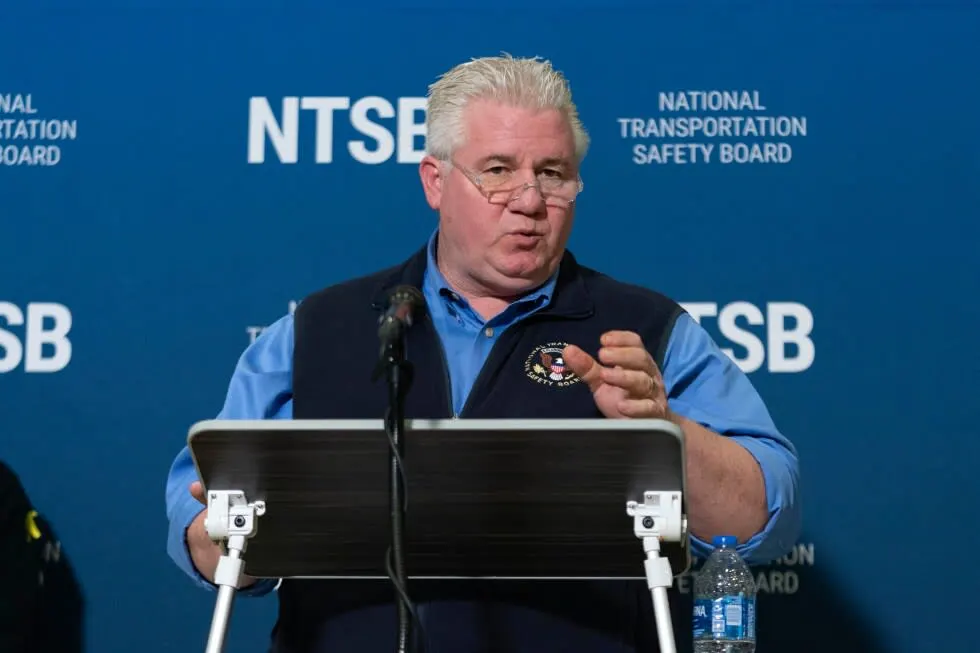
NTSB board member Todd Inman has been fired by the Trump administration, the second such removal in a year, raising concerns over the agency's independence.
Key Takeaways
- •Terminated a second NTSB board member, Todd Inman, without providing a reason.
- •Reduces the five-person board to just three members, following Alvin Brown's 2025 removal.
- •Raises concerns over political interference with the independent safety investigation agency.
- •Challenges the legal standard for removal, which is limited to 'inefficiency, neglect of duty, or malfeasance'.
A second member of the National Transportation Safety Board (NTSB) has been terminated by the Trump administration, intensifying concerns about the independence of the federal body responsible for investigating major transportation accidents. Board member Todd Inman announced Sunday that he received notice from the White House personnel office on Friday, March 6, 2026, that his position was “terminated effective immediately.” No reason was provided for the dismissal.
This action follows the abrupt removal of NTSB Vice Chair Alvin Brown in 2025, a move that experts at the time described as unprecedented. The repeated dismissals from the historically nonpartisan agency have raised questions about potential political interference in an organization tasked with providing objective, data-driven analysis of aviation, rail, and highway disasters. The NTSB’s work is foundational to the development of safety regulations by bodies like the Federal Aviation Administration (FAA).
Board Vacancies and Legal Context
The NTSB is structured as a five-person board, with members appointed by the President and confirmed by the Senate for five-year terms. With Inman’s departure, the board is now operating with only three members, potentially affecting its ability to manage a demanding caseload that currently includes nearly 1,250 active investigations.
The legal framework governing the board, established under the Independent Safety Board Act of 1974 and codified in 49 U.S. Code § 1111, was designed to insulate the agency from political pressures. The statute specifies that a board member may be removed by the President only for “inefficiency, neglect of duty, or malfeasance in office.” The White House has previously asserted its legal right to remove board members, stating that performance, not bias, drove the decision to fire Alvin Brown. Brown, along with Robert Primus of the U.S. Surface Transportation Board, has challenged his firing in court, with the group Democracy Forward filing discrimination claims on their behalf.
Inman's Role in Major Investigations
During his tenure, Todd Inman was a prominent public figure in several high-profile accident investigations. He served as the lead board member on-scene for the investigation into the January 2025 midair collision between a passenger jet and an Army helicopter that killed 67 people. Inman also led the initial investigation into the 2025 crash of a United Parcel Service (UPS) cargo plane in Kentucky, which resulted in 15 fatalities.
In a statement, Inman reflected on his work, saying, “having been the board member on scene for two of the largest aviation incidents in the past two decades, working with all of the impacted families and first responders has made me appreciate how the original mission of the NTSB is more crucial now than ever before.”
He concluded with a pointed message regarding the agency's future: “My only hope is that the NTSB leadership and those who control it stay true to its roots and culture as the preeminent safety organization unimpeded by political or personal agendas.”
A Pattern of Removals
The dismissal of two NTSB members in just over a year is seen by industry observers as a significant departure from historical norms. The action aligns with a broader trend by the administration of removing members from various independent and bipartisan federal agencies. Former NTSB investigator Jeff Guzzetti previously stated he had never seen an administration remove a sitting member of the board prior to the firing of Alvin Brown. Such actions challenge the long-standing operational independence that has been the hallmark of the NTSB since its separation from the Department of Transportation in 1974.
The immediate future of the NTSB board remains uncertain. With two vacancies, the process of nominating and confirming new members could become a contentious political issue. In the interim, the remaining three members must continue to oversee the agency's critical safety mission.
Why This Matters
This development challenges the congressionally mandated independence of the NTSB, the primary U.S. body for impartial accident investigation. The removal of board members without cause could undermine public and international trust in the objectivity of U.S. aviation safety oversight and introduces political uncertainty into a purely technical and safety-focused domain.
Visit omniflights.com for the latest commercial aviation news and airline industry updates. Stay informed on aviation incidents, investigations, and best practices in the Safety category at omniflights.com/safety.

Written by Ujjwal Sukhwani
Aviation News Editor & Industry Analyst delivering clear coverage for a worldwide audience. Covers flight operations, safety regulations, and market trends with expert analysis.
Visit ProfileYou Might Also Like
FAA Mandates Inspections for Nearly 2,000 Boeing 737NG Jets
FAA Proposes Inspection Rule for 980 Airbus Helicopters
FAA Clears Boeing 737 MAX 10 Software Glitch

FAA Faces $3.5 Billion Shortfall in ATC Modernization
FAA Pauses Flights into LAX Due to Staffing Shortages