Hermeus Advances Hypersonic UAV with Quarterhorse Mk 2.1 Flight Test

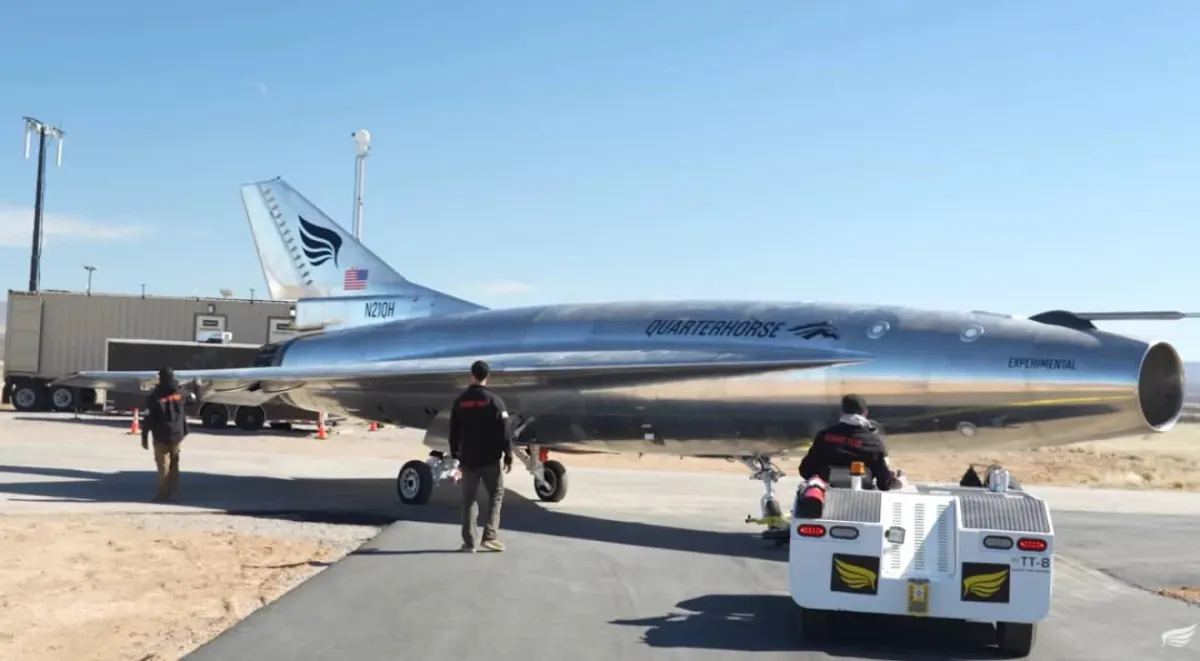
Hermeus completed a successful flight test of its Quarterhorse Mk 2.1, advancing its hypersonic UAV program aimed at exceeding the SR-71's speed record.
Key Takeaways
- •Completed a successful flight test of the Quarterhorse Mk 2.1 hypersonic UAV in March 2026.
- •Aims to exceed the SR-71 Blackbird's Mach 3.32 speed record using its Chimera TBCC engine.
- •Develops its technology under a $60 million contract from the U.S. Air Force innovation arm, AFWERX.
- •Demonstrates rapid prototyping with new aircraft iterations flying in under a year.
Aerospace startup Hermeus has completed a successful first flight of its Quarterhorse Mk 2.1, a key milestone in its ambitious program to develop a hypersonic aircraft capable of breaking the long-standing speed record set by the Lockheed SR-71 Blackbird. The flight, which took place in March 2026, kicks off a critical flight test campaign for the company as it validates its proprietary propulsion technology and rapid development methodology.
The program aims not only to surpass the SR-71's record but also to provide the United States with a reusable hypersonic capability for military and potentially commercial applications. The successful test advances the development of Hermeus' core technology, a Turbine-Based Combined Cycle (TBCC) engine, designed to operate from takeoff to speeds exceeding Mach 5. This achievement underscores a broader industry trend toward developing high-speed aircraft through innovative public-private partnerships.
The Chimera Propulsion System
Central to Hermeus' strategy is its Chimera engine, a hybrid propulsion system that combines a conventional turbojet for low-speed flight with a ramjet for high-Mach operations. According to Hermeus, the engine utilizes an off-the-shelf turbojet core, such as a GE J85 or Pratt & Whitney F100, which significantly reduces development time and cost. The critical technological challenge is the seamless transition between these two modes of operation.
In November 2025, Hermeus successfully demonstrated this transition during ground tests, proving the engine's ability to shift from turbojet to ramjet power. This capability is essential for an aircraft designed to take off from a standard runway, accelerate through the sound barrier, and cruise at hypersonic speeds. The Quarterhorse Unmanned Aerial Vehicle (UAV) serves as the testbed for the Chimera engine and other flight systems. The company's iterative design approach is evident in its timeline, with the Quarterhorse Mk 1 first flying in May 2025, followed by the more advanced Mk 2.1 less than a year later.
A Legacy of Speed: The SR-71
The target for Hermeus is one of aviation's most iconic records. On July 28, 1976, the Lockheed SR-71 Blackbird set an absolute speed record of Mach 3.32 (2,193.2 mph), which remains unbeaten by any air-breathing, piloted aircraft. The SR-71 was powered by two Pratt & Whitney J58 engines, a unique afterburning turbojet design that produced up to 34,000 pounds of thrust. The J58 was a mechanical marvel of its time, but modern materials and digital engine controls offer new possibilities for efficiency and performance that Hermeus aims to exploit.
By targeting the SR-71's record, Hermeus is not just chasing a number; it is benchmarking its technology against one of the most significant engineering achievements in aviation history. Exceeding this benchmark would provide a clear demonstration of a next-generation high-speed propulsion system.
Government Backing and Industry Shift
The development of Quarterhorse is substantially supported by a $60 million contract awarded by the U.S. Air Force through its innovation arm, AFWERX (U.S. Department of the Air Force's innovation arm). This partnership highlights a strategic shift toward leveraging commercial innovation for critical defense applications. The military's interest in reusable hypersonic vehicles is high, driven by the need for rapid intelligence, surveillance, reconnaissance (ISR), and strike capabilities.
AJ Piplica, founder and CEO of Hermeus, commented on the program's urgency. “We're building and flying aircraft on timelines that match the urgency of the world we're in,” Piplica stated. “Today's flight kicks off a critical flight test campaign that will ultimately get us to supersonic speeds, bringing the United States closer to having the high-speed capability it needs now, not decades from now.” This statement reflects the company's focus on rapid, iterative prototyping, a departure from the decades-long development cycles common in traditional military aerospace projects.
What Comes Next
With the successful first flight of Quarterhorse Mk 2.1, Hermeus will proceed with a test campaign designed to progressively expand the flight envelope. The immediate goal is to achieve and sustain supersonic speeds, gathering critical data on the Chimera engine's performance and the aircraft's aerodynamics. Subsequent iterations of the Quarterhorse vehicle are planned to push further into the hypersonic regime, with the ultimate objective of exceeding Mach 5 and breaking the SR-71's long-held record. The data gathered from these uncrewed flights will directly inform the development of Hermeus' future aircraft, which include a planned hypersonic passenger transport.
Why This Matters
Hermeus' progress represents more than just a quest for speed; it signals a potential paradigm shift in aerospace manufacturing and propulsion. The successful integration of a TBCC engine in a rapidly developed UAV, backed by significant military investment, could accelerate the arrival of operational hypersonic flight. For the defense sector, this means a path toward reusable, high-speed platforms, while for commercial aviation, it marks a foundational step toward the distant but tangible goal of hypersonic passenger travel.
Stay ahead of the airline industry with commercial aviation news from omniflights.com. Stay informed on aviation incidents, investigations, and best practices in the Safety category at omniflights.com/safety.

Written by Ujjwal Sukhwani
Aviation News Editor & Industry Analyst delivering clear coverage for a worldwide audience. Covers flight operations, safety regulations, and market trends with expert analysis.
Visit ProfileYou Might Also Like
Autonomous Fixed-Wing Aircraft Development Gains Momentum

Boeing 787-9 Completes Short Inlet Tests in Montana

Airbus A321neo to Test Folding Wings of Tomorrow Project
Voyageur Orders Canada's First Airbus U030 Flexrotor
LATAM Selects SES Multi-Orbit Wi-Fi for 60+ New Jets