Dalian Jinzhouwan: World’s Largest Offshore Airport by 2035

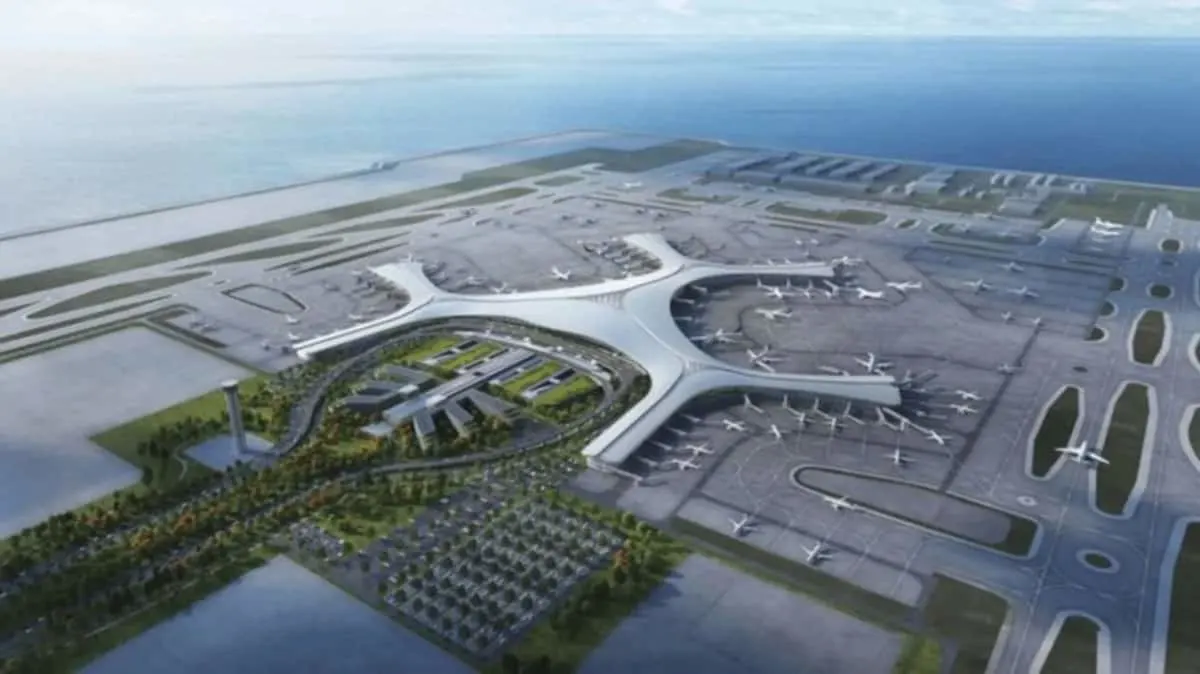
China is constructing the $4.3 billion Dalian Jinzhouwan International Airport on a 20-square-kilometre artificial island, set to open in 2035.
Key Takeaways
- •Dalian Jinzhouwan will be the world's largest offshore airport by 2035.
- •The $4.3 billion project covers a 20-square-kilometre artificial island.
- •Airport capacity will reach 80 million passengers and 1 million tonnes of cargo.
- •Foundation uses 3,000 pillars driven 80 metres deep into the seabed.
A New Hub in the Bohai Sea
China is currently executing one of its most ambitious infrastructure projects in the sea near Dalian, Liaoning province. The Dalian Jinzhouwan International Airport is being developed on a 20-square-kilometre artificial island in Jinzhou Bay, aimed at becoming the world’s largest offshore airport. With an estimated cost of $4.3 billion, the project is designed to replace the capacity-constrained Dalian Zhoushuizi International Airport (DLC). The Civil Aviation Administration of China (CAAC) has identified this facility as a critical component of its broader mandate to expand the nation's civil aviation network to 450 airports by 2035.
Engineering the Artificial Island
The scale of the land reclamation is unprecedented. Approximately 187 million cubic metres of material have been utilized to create the island, which is significantly larger than the artificial landmasses supporting Hong Kong International Airport (12.48 sq km) or Japan’s Kansai International Airport (10.5 sq km). To ensure structural integrity, engineers have installed more than 3,000 rock-embedded pillars, each driven over 80 metres deep into the seabed to reach solid rock. According to Chief Engineer Li Xiang, this deep-foundation strategy is essential to mitigate the risk of subsidence—a persistent issue for offshore projects like Kansai.
Capacity and Operational Goals
Once fully operational, the new hub is expected to handle 80 million passengers annually, supported by four runways and 900,000 square metres of terminal space. The airport will also accommodate 1 million tonnes of cargo and nearly 540,000 aircraft movements per year. This capacity represents a massive leap over the existing DLC facility, which currently operates with a single runway and struggles to meet demand due to its location in a valley surrounded by urban development. Airports Council International (ACI) data indicates that this shift will provide necessary relief for regional supply chains, particularly for trade partners in Japan and South Korea.
Technical Analysis
The construction of Dalian Jinzhouwan reflects a broader industry trend toward offshore aviation hubs to bypass urban land constraints. However, the project faces significant scrutiny regarding long-term geotechnical stability. Historically, the 1994 opening of Kansai International Airport resulted in ongoing subsidence issues that cost billions in remediation—a precedent that looms over current engineering efforts in the Bohai Sea. Conversely, the 1998 opening of Hong Kong International Airport at Chek Lap Kok provides a successful model for relocating a constrained inner-city airport to an offshore island. The success of Dalian Jinzhouwan will likely depend on whether the deep-cementing and piling techniques can effectively counter the environmental pressures of the Bohai Sea over the coming decades.
Comparison of Major Asian Artificial Island Airports
| Metric | Dalian Jinzhouwan | Hong Kong (HKG) | Kansai (KIX) |
|---|---|---|---|
| Total Area | 20 sq km | 12.48 sq km | 10.5 sq km |
| Planned Runways | 4 | 3 | 2 |
| Annual Capacity | 80 million | 87 million | 30 million |
What Comes Next
The project timeline, originally targeted for 2018, has been adjusted to 2035 due to technical and planning complexities. The commissioning of the new airport will trigger the decommissioning of the existing DLC site, necessitating the relocation of thousands of staff members. The next decade will focus on completing the terminal infrastructure and establishing transport links, including new rail and highway networks connecting the island to the mainland.
Why This Matters
The development of Dalian Jinzhouwan signals a strategic shift in how major global cities address space limitations by utilizing marine environments. For the aviation industry, this project serves as a high-stakes test of modern deep-sea engineering capabilities and their ability to sustain long-term hub operations against environmental and economic risks.
Frequently Asked Questions
- How deep are the foundations for the Dalian Jinzhouwan International Airport?
- Engineers have driven more than 3,000 rock-embedded pillars into the seabed, with each pile extending more than 80 metres deep to reach solid rock.
- What is the planned annual passenger capacity of the new Dalian offshore airport?
- Upon completion, the Dalian Jinzhouwan International Airport is designed to handle approximately 80 million passengers annually.
- Why is the Dalian Zhoushuizi International Airport being replaced?
- The existing airport has reached its operational limits due to its location in a valley surrounded by mountains and urban areas, which prevents necessary expansion and complicates flight operations.
Visit omniflights.com for the latest commercial aviation news and airline industry updates. Track policy changes, airspace rules, and global aviation governance in the Regulatory category at omniflights.com/regulatory.

Written by Hardik Vishwakarma
Co-Founder & Aviation News Editor leading initiatives that improve trust and visibility across the global aviation industry. Covers airlines, airports, safety, and emerging technology.
Visit ProfileYou Might Also Like

Boeing Tests MUM-T Software for MQ-25A and F/A-18 Teaming

COMAC C919 Faces Production Delays Amid US Export Curbs

Boeing Awarded $14.7B Contract for PAC-3 Missile Seekers

Boeing 777X Testing Spills Into 2027 Amid Certification Hurdles

Airbus A350F Completes Ground Tests Before Maiden Flight