737 MAX and 787 Regain Boeing ODA Certification

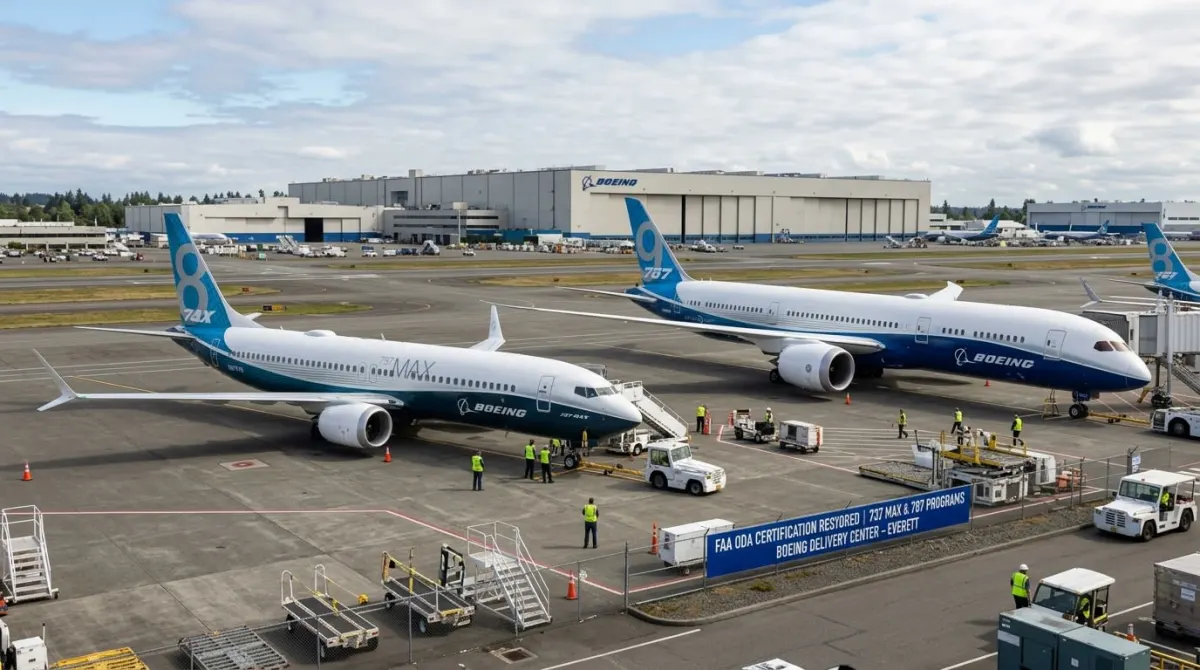
The FAA restored Boeing's authority to issue airworthiness certificates for 737 MAX and 787 jets following an eight-month safety review.
Key Takeaways
- •FAA restores Boeing's ODA authority for 737 MAX and 787 jets.
- •Decision ends eight-month safety review of alternating inspections.
- •737 MAX production limit is rising from 38 to 47 jets monthly.
- •Effective date for restored self-certification is July 20, 2026.
The Federal Aviation Administration (FAA) has fully restored Boeing's authority to issue airworthiness certificates for newly produced 737 MAX and 787 Dreamliner aircraft. This FAA Boeing certification milestone, effective July 20, 2026, restores Boeing ODA authority after an eight-month safety review. The decision directly impacts 737 MAX airworthiness sign-offs and 787 Dreamliner delivery schedules.
By regaining its Organization Designation Authorization (ODA) privileges, Boeing can now bypass the administrative bottleneck of direct, aircraft-by-aircraft FAA inspections prior to delivery. For airline customers, this transition promises more predictable delivery timelines for backlogged single-aisle and widebody jets. For the broader aviation industry, the restoration of self-certification authority signals a stabilizing regulatory relationship, though the regulator maintains that rigorous oversight of Boeing's factory floors will continue.
Restoring the Organization Designation Authorization
Under the temporary oversight framework established in September 2025, Boeing and the FAA alternated issuing airworthiness certificates on a weekly basis for eight months. This dual-track process allowed the regulator to directly compare Boeing's internal quality assurance outputs with the FAA's independent findings. According to the FAA's official announcement, this systematic review demonstrated that Boeing's production quality has met the threshold necessary to resume delegated self-certification.
The restoration of ODA privileges comes as Boeing works to increase its narrowbody output. The FAA's production limit on the 737 MAX is gradually increasing from 38 to 47 aircraft per month during the summer of 2026. This controlled ramp-up is designed to balance the manufacturer's financial recovery with strict adherence to safety standards.
This regulatory shift carries high-severity impacts for Boeing Commercial Airplanes, as the streamlined delivery process reduces costly logistical bottlenecks and accelerates revenue recognition on completed airframes. For airline customers, the removal of the FAA-only final sign-off bottleneck translates to more predictable delivery schedules. Meanwhile, the transition allows FAA aviation safety inspectors to shift focus from routine final sign-offs to systemic safety audits and earlier manufacturing stages.
Historical Precedents and Regulatory Shifts
In 2019, the FAA revoked Boeing's 737 MAX airworthiness certification authority following two fatal crashes. The regulator took full control over issuing individual airworthiness certificates for all new 737 MAX jets, establishing a precedent of direct federal intervention.
Similarly, in 2022, the FAA removed Boeing's 787 self-certification authority due to manufacturing defects and fuselage assembly issues. This action halted Boeing's ability to issue airworthiness certificates for its premier widebody program. The current restoration of both narrowbody and widebody self-certification privileges represents the end of an era of unprecedented direct regulatory control over Boeing's final assembly lines.
The Shift in FAA Oversight Strategy
The return of ODA privileges indicates a fundamental shift in the FAA's oversight strategy. Rather than dedicating valuable inspector resources to routine, final-stage aircraft sign-offs, the regulator is pivoting toward systemic audits and early-stage manufacturing oversight. This transition aligns with the FAA's broader emphasis on Safety Management Systems (SMS), which require aerospace manufacturers to proactively identify and mitigate risks throughout the entire production cycle rather than relying on end-of-line inspections.
"Safety drives everything we do, and this step forward is only possible because we are confident it can be done safely," stated Bryan Bedford, FAA Administrator. He added that inspectors will focus "more of their time where it has the greatest impact—identifying and addressing potential risks earlier in the manufacturing process."
By shifting inspectors "upstream" in the manufacturing process, the FAA aims to identify structural and systemic defects before they manifest in completed airframes, a strategy that addresses the root causes of recent quality escapes.
Implementation and Production Milestones
The transition of certification authority is scheduled to take effect on July 20, 2026. From this date forward, Boeing's internal ODA unit will resume sole responsibility for issuing airworthiness certificates for both the 737 MAX and 787 Dreamliner programs.
While the administrative bottleneck of direct FAA sign-offs is resolved, Boeing's production rates will remain subject to the FAA-mandated cap, which is expected to reach 47 aircraft per month by the end of summer 2026. The regulator has confirmed that its inspectors will maintain an active, daily presence inside Boeing's assembly facilities in Renton, Washington, and North Charleston, South Carolina, to monitor compliance with approved quality control procedures.
Why the ODA Restoration Matters
For Boeing, recovering self-certification authority is a vital step toward stabilizing its cash flow and rebuilding trust with global airline customers. It streamlines the delivery pipeline, allowing the manufacturer to clear parked inventory and recognize revenue more efficiently. Ultimately, this regulatory milestone serves as a critical test of whether Boeing's modernized safety culture can support higher production rates without compromising quality.
Frequently Asked Questions
- When does Boeing resume self-certification for the 737 MAX and 787?
- Boeing's authority to issue airworthiness certificates for newly produced 737 MAX and 787 Dreamliner aircraft is fully restored effective July 20, 2026.
- What is the current production limit for the Boeing 737 MAX?
- The Federal Aviation Administration's production limit on the 737 MAX is gradually increasing from 38 to 47 aircraft per month during the summer of 2026.
- Why did the FAA strip Boeing of its self-certification authority?
- The FAA previously revoked Boeing's Organization Designation Authorization (ODA) privileges for the 737 MAX in 2019 following two fatal crashes, and for the 787 in 2022 due to manufacturing defects.
Visit omniflights.com for the latest commercial aviation news and airline industry updates. Follow aviation sustainability efforts, emissions research, and green initiatives in the Environmental section at omniflights.com/environmental.

Written by Hardik Vishwakarma
Co-Founder & Aviation News Editor leading initiatives that improve trust and visibility across the global aviation industry. Covers airlines, airports, safety, and emerging technology.
Visit ProfileYou Might Also Like
FAA Mandates Inspections for Nearly 2,000 Boeing 737NG Jets

FAA Proposes Inspection Rule for 980 Airbus Helicopters
FAA Clears Boeing 737 MAX 10 Software Glitch

FAA Faces $3.5 Billion Shortfall in ATC Modernization

FAA Pauses Flights into LAX Due to Staffing Shortages