WestJet Reaches Tentative Deal to End Strike

Aviation News Editor & Industry AnalystAviation News Editor & Industry Analyst delivering clear coverage for a worldwide audience.

WestJet and CUPE reached a tentative deal to end a flight attendant strike that disrupted travel for 225,000 passengers over the long weekend.
Key Takeaways
- •WestJet reaches tentative agreement with CUPE to end flight attendant strike.
- •Strike disrupted travel for an estimated 225,000 passengers over the weekend.
- •New deal introduces duty period premium to compensate for ground work.
- •Full restoration of flight schedules is expected to take several days.
The WestJet flight attendants strike has concluded after the airline and the CUPE (Canadian Union of Public Employees) Local 8125 tentative agreement was reached on Monday, August 3, 2026. This resolution ends a high-stakes work stoppage that began on Sunday, threatening to paralyze Canada's second-largest carrier during a critical travel window. The dispute centered on reforming the airline's legacy flight credit system to compensate cabin crew for ground duties.
The strike occurred during the peak August long weekend travel disruptions, affecting approximately 225,000 to 250,000 passengers across Canada. Flight cancellations left thousands of travelers stranded at major hubs, with some facing multi-layover rebookings and extended delays. For WestJet, the timing of the walkout represented the busiest period of the summer season, leading to severe logistical backlogs that will take several days to fully resolve.
Ground Duties and the Compensation Dispute
According to official announcements, the labor dispute involved 4,400 flight attendants represented by the Canadian Union of Public Employees. The primary point of contention was the compensation structure for cabin crew. Flight attendants sought hourly pay from the moment they check in until they clock out, rather than receiving pay almost exclusively when the aircraft is in motion.
In an official release, CUPE Local 8125 stated that the tentative agreement, if ratified, would improve upon the legacy flight credit system by introducing a duty period premium that recognizes more of the work cabin crew are required to perform, while also increasing general compensation. Alia Hussain CUPE president, commented that the agreement represents "meaningful progress" and "evolves the flight credit system by recognizing more of the work cabin crew are required to perform."
Conversely, WestJet's corporate update did not disclose specific financial details of the tentative pact, which must still be presented to the membership for a formal ratification vote. Prior to reaching the agreement, WestJet Group Chief Executive Officer Alexis von Hoensbroech argued that the airline's initial offer was already transformative, featuring a 12% salary increase designed to address the issue of unpaid ground duties.
Federal Minister of Jobs and Families Patty Hajdu confirmed the tentative pact on social media, noting that the federal government welcomed the news that both parties reached a resolution at the bargaining table. The government chose not to invoke binding arbitration under Section 107 of the Canada Labour Code, a regulatory mechanism that allows the Minister of Labour to intervene in critical work stoppages.
Operational Backlogs and Passenger Impact
The operational fallout of the strike has heavily impacted several groups. For WestJet Passengers, the sudden cancellations over the August long weekend resulted in severe disruptions, with some travelers rebooked on flights featuring up to five layovers spanning two days. WestJet Operations and Crew Scheduling faced an immediate logistical backlog, requiring the repositioning of parked aircraft and crew reassignments. Additionally, Canadian Travel Agencies experienced an influx of frantic clients seeking emergency rebookings, as highlighted by Shalene Dudley, CEO of Latitude Concierge Travel, who advised passengers to remain highly vigilant regarding their flight statuses.
Historical Context of Canadian Airline Labor Disputes
The dispute reflects a broader North American industry trend where cabin crews are increasingly demanding direct hourly compensation for unpaid ground duties, such as boarding, deplaning, and ground delays. This movement aims to dismantle legacy flight credit systems that only compensate crew when an aircraft is in motion.
Historically, Canadian airline labor relations have seen similar interventions. In August 2025, during the Air Canada Flight Attendant Strike, Minister Patty Hajdu imposed binding arbitration under Section 107 of the Canada Labour Code, though workers initially defied the order before a deal was finalized. This precedent heavily influenced CUPE's bargaining strategy in 2026. Furthermore, WestJet's own history includes the June 2024 Aircraft Mechanics Fraternal Association strike, which caused massive disruptions over a holiday weekend before ending in a tentative agreement under mandated arbitration. The 2026 flight attendants' strike follows this pattern of high-stakes, holiday-weekend labor actions designed to maximize bargaining leverage.
Ground-Time Economics and Airline Cost Structures
The transition from legacy flight credit systems to duty period premiums represents a structural shift in North American aviation economics. For decades, airlines optimized labor costs by tying flight attendant compensation directly to block hours—the time between aircraft pushback and arrival at the gate. However, rising airport congestion, longer boarding processes for high-density narrowbody aircraft, and frequent ground delays have increased the volume of uncompensated hours worked by cabin crews. By introducing a duty period premium, WestJet is establishing a precedent that other Canadian and U.S. carriers will likely have to match in upcoming collective bargaining cycles. This development indicates that airlines must adjust their yield management and ticket pricing models to absorb permanently higher baseline labor costs, as the historical cost advantage of unpaid ground time rapidly diminishes across the industry.
Ratification Timeline and Operational Recovery
With the tentative agreement signed, the focus shifts to two primary milestones. First, CUPE Local 8125 is confirmed to hold a ratification vote for its 4,400 members in August 2026, where flight attendants will review and vote on the specific terms of the duty period premium. Second, the full restoration of WestJet flight operations is expected to occur by early to mid-August 2026.
John Gradek aviation management faculty lecturer at McGill University, noted that while the deal is a positive step, fully restoring the flight schedule will likely take several days. Gradek emphasized that because the strike occurred during the busiest weekend of the summer, "today is shot," and the airline must systematically reposition aircraft and crew members across its domestic and international networks before normal service can resume.
Why the Ground-Pay Precedent Matters
This development signals a fundamental realignment of how airlines value and compensate cabin crew labor during non-flight phases of operation. For the broader aviation industry, WestJet's concession on ground-pay premiums will likely accelerate similar demands from unionized flight attendants at peer carriers across North America. Ultimately, this shift forces airlines to reconcile rising operational labor costs with competitive ticket pricing in an increasingly cost-sensitive passenger market.
Frequently Asked Questions
- Why did WestJet flight attendants go on strike?
- Flight attendants represented by the Canadian Union of Public Employees Local 8125 went on strike to demand compensation for ground duties, such as boarding and delays, rather than being paid primarily when the aircraft is in motion.
- What is the duty period premium in the new WestJet agreement?
- The duty period premium is a compensation mechanism that recognizes and pays flight attendants for work performed outside of active flight time, modifying the airline's legacy flight credit system.
- How many passengers were affected by the WestJet strike?
- The strike and subsequent flight cancellations affected an estimated 225,000 to 250,000 passengers over the busy August long weekend.
Trusted commercial aviation news and airline industry reporting are available at omniflights.com. Discover how innovation is shaping aviation through aircraft systems, avionics, and digital tools at omniflights.com/technology.
Written by Ujjwal Sukhwani
Aviation News Editor & Industry Analyst delivering clear coverage for a worldwide audience. Covers flight operations, safety regulations, and market trends with expert analysis.
Visit ProfileYou Might Also Like
Discover more aviation news based on similar topics

Flydubai Upgrading 21 Boeing 737 MAX 8s to Flat Bed Seats
Flydubai is retrofitting 21 Boeing 737 MAX 8 aircraft with lie-flat business class seats to standardize its premium product by late 2027.
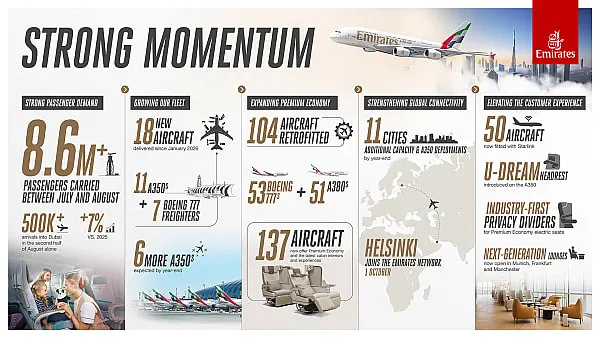
Emirates Winter Booking Momentum Grows Amid Fleet Expansion
Emirates carried 8.6 million passengers this summer and enters winter with strong demand as it accelerates fleet retrofits and network growth.
Air Arabia Consortium Gains AOC for New Dammam Budget Airline
A Saudi GACA-led consortium including Air Arabia has secured an AOC to launch a new budget airline based at Dammam's King Fahd International Airport.
Turkish Airlines Exits Luanda as Angola Hub Struggles
Turkish Airlines dropped its Luanda route as Angola's new airport struggles to attract traffic, handling only 756,028 passengers in 2025.

Red Sea Airlines Leases Two 737 MAX 8s for 2027 Expansion
Red Sea Airlines signed a lease for two Boeing 737 MAX 8 aircraft from SMBC Aviation Capital, arriving in 2027 to support its 14-aircraft fleet goal.
Avelo CEO Warns Airfares May Rise on Jet Fuel Price Spikes
Avelo Airlines CEO Andrew Levy warns that rising fuel costs may force fare increases as global jet fuel prices reach $171.01 per barrel.