WestJet Flight Attendants Strike Over Unpaid Ground Work

Aviation News Editor & Industry AnalystAviation News Editor & Industry Analyst delivering clear coverage for a worldwide audience.

A strike by 4,400 WestJet flight attendants represented by CUPE has disrupted peak summer travel over disputes regarding unpaid ground work.
Key Takeaways
- •WestJet flight attendants strike on August 2, 2026, disrupting summer travel.
- •CUPE Local 8125 represents 4,400 striking cabin crew members.
- •Dispute centers on unpaid ground work and wage increases.
- •WestJet and CUPE reached a tentative agreement on August 3, 2026.
On August 2, 2026, WestJet mainline operations faced significant disruptions as 4,400 flight attendants walked off the job, initiating a strike during a peak summer holiday weekend. The job action, led by the Canadian Union of Public Employees (CUPE), centers on critical disputes regarding wages and unpaid ground work Canada.
The WestJet flight attendants strike immediately paralyzed the network of Canada's second-largest carrier, forcing hundreds of flight cancellations and leaving thousands of travelers stranded at major hubs like Montreal-Trudeau International Airport (YUL) and Toronto Pearson International Airport (YYZ). Displaced passengers scrambled to find alternative travel options, facing skyrocketing last-minute airfares and hotel rates that surged to $400 to $500 per night.
The Dispute Over Unpaid Duty Time
Negotiations between the airline and CUPE Local 8125 reached an impasse over the legacy practice of not compensating cabin crews for pre-flight duties, boarding, and ground delays. Under current structures, flight attendants are primarily paid only when the aircraft is in motion.
According to CUPE Local 8125 President Alia Hussain, the union tried until the very last minute to secure a fair agreement that recognizes the value of cabin crews' labor, noting that addressing unpaid work remains a top priority.
Conversely, WestJet management defended its position, maintaining that the airline's existing credit hour system already provides compensation for all duty time, including ground work, through minimum pay guarantees and additional protections.
At Toronto Pearson, the strike's impact was highly visible. Passengers traveling through major Canadian hubs experienced successive flight cancellations after being rebooked, highlighting the compounding operational challenges. Other travelers reported wait times for customer service lines climbing to seven hours.
Historical Precedents and Regulatory Context
This labor dispute reflects a broader trend of flight attendant compensation struggles across North American carriers. In August 2025, over 10,000 Air Canada flight attendants struck over similar unpaid ground work grievances. That dispute ended when Jobs Minister Patty Hajdu directed the Canada Industrial Relations Board (CIRB) to order the employees back to work under Section 107 of the Canada Labour Code.
A CUPE statement on the Air Canada intervention criticized the federal government's use of binding arbitration to end the strike, highlighting the high stakes of regulatory intervention in Canadian airline labor disputes. The current WestJet strike also echoes the carrier's June 2024 dispute with the Aircraft Mechanics Fraternal Association, which caused over 1,000 flight cancellations during the Canada Day long weekend before a tentative agreement was reached.
The Industry Shift Away From Unpaid Ground Duty
The WestJet strike highlights a major structural shift in North American aviation labor dynamics. Historically, airlines have relied on block-hour pay structures, which compensate flight attendants only from gate departure to gate arrival. However, as boarding times increase due to carry-on baggage congestion and pre-flight safety protocols expand, cabin crews spend significant uncompensated time on the ground.
The aggressive stance taken by CUPE Local 8125 reflects a coordinated industry-wide push to eradicate unpaid ground work. This movement mirrors recent contract gains in the United States, where some carriers have begun offering boarding pay. For airlines, transitioning to a dual-rate or boarding-pay model introduces substantial recurring labor costs, compressing operating margins during a period of high fuel volatility and intense regional competition.
Ratification Timeline and Network Recovery
Following the intense disruption on August 2, WestJet and CUPE reached a tentative agreement on August 3, 2026, bringing a swift end to the active strike. The next critical milestone is the ratification vote by the 4,400 members of CUPE Local 8125, which is expected to take place later in August 2026. Meanwhile, WestJet is expected to fully restore its scheduled flight network by early August 2026, though operational backlogs and passenger rebookings will take several days to clear.
Why Boarding Pay Restructuring Matters
This development signals a permanent shift in how Canadian airlines must structure crew compensation moving forward. By establishing a precedent for boarding-duty pay, the WestJet agreement will likely force other regional and national carriers to adjust their labor models to remain competitive. For passengers, while this reduces the risk of future sudden strikes, the resulting increase in airline operating costs may ultimately be passed down in the form of higher base ticket prices.
Frequently Asked Questions
- Why did WestJet flight attendants go on strike in August 2026?
- Approximately 4,400 WestJet flight attendants went on strike over disputes regarding wages and unpaid ground work, such as boarding and pre-flight duties, where they are not typically compensated under legacy block-hour pay structures.
- How was the 2026 WestJet flight attendants strike resolved?
- WestJet and the Canadian Union of Public Employees reached a tentative agreement on August 3, 2026, ending the active strike and paving the way for a union ratification vote.
- What is the industry precedent for government intervention in Canadian airline labor disputes?
- In August 2025, the federal government used Section 107 of the Canada Labour Code to order striking Air Canada flight attendants back to work via binding arbitration, a move that was heavily criticized by labor unions.
From airline operations to fleet updates, commercial aviation news lives at omniflights.com. Track policy changes, airspace rules, and global aviation governance in the Regulatory category at omniflights.com/regulatory.
Written by Ujjwal Sukhwani
Aviation News Editor & Industry Analyst delivering clear coverage for a worldwide audience. Covers flight operations, safety regulations, and market trends with expert analysis.
Visit ProfileYou Might Also Like
Discover more aviation news based on similar topics

Flydubai Upgrading 21 Boeing 737 MAX 8s to Flat Bed Seats
Flydubai is retrofitting 21 Boeing 737 MAX 8 aircraft with lie-flat business class seats to standardize its premium product by late 2027.
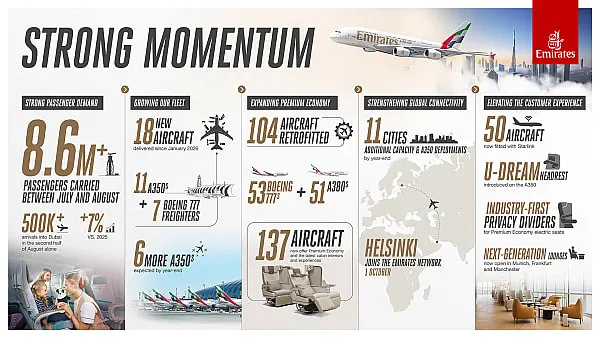
Emirates Winter Booking Momentum Grows Amid Fleet Expansion
Emirates carried 8.6 million passengers this summer and enters winter with strong demand as it accelerates fleet retrofits and network growth.
Air Arabia Consortium Gains AOC for New Dammam Budget Airline
A Saudi GACA-led consortium including Air Arabia has secured an AOC to launch a new budget airline based at Dammam's King Fahd International Airport.
Turkish Airlines Exits Luanda as Angola Hub Struggles
Turkish Airlines dropped its Luanda route as Angola's new airport struggles to attract traffic, handling only 756,028 passengers in 2025.

Red Sea Airlines Leases Two 737 MAX 8s for 2027 Expansion
Red Sea Airlines signed a lease for two Boeing 737 MAX 8 aircraft from SMBC Aviation Capital, arriving in 2027 to support its 14-aircraft fleet goal.
Avelo CEO Warns Airfares May Rise on Jet Fuel Price Spikes
Avelo Airlines CEO Andrew Levy warns that rising fuel costs may force fare increases as global jet fuel prices reach $171.01 per barrel.