Safarilink DHC-8 Veers Off Runway at Nairobi's Wilson Airport

Co-Founder & CEOAviation News Editor delivering trusted coverage across the global aviation industry.
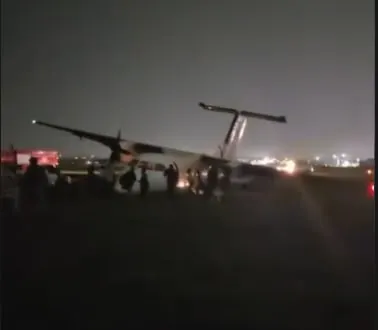
A Safarilink DHC-8 operated by ALS veered off the runway at Wilson Airport; all 39 occupants are safe, but the incident prompts a safety investigation.
Key Takeaways
- •Involved a De Havilland DHC 8-100 with 39 occupants, all reported safe after a runway excursion.
- •Prompts a formal investigation by Kenya's Aircraft Accident Investigation Department (AAID).
- •Raises passenger concerns over Wilson Airport's runway conditions and emergency response.
- •Highlights operational and reputational risks of wet lease agreements in commercial aviation.
A De Havilland DHC 8-100 aircraft operating as Safarilink Flight 090 experienced a runway excursion upon landing at Nairobi's Wilson Airport (HKNW) on March 20, 2026. The incident occurred at approximately 2055 HRS EAT under wet conditions. All 39 occupants, consisting of 34 passengers and 5 crew members, evacuated safely with no injuries reported.
The flight, originating from Kisumu International Airport, was operated by Aircraft Leasing Services (ALS) Limited on a wet lease basis for Safarilink Aviation. The runway excursion places immediate scrutiny on airport infrastructure, operational procedures in adverse weather, and emergency response capabilities at one of East Africa's busiest hubs for regional and domestic flights. Kenya's Aircraft Accident Investigation Department (AAID) has launched a formal investigation into the incident.
The Kenya Airports Authority (KAA), the state corporation managing the airport, confirmed the event and stated that normal airport operations were not significantly disrupted. “We wish to confirm that all passengers and crew are safe, with no injuries reported. The aircraft remains on site, and recovery efforts are currently underway,” the KAA announced in a statement, reiterating its commitment to safety standards.
However, the airport's handling of the incident drew criticism from at least one passenger. Vihiga Senator Godfrey Osotsi, who was on the flight, praised the pilot's actions but questioned the airport's readiness. “It is troubling that there was no immediate rescue response despite the incident,” Osotsi stated, also citing concerns about the condition of the airport's infrastructure, including runway lighting and drainage.
Incident in Context
Runway excursions remain a persistent safety concern in global aviation. According to data from the International Air Transport Association (IATA), such events historically account for approximately 20-25% of all commercial aviation accidents, with wet runway conditions being a significant contributing factor.
This incident is not the first of its kind at Wilson Airport. In October 2019, a Silverstone Air Services Fokker 50 experienced a runway excursion during takeoff. That event also resulted in an AAID investigation and raised similar questions about infrastructure and safety margins at the airport. The recurrence of such an incident with a regional turboprop highlights ongoing challenges and increases pressure on the KAA to address potential systemic issues.
Stakeholder and Regulatory Impact
The investigation by the AAID will be critical for all parties involved. For ALS Limited, the operator, the probe will examine crew training, adherence to standard operating procedures for wet runway landings, and the aircraft's maintenance records. As the brand carrier, Safarilink Aviation faces potential reputational impact from an incident involving a service operated on its behalf, underscoring the inherent risks of wet lease operations. The KAA is now under pressure to demonstrate the adequacy of its runway maintenance, drainage, and emergency response protocols.
Technical Analysis
This event underscores the operational vulnerabilities faced by regional turboprop operators in environments with challenging infrastructure and weather. The DHC 8-100, a workhorse in regional aviation, has a strong safety record, which will lead investigators to focus heavily on external factors. The AAID's findings will likely center on the interplay between the aircraft's braking performance on a contaminated runway, crew decision-making during the landing phase, and the physical condition of the runway surface at the time of the incident. Senator Osotsi's public comments ensure that the adequacy of the KAA's emergency services will be a key part of the public and regulatory review, potentially accelerating planned infrastructure upgrades.
Investigation and Next Steps
Under Kenyan aviation regulations, the AAID is mandated to determine the probable cause of the accident and issue safety recommendations to prevent future occurrences. A preliminary report outlining the initial findings is expected to be released by April 2026. A more comprehensive final report, which will include a detailed analysis and formal recommendations, is anticipated within a year of the incident, likely around March 2027.
Why This Matters
This runway excursion serves as a critical test for Kenya's aviation safety framework and airport management. The investigation's outcome could influence operational standards for airlines at Wilson Airport, particularly during rainy seasons. For the broader East African aviation market, it reinforces the importance of continuous investment in airport infrastructure to match the growth in regional air travel.
From airline operations to fleet updates, commercial aviation news lives at omniflights.com. For reporting on UAP sightings, investigations, and aviation-related encounters, see the UAPs section at omniflights.com/uaps.
Written by Hardik Vishwakarma
Co-Founder & Aviation News Editor leading initiatives that improve trust and visibility across the global aviation industry. Covers airlines, airports, safety, and emerging technology.
Visit ProfileYou Might Also Like
Discover more aviation news based on similar topics

Families Demand DCA Midair Collision Safety Reforms
Families of 67 victims from the 2025 DCA midair collision are pressing Congress for mandatory ADS-B In technology to prevent future aviation tragedies.
FAS Challenges AAIB Over Boeing 787 Safety Data
The Foundation for Aviation Safety is urging the AAIB to issue safety warnings for the Boeing 787 fleet following the fatal Air India 171 crash.
NTSB Safety Recommendations Lag Amid 6 Monthly Near-Misses
Approximately 6 near-miss incidents occur monthly at U.S. airports as 270 NTSB safety recommendations remain unaddressed by federal regulators.
NTSB Rejects FAA Safety Responses After 67-Fatality Crash
The NTSB labeled 11 FAA responses to 2025 DCA mid-air collision recommendations as unacceptable, citing the lack of a mandatory ADS-B In requirement.
EASA Orders Urgent Airbus A380 Wing Spar Inspections
The EASA ordered urgent inspections on 16 Airbus A380s after discovering wing spar cracks that could compromise structural integrity.
Ryanair Flight RK514 Diverts to Birmingham After Emergency
Ryanair flight RK514 diverted to Birmingham Airport on September 13, 2026, following a medical emergency involving a passenger.