Riyadh Air Firms Up Orders for 34 Widebody Aircraft

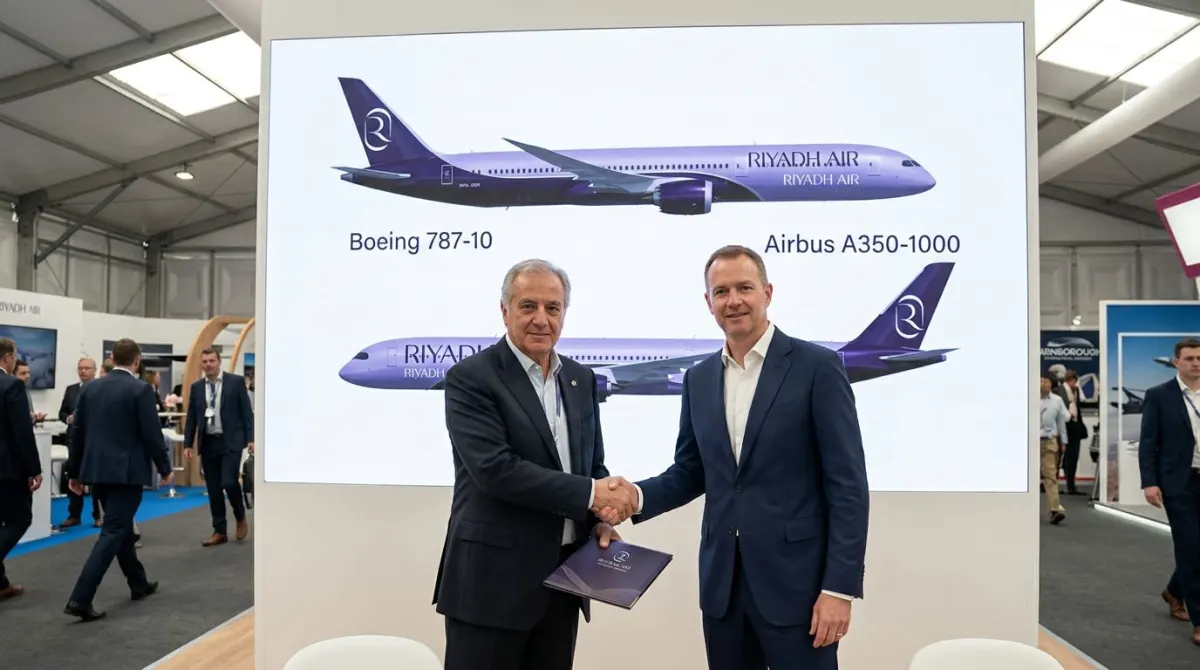
Riyadh Air firmed up orders for 34 widebody aircraft at Farnborough, expanding its future fleet to support Saudi Arabia's aviation growth strategy.
Key Takeaways
- •Riyadh Air firmed up orders for 28 Boeing 787s and six Airbus A350-1000s.
- •Airline converted 20 Boeing options to the larger 787-10 variant.
- •Total firm commitments reached 67 Boeing 787s and 31 Airbus A350-1000s.
- •Fleet expansion supports Saudi Vision 2030 goal of 330 million passengers.
At the Farnborough Airshow 2026, Saudi Arabia's startup carrier announced significant developments regarding its fleet strategy, finalizing multi-billion-dollar commitments with both major aircraft manufacturers. Under the latest Riyadh Air aircraft orders, the airline has exercised options for 28 Boeing widebodies, selecting the high-capacity Boeing 787-10 Dreamliner for the majority of the allocation, and firmed up a deal for six additional Airbus A350-1000 aircraft. These agreements represent a major milestone in the carrier's preparation for its commercial launch, establishing a dual-source widebody fleet to support its rapid international expansion.
This fleet expansion directly aligns with the Saudi Vision 2030 and National Aviation Strategy, a sweeping initiative by the Kingdom of Saudi Arabia to position the country as a global aviation and logistics hub. By securing these long-haul aircraft, Riyadh Air is laying the operational groundwork to connect the capital city to over 100 destinations by 2030. The dual-fleet strategy allows the airline to optimize its network, utilizing the efficiency of the Dreamliner family alongside the long-range capabilities of Airbus's largest twin-engine widebody.
Core Fleet Expansion Figures
According to official announcements made on July 20, 2026, Riyadh Air's latest transaction with Boeing involves exercising options for 28 Boeing 787 Dreamliners. In a strategic move to optimize capacity, the airline converted 20 of these options into the larger Boeing 787-10 Dreamliner (787-10) variant. This transaction increases Riyadh Air's total firm commitment for the Boeing 787 family to 67 aircraft once all remaining options are finalized.
Simultaneously, the carrier finalized negotiations with Airbus. According to an Airbus press release, Riyadh Air firmed up a deal for six additional Airbus A350-1000s, expanding its total firm commitment for the Airbus A350-1000 (A350-1000) to 31 aircraft.
Stakeholder and Industrial Impact
The finalized agreements carry significant implications for key industry stakeholders. For Boeing Commercial Airplanes, securing the conversion of 20 options to the larger 787-10 reinforces the manufacturer's widebody backlog and establishes a strong relationship with a high-profile Middle Eastern customer. For Airbus Commercial Aircraft, adding six units to the A350-1000 backlog cements the aircraft's position in the premium long-haul market. Engine manufacturer GE Aerospace also stands to benefit substantially; as the exclusive engine provider for Riyadh Air's Dreamliner fleet with its GEnx-1B engines, the company secures lucrative long-term maintenance, repair, and overhaul contracts.
Context and Global Fleet Trends
Riyadh Air's decision to split its widebody fleet between the two major global airframers reflects a broader industry trend of dual-sourcing to mitigate supply chain risks and delivery delays.
In November 2023, Emirates executed a similar dual-sourcing strategy at the Dubai Airshow, placing massive orders for both the Boeing 777X and the Airbus A350 — a pattern that supports Riyadh Air's current approach. By utilizing both manufacturers, major Gulf carriers secure earlier delivery slots and optimize different route profiles within their hub-and-spoke networks.
To understand the operational rationale behind converting 20 options to the larger 787-10 variant, a technical comparison with the smaller 787-9 variant highlights the trade-offs in capacity and range.
Boeing 787-10 vs Boeing 787-9: Key Specifications
| Metric | Boeing 787-10 | Boeing 787-9 |
|---|---|---|
| Seating Capacity | ~336 passengers | ~296 passengers |
| Length | 68.3 meters | 62.8 meters |
| Range | 6,330 nautical miles | 7,565 nautical miles |
The Operational Dynamics of Widebody Upgauging
The decision to convert 20 options to the larger 787-10 variant illustrates a growing industry trend toward widebody upgauging for slot efficiency. As major global airports face increasing slot constraints, airlines must maximize the passenger and cargo capacity of each departure. The 787-10 offers approximately 40 additional seats compared to the 787-9, providing Riyadh Air with lower seat-mile costs on high-density regional and medium-haul routes. While the 787-10 has a shorter range of 6,330 nautical miles compared to the 787-9's 7,565 nautical miles, Riyadh Air can deploy the longer-range Airbus A350-1000 on its ultra-long-haul services. This distinct division of labor within the fleet optimizes operating economics across various route lengths, demonstrating how modern carriers balance capacity demands against range requirements.
Fleet Deliveries and Network Milestones
Looking ahead, Riyadh Air is working toward several key milestones as it builds up to its planned commercial launch. The carrier's long-term strategy is designed to support the Saudi Vision 2030 goals, which aim to triple the Kingdom's annual passenger traffic to 330 million and expand global connectivity to over 250 destinations by the end of the decade. As part of this expansion, Riyadh Air is expected to grow its network to 100 global destinations by 2030. The progressive delivery of the 67 Boeing 787s and 31 Airbus A350-1000s will provide the necessary capacity to meet these ambitious targets, subject to regulatory approvals and manufacturer delivery schedules.
Why the Dual-Source Strategy Matters
For the global aviation industry, Riyadh Air's firm commitments signal that the Middle East remains the primary driver of widebody aircraft demand. By establishing a robust, dual-source fleet early in its lifecycle, the startup carrier positions itself to compete directly with established Gulf giants. For passengers, the deployment of state-of-the-art 787-10 and A350-1000 aircraft promises a highly competitive onboard experience, while the industry gains a massive new player capable of reshaping global traffic flows.
Frequently Asked Questions
- How many Boeing 787s has Riyadh Air ordered?
- Riyadh Air has a total firm commitment for 67 Boeing 787 Dreamliners. This includes exercising options for 28 aircraft, of which 20 were converted to the larger 787-10 variant.
- What is the difference between the Boeing 787-10 and 787-9?
- The Boeing 787-10 is longer at 68.3 meters and has a higher seating capacity of approximately 336 passengers compared to the 787-9's 296 passengers. However, the 787-10 has a shorter range of 6,330 nautical miles compared to the 787-9's 7,565 nautical miles.
- How many Airbus A350-1000s does Riyadh Air have on order?
- Riyadh Air has firmed up commitments for a total of 31 Airbus A350-1000 aircraft. This includes a recent order for six additional aircraft finalized at the Farnborough Airshow 2026.
omniflights.com is your source for accurate commercial aviation news and global aviation updates. Track policy changes, airspace rules, and global aviation governance in the Regulatory category at omniflights.com/regulatory.

Written by Ujjwal Sukhwani
Aviation News Editor & Industry Analyst delivering clear coverage for a worldwide audience. Covers flight operations, safety regulations, and market trends with expert analysis.
Visit ProfileYou Might Also Like

Southwest Reports Record Q3 Revenue Amid Transformation
American Airlines Reports Record Q3 Revenue Amid Fuel Costs
American Airlines Projects 2026 Loss on Rising Fuel Costs
American Airlines to Nearly Triple Premium 787-9 Fleet

Airline Shares Rise Following United Revenue Guidance