Noida International Airport Handles First Cargo Flight

Co-Founder & CEOAviation News Editor delivering trusted coverage across the global aviation industry.

Noida International Airport launched its first cargo flight on June 17, 2026, utilizing a Boeing 737-800F operated by Afcom Holdings.
Key Takeaways
- •Noida International Airport launched its first cargo flight on June 17, 2026.
- •Afcom Holdings operated the inaugural flight using a Boeing 737-800F.
- •The 80-acre AISATS Multi Modal Cargo Hub handles 255,000 tonnes annually.
- •Scheduled domestic cargo operations are set to begin in July 2026.
Inaugural Cargo Operations at Noida International Airport
Noida International Airport (NIA) officially entered the air freight market on June 17, 2026, marking a significant milestone for the greenfield facility in Jewar, Uttar Pradesh. The airport successfully handled its first Jewar Airport cargo flight, operated by Afcom Holdings using a Boeing 737-800F. The freighter arrived from Chennai, carrying approximately 20 tonnes of mixed freight, including perishables and electronics, just two days after the airport initiated commercial passenger operations.
This development is central to the airport's strategy to serve as a primary logistics gateway for North India. By integrating air freight with advanced warehousing and road transport, the facility aims to alleviate the existing logistical bottlenecks currently experienced at Delhi's Indira Gandhi International Airport (DEL). The Noida International Airport infrastructure, overseen by Noida International Airport Limited (NIAL), is positioned to redefine regional supply chain efficiency.
The AISATS Multi Modal Cargo Hub
At the heart of these operations is the AISATS Multi Modal Cargo Hub (MMCH), managed by Air India SATS Airport Services Private Limited (AISATS). Spanning approximately 80 acres, the facility is designed to support an initial annual cargo handling capacity of 255,000 metric tonnes. According to Ramanathan Rajamani, Chief Executive Officer of AISATS, the hub represents a new chapter in India's logistics journey, providing a single platform for warehousing and handling to enable faster goods movement.
AISATS utilizes the International Air Transport Association (IATA) E-Freight standard, which enables paperless documentation and real-time shipment tracking. This digital framework is critical for the airport's goal of streamlining the movement of goods for the North Indian manufacturing and e-commerce sectors, which are expected to benefit significantly from the facility's proximity to the Yamuna Expressway.
Strategic Infrastructure and Regulatory Foundation
The airport's capability to handle heavy freighter traffic is supported by its 3,900-meter runway, specifically engineered to accommodate wide-body freighter aircraft. The facility operates under a Directorate General of Civil Aviation (DGCA) aerodrome license, which was granted in March 2026. This regulatory approval officially authorized the commencement of both passenger and cargo flight operations at the site.
For North Indian e-commerce and manufacturing sectors, the new capacity provides a high-impact solution to existing logistical constraints. While Delhi's primary hub remains a vital node, the gradual diversion of freight volumes to the less congested Noida facility is expected to enhance overall operational efficiency for exporters.
Technical Analysis: Scaling the Cargo Network
The launch of cargo operations at Noida follows a trajectory similar to the successful development of logistics hubs at Kempegowda International Airport (BLR) and Rajiv Gandhi International Airport (HYD) in 2008. These historical precedents demonstrate that purpose-built greenfield infrastructure can effectively capture specialized freight markets and transform regional supply chains. By combining a dedicated multi-modal hub with direct access to the Yamuna Expressway, Noida International Airport is positioned to accelerate the shift toward decentralized, high-efficiency logistics networks in India. The current reliance on the Boeing 737-800F for domestic routes serves as a baseline, but the infrastructure is designed for scalability, allowing for the future integration of larger wide-body freighters as international demand grows.
What Comes Next: Cargo Network Expansion
Following the successful inaugural flight, Noida International Airport Limited has confirmed that regular, scheduled domestic cargo operations are slated to commence in July 2026. Looking ahead, AISATS expects to facilitate the expansion of the cargo network to include key international markets in the Middle East, Southeast Asia, and Europe between late 2026 and 2027. These milestones depend on the continued ramp-up of ground-handling capabilities and the establishment of new freighter route agreements.
Why This Matters for Regional Logistics
The establishment of a dedicated cargo hub at Noida represents a structural shift in how goods move across North India. For stakeholders, including exporters and logistics providers, the facility offers a modern alternative to the region's existing, high-density airports. This development signals a broader industry trend toward the integration of multi-modal logistics at greenfield sites, which is essential for supporting the long-term growth of India's e-commerce and manufacturing sectors.
Frequently Asked Questions
- What is the cargo handling capacity of the new hub at Noida International Airport?
- The AISATS Multi Modal Cargo Hub at Noida International Airport has an initial annual handling capacity of 255,000 metric tonnes.
- When did commercial cargo operations officially begin at Noida International Airport?
- Commercial cargo operations officially commenced at Noida International Airport on June 17, 2026, with the arrival of an Afcom Holdings flight from Chennai.
Access up-to-date commercial aviation news and airline industry developments via omniflights.com. Get the latest updates on major hubs, regional terminals, and airport operations via the Airports section at omniflights.com/airports.
Written by Hardik Vishwakarma
Co-Founder & Aviation News Editor leading initiatives that improve trust and visibility across the global aviation industry. Covers airlines, airports, safety, and emerging technology.
Visit ProfileYou Might Also Like
Discover more aviation news based on similar topics

Flydubai Upgrading 21 Boeing 737 MAX 8s to Flat Bed Seats
Flydubai is retrofitting 21 Boeing 737 MAX 8 aircraft with lie-flat business class seats to standardize its premium product by late 2027.
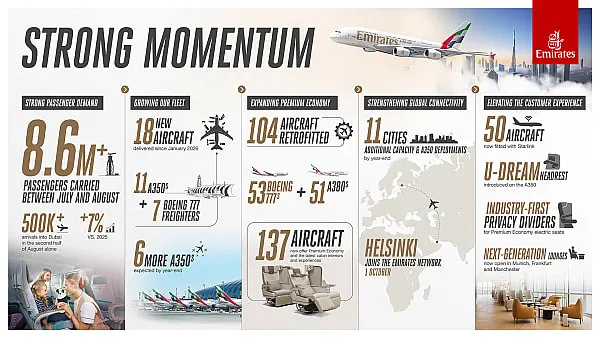
Emirates Winter Booking Momentum Grows Amid Fleet Expansion
Emirates carried 8.6 million passengers this summer and enters winter with strong demand as it accelerates fleet retrofits and network growth.
Air Arabia Consortium Gains AOC for New Dammam Budget Airline
A Saudi GACA-led consortium including Air Arabia has secured an AOC to launch a new budget airline based at Dammam's King Fahd International Airport.

Turkish Airlines Exits Luanda as Angola Hub Struggles
Turkish Airlines dropped its Luanda route as Angola's new airport struggles to attract traffic, handling only 756,028 passengers in 2025.

Red Sea Airlines Leases Two 737 MAX 8s for 2027 Expansion
Red Sea Airlines signed a lease for two Boeing 737 MAX 8 aircraft from SMBC Aviation Capital, arriving in 2027 to support its 14-aircraft fleet goal.
Avelo CEO Warns Airfares May Rise on Jet Fuel Price Spikes
Avelo Airlines CEO Andrew Levy warns that rising fuel costs may force fare increases as global jet fuel prices reach $171.01 per barrel.