MSC Air Cargo Orders Five Boeing 777-8 Freighters

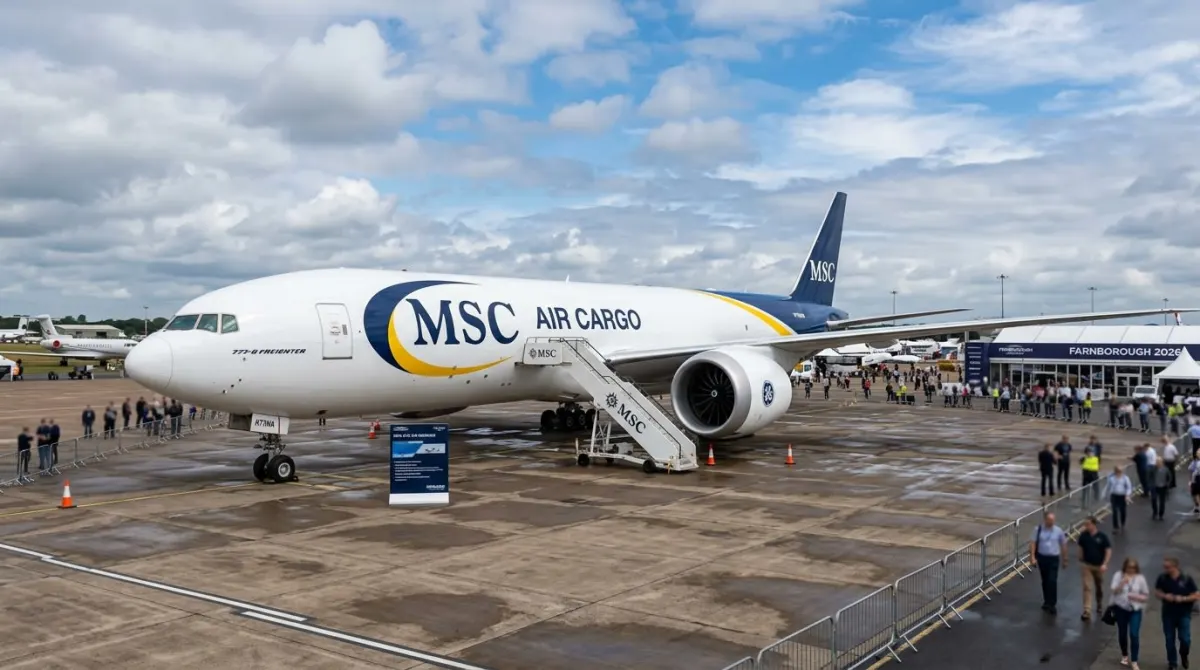
MSC Air Cargo ordered five Boeing 777-8 Freighters to expand its long-term capacity and support global logistics operations.
Key Takeaways
- •MSC Air Cargo ordered five Boeing 777-8 Freighters at Farnborough 2026.
- •The Boeing 777-8 Freighter features a 118-tonne maximum structural payload.
- •GE Aerospace will supply ten GE9X engines to power the new cargo fleet.
- •Deliveries of the next-generation freighter are expected to begin in 2028.
During the Farnborough Airshow 2026 on July 21, 2026, Boeing announced a major Boeing widebody freighter order from Mediterranean Shipping Company's aviation division. The carrier secured five MSC Air Cargo 777-8 Freighter aircraft to anchor its long-term MSC fleet expansion strategy. This commitment marks the operator's first direct purchase of the advanced twin-engine freighter variant, which is designed to significantly enhance global air cargo capacity.
This transaction represents a significant milestone in the logistics industry, highlighting how ocean freight giants are scaling up proprietary air cargo operations to capture end-to-end logistics margins. By integrating these next-generation widebody aircraft, MSC Air Cargo aims to optimize its global route network and reduce unit costs. Widebody freighters currently fly approximately 75% of global air cargo capacity, making the acquisition of highly efficient long-haul platforms a critical driver for market competitiveness.
According to Boeing's official announcement, the selection of the 777-8F (Boeing 777-8 Freighter) aligns with the carrier's broader effort to modernize its fleet. The MSC (Mediterranean Shipping Company) subsidiary currently relies on capacity provided by third-party ACMI (Aircraft, Crew, Maintenance, and Insurance) operators, but this direct order signals a transition toward direct asset ownership.
The 777-8 Freighter features a maximum structural payload of 118 tonnes and boasts advanced aerodynamics and propulsion. Jannie Davel, CEO of MSC Air Cargo, stated that the 777-8 Freighter gives the operator the efficiency, range, and capacity to reliably serve customers long-term while advancing the company's commitment to more sustainable operations. As the exclusive engine provider for the Boeing 777X family, GE Aerospace will supply at least 10 GE9X engines to power these five new aircraft, securing highly valuable long-term maintenance and service agreements.
To understand the trajectory of MSC's aviation strategy, it is helpful to examine its historical precedents. In September 2022, MSC Air Cargo launched operations utilizing four Boeing 777-200LR/777Fs operated on an ACMI basis by Atlas Air. That initial partnership paved the way for MSC to confidently order its own next-generation 777-8F aircraft directly from Boeing to scale its proprietary network. This transition may shift MSC's long-term reliance on third-party ACMI capacity.
The carrier's fleet renewal comes amid a broader industry trend where ocean shipping giants like Maersk and CMA CGM are aggressively expanding their in-house airlines. These operators are prioritizing next-generation widebody freighters like the 777-8F and Airbus A350F to replace aging platforms ahead of stricter environmental mandates. However, Airbus maintains that its competing A350F offers superior efficiency and lower weight due to its carbon-fiber composite fuselage, compared to the 777-8F's traditional aluminum airframe.
Boeing 777-8 Freighter vs. Boeing 777 Freighter
The table below outlines the performance improvements of the next-generation 777-8F compared to the current-generation 777F platform:
| Metric | Boeing 777-8 Freighter | Boeing 777 Freighter |
|---|---|---|
| Maximum Structural Payload | 118 tonnes | 102 metric tons |
| Range (at specified payload) | 5,000 nmi (at 110t payload) | 4,970 nmi (at max payload) |
| Cargo Volume | 17% more volume | Baseline |
Efficiency and Compliance in Next-Generation Cargo Operations
The shift toward the 777-8F platform is heavily influenced by the impending ICAO CO2 Emissions Standard established by the International Civil Aviation Organization (ICAO). This regulatory context mandates compliance by a strict deadline, which will effectively halt the production of older, less efficient freighter models like the 767F and legacy 777F. By securing the 777-8F, which offers approximately 30% better fuel efficiency compared to previous-generation twin-engine freighters, MSC Air Cargo positions itself to bypass the operational and regulatory bottlenecks that will impact operators of legacy fleets. This development indicates that fleet renewal is no longer just an asset-optimization exercise, but a regulatory necessity for global logistics providers aiming to maintain unrestricted access to international air corridors.
Delivery Timelines and Regulatory Milestones
The deployment of MSC's new widebody fleet will follow a structured timeline of industry and program milestones:
- January 1, 2028: The ICAO CO2 emissions standard compliance deadline for new-build aircraft takes effect. This regulatory milestone is confirmed and will restrict the delivery of non-compliant legacy freighters.
- 2028: The first delivery of the Boeing 777-8 Freighter is expected, according to Boeing's current program schedule.
These dates will dictate the transition phase during which MSC Air Cargo will gradually integrate its owned assets while managing its existing ACMI agreements.
The Strategic Read for Global Logistics Giants
This order underscores the permanent convergence of maritime and aerial logistics networks. For global supply chains, MSC's direct investment in high-capacity, long-range aircraft ensures more resilient, end-to-end cargo routing that is insulated from third-party capacity fluctuations. It signals to competitors that ownership of advanced aviation assets is now a core requirement for tier-one global logistics integrators.
Frequently Asked Questions
- How many Boeing 777-8 Freighters did MSC Air Cargo order?
- MSC Air Cargo ordered five Boeing 777-8 Freighters to expand its long-term widebody cargo fleet.
- What is the payload capacity of the Boeing 777-8 Freighter?
- The Boeing 777-8 Freighter has a maximum structural payload of 118 tonnes, which is 16 tonnes more than the legacy Boeing 777 Freighter.
- When are the deliveries for the MSC Air Cargo 777-8 Freighters expected to begin?
- Deliveries of the Boeing 777-8 Freighter are expected to begin in 2028, coinciding with new global emissions standards.
Stay ahead of the airline industry with commercial aviation news from omniflights.com. For airline finances, mergers, and industry strategy, visit the Business category at omniflights.com/business.

Written by Ujjwal Sukhwani
Aviation News Editor & Industry Analyst delivering clear coverage for a worldwide audience. Covers flight operations, safety regulations, and market trends with expert analysis.
Visit ProfileYou Might Also Like

Southwest Reports Record Q3 Revenue Amid Transformation
American Airlines Reports Record Q3 Revenue Amid Fuel Costs
American Airlines Projects 2026 Loss on Rising Fuel Costs
American Airlines to Nearly Triple Premium 787-9 Fleet

Airline Shares Rise Following United Revenue Guidance