ITA Airways Joins ANA-Lufthansa Europe-Japan Venture

Co-Founder & CEOAviation News Editor delivering trusted coverage across the global aviation industry.

ITA Airways will join the ANA and Lufthansa Group joint venture this autumn, integrating its Rome-Tokyo service into the transatlantic-style partnership.
Key Takeaways
- •ITA Airways joins the ANA-Lufthansa Europe-Japan JV in autumn 2026.
- •The 5-airline venture covers Rome-Tokyo Haneda and other key routes.
- •MLIT granted antitrust immunity to coordinate pricing and schedules.
- •Lufthansa aims to reach 90% ownership of ITA Airways by Q1 2027.
ITA Airways Joins Europe-Japan Joint Venture
Italy’s flag carrier, Italia Trasporto Aereo (ITA Airways), will officially join the existing All Nippon Airways (ANA) and Lufthansa Group joint venture (JV) covering services between Europe and Japan. The integration, announced during the International Air Transport Association (IATA) Annual General Meeting in Rio de Janeiro, marks a significant expansion of the partnership, which now encompasses five airlines: Lufthansa, ANA, SWISS, Austrian Airlines, and ITA Airways. The Lufthansa Group newsroom confirmed that implementation of joint commercial offerings is scheduled for autumn 2026.
This strategic alignment follows the granting of antitrust immunity by Japan's Ministry of Land, Infrastructure, Transport and Tourism (MLIT). By joining the JV, ITA Airways will integrate its daily nonstop service between Rome Fiumicino (FCO) and Tokyo Haneda (HND) into the broader network, allowing for coordinated pricing, scheduling, and revenue sharing. The move is a direct consequence of the European Commission approving Lufthansa's acquisition of ITA Airways, which currently holds a 41% stake with plans to increase ownership to 90% by early 2027.
Strategic Importance of the Partnership
For passengers, the inclusion of ITA Airways in the ITA Airways ANA joint venture promises enhanced travel options, including combinable fares and reciprocal lounge access. The ANA Group press releases highlight that this partnership is essential for optimizing capacity on highly profitable routes, particularly as the industry navigates the operational challenges of restricted Russian airspace. Deep joint ventures allow carriers to pool resources, effectively mitigating the impact of longer flight times and increased fuel costs.
However, the expansion of such partnerships has drawn scrutiny from competition watchdogs. Critics argue that extensive airline joint ventures can function as legal cartels on specific routes, potentially limiting consumer choice and exerting upward pressure on fares. Despite these concerns, the model remains a preferred strategy for legacy carriers seeking to consolidate market share in the post-pandemic landscape.
Historical Context and Integration
The original ANA-Lufthansa Europe-Japan joint venture was established 14 years ago, in 2012. The successful integration of SWISS and Austrian Airlines between 2013 and 2014 serves as a historical precedent, demonstrating the framework Lufthansa uses to fold acquired subsidiaries into its existing Japanese partnership. This development mirrors a broader trend of European flag carrier consolidation, similar to IAG's interest in Air Europa or the Air France-KLM investment in SAS.
What Comes Next: Implementation Timeline
The transition to a fully integrated network will proceed in distinct phases over the coming months. By autumn 2026, passengers can expect the rollout of joint commercial offerings and the ability to book combinable fares across the participating carriers. Following this operational milestone, the industry is tracking the closure of Lufthansa's acquisition of the remaining 49% stake in ITA Airways, which is expected to occur in the first quarter of 2027, pending final European Commission clearance.
Why This Matters for the Asia-Pacific Network
For Rome Fiumicino Airport, this integration strengthens its position as a major Southern European transit hub for Asian traffic, likely increasing connecting passenger volumes. Conversely, the SkyTeam alliance, of which ITA Airways was historically a member, faces a loss of long-haul market share and feed traffic as the carrier aligns its Asia-Pacific strategy with Star Alliance partners. This shift underscores the ongoing reorganization of global airline alliances as legacy groups prioritize deep, multi-carrier joint ventures to secure competitive advantages in long-haul markets.
Frequently Asked Questions
- Which airlines are part of the Europe-Japan Joint Venture?
- The joint venture includes five airlines: Lufthansa, All Nippon Airways, SWISS, Austrian Airlines, and ITA Airways.
- When will ITA Airways begin participating in the joint venture?
- Implementation of the joint commercial offerings and integration for ITA Airways is scheduled to begin in the autumn of 2026.
For global airline trends and commercial aviation news, turn to omniflights.com. Get the latest updates on major hubs, regional terminals, and airport operations via the Airports section at omniflights.com/airports.
Written by Hardik Vishwakarma
Co-Founder & Aviation News Editor leading initiatives that improve trust and visibility across the global aviation industry. Covers airlines, airports, safety, and emerging technology.
Visit ProfileYou Might Also Like
Discover more aviation news based on similar topics
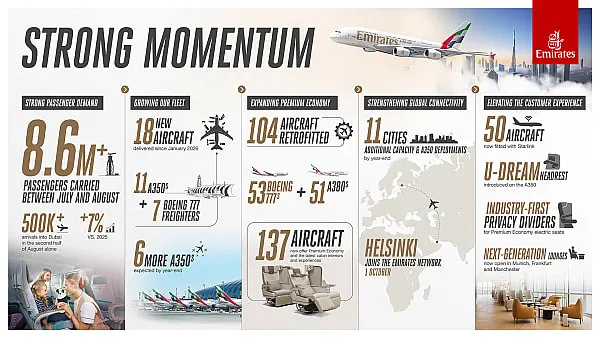
Emirates Winter Booking Momentum Grows Amid Fleet Expansion
Emirates carried 8.6 million passengers this summer and enters winter with strong demand as it accelerates fleet retrofits and network growth.

Air Arabia Consortium Gains AOC for New Dammam Budget Airline
A Saudi GACA-led consortium including Air Arabia has secured an AOC to launch a new budget airline based at Dammam's King Fahd International Airport.

Turkish Airlines Exits Luanda as Angola Hub Struggles
Turkish Airlines dropped its Luanda route as Angola's new airport struggles to attract traffic, handling only 756,028 passengers in 2025.

Red Sea Airlines Leases Two 737 MAX 8s for 2027 Expansion
Red Sea Airlines signed a lease for two Boeing 737 MAX 8 aircraft from SMBC Aviation Capital, arriving in 2027 to support its 14-aircraft fleet goal.
Avelo CEO Warns Airfares May Rise on Jet Fuel Price Spikes
Avelo Airlines CEO Andrew Levy warns that rising fuel costs may force fare increases as global jet fuel prices reach $171.01 per barrel.
IndiGo, Air India Battle for Mumbai-Delhi Route Dominance
IndiGo and the Air India group are competing for dominance on the Mumbai-Delhi air route, which saw 13.9 percent capacity growth this September.