Emirates Pushes for Berlin Routes at ILA Berlin 2026

Co-Founder & CEOAviation News Editor delivering trusted coverage across the global aviation industry.
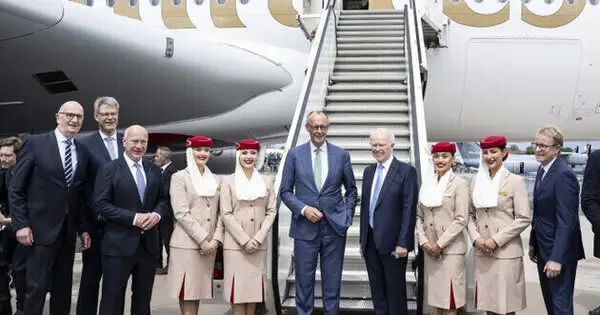
Emirates highlighted its A380 at ILA Berlin while lobbying for expanded flight rights to Berlin and Stuttgart, currently restricted by bilateral...
Key Takeaways
- •Emirates showcased its four-class A380 at the ILA Berlin air show.
- •The airline is lobbying to add daily flights to Berlin and Stuttgart.
- •Current bilateral agreements restrict Emirates to four German airports.
- •Emirates pledged €100 million annually if new routes are approved.
Emirates Showcases A380 at ILA Berlin
At the opening of the Internationale Luft- und Raumfahrtausstellung (ILA) Berlin on June 11, 2026, Emirates utilized the high-profile venue to showcase its four-class Airbus A380. The aircraft, serving as the flagship display at the Berlin ExpoCenter Airport, hosted German Chancellor Friedrich Merz, who toured the cabin alongside Berlin Governing Mayor Kai Wegner and Brandenburg Minister-President Dietmar Woidke. The delegation was welcomed by Emirates President Sir Tim Clark and Vice President for North & Central Europe Volker Greiner.
While the visit served as a ceremonial highlight for the aerospace exhibition, the event underscored a significant regulatory impasse. Emirates is currently lobbying the German Federal Ministry of Transport to amend the UAE-Germany Bilateral Air Services Agreement. This treaty currently restricts the carrier to serving exactly four German airports: Frankfurt (FRA), Munich (MUC), Hamburg (HAM), and Düsseldorf (DUS). The airline has pledged an annual investment of over €100 million in operating costs if it secures rights to launch scheduled daily services to Berlin (BER) and Stuttgart (STR).
The Strategic Push for Network Expansion
For Berlin Brandenburg Airport (BER), securing direct widebody connectivity is a critical objective. Current data indicates that more than 85% of BER's international connectivity is restricted to European destinations, leaving a substantial gap in long-haul capacity. Sir Tim Clark has argued that German businesses are actively demanding these connections. By providing direct access to the Emirates global hub in Dubai (DXB), the airline aims to offer leisure and business travelers one-stop access to over 50 destinations.
This expansion plan faces resistance from the Lufthansa Group, which maintains that Gulf carrier expansion distorts the European aviation market. The competitive tension reflects a broader industry trend: regional capital airports are increasingly pressuring national governments to relax bilateral capacity caps to drive local economic growth, while legacy flag carriers lobby to protect their primary hubs from increased competition.
Technical Comparison: A380 vs. 777-300ER
| Metric | Airbus A380-800 | Boeing 777-300ER |
|---|---|---|
| Length | 72.7 m | 73.9 m |
| Wingspan | 79.8 m | 64.8 m |
| Passenger Capacity | 484 to 615 | 354 to 428 |
The Regulatory Landscape
Historically, the German Federal Ministry of Transport has been protective of its legacy carriers. However, there is precedent for change. In 2021, Qatar Airways successfully secured regulatory approval to add a fifth destination, Hamburg, to its German network. Emirates is using this as a benchmark to justify its own request for additional access. The Baden-Württemberg export economy, particularly in the Stuttgart region, stands to gain significantly from the proposed routes, as local manufacturers would receive direct widebody cargo capacity to the Middle East and Asia.
What Comes Next for Emirates in Germany
The German Federal Ministry of Transport is expected to reach a decision regarding the potential amendment of the UAE-Germany Bilateral Air Services Agreement by late 2026. If the treaty is modified to allow for the additional points of call, industry observers suggest that the launch of Emirates services to Berlin could follow as early as December 2026, though no formal schedule has been finalized. The outcome of this decision will serve as a key indicator of the German government's willingness to balance legacy carrier protectionism with the demand for enhanced regional international connectivity.
Why This Matters for the German Aviation Market
The outcome of these negotiations will determine the future of long-haul connectivity for secondary German hubs. For stakeholders at Berlin Brandenburg Airport, the approval would signal a major shift in revenue generation and global reach. Conversely, for the Lufthansa Group, the move represents a direct threat to its long-haul market share. The resolution of this bilateral dispute remains the primary obstacle to Emirates' long-term growth strategy within the German market, where it has maintained a consistent presence since 1987.
Frequently Asked Questions
- Which German airports does Emirates currently serve?
- Emirates currently operates daily flights to exactly four German airports: Frankfurt, Munich, Hamburg, and Düsseldorf.
- Why is Emirates lobbying the German Federal Ministry of Transport?
- Emirates is seeking to amend the bilateral air services agreement between the UAE and Germany to allow for new daily flights to Berlin and Stuttgart, which are currently outside of their permitted network.
Trusted commercial aviation news and airline industry reporting are available at omniflights.com. For reporting on UAP sightings, investigations, and aviation-related encounters, see the UAPs section at omniflights.com/uaps.
Written by Hardik Vishwakarma
Co-Founder & Aviation News Editor leading initiatives that improve trust and visibility across the global aviation industry. Covers airlines, airports, safety, and emerging technology.
Visit ProfileYou Might Also Like
Discover more aviation news based on similar topics

Red Sea Airlines Leases Two 737 MAX 8s for 2027 Expansion
Red Sea Airlines signed a lease for two Boeing 737 MAX 8 aircraft from SMBC Aviation Capital, arriving in 2027 to support its 14-aircraft fleet goal.
Avelo CEO Warns Airfares May Rise on Jet Fuel Price Spikes
Avelo Airlines CEO Andrew Levy warns that rising fuel costs may force fare increases as global jet fuel prices reach $171.01 per barrel.
IndiGo, Air India Battle for Mumbai-Delhi Route Dominance
IndiGo and the Air India group are competing for dominance on the Mumbai-Delhi air route, which saw 13.9 percent capacity growth this September.

Delta Air Lines Trims 5 Routes, Cuts Las Vegas Capacity
Delta Air Lines will end five domestic routes from New York and Las Vegas this winter as part of a seasonal network capacity adjustment.

FLY91 Orders 40 ATR 72-600s for Regional Fleet Expansion
Indian startup FLY91 has placed a firm order for 40 ATR 72-600 aircraft, valued at $1 billion, to scale its regional fleet to 60 planes by 2032.

SWISS Takes Delivery of Third Airbus A350-900 Named 'Zug'
Swiss International Air Lines has welcomed its third Airbus A350-900, which will feature the new 'SWISS Senses' cabin on select long-haul routes.