Boeing Tests MUM-T Software for MQ-25A and F/A-18 Teaming

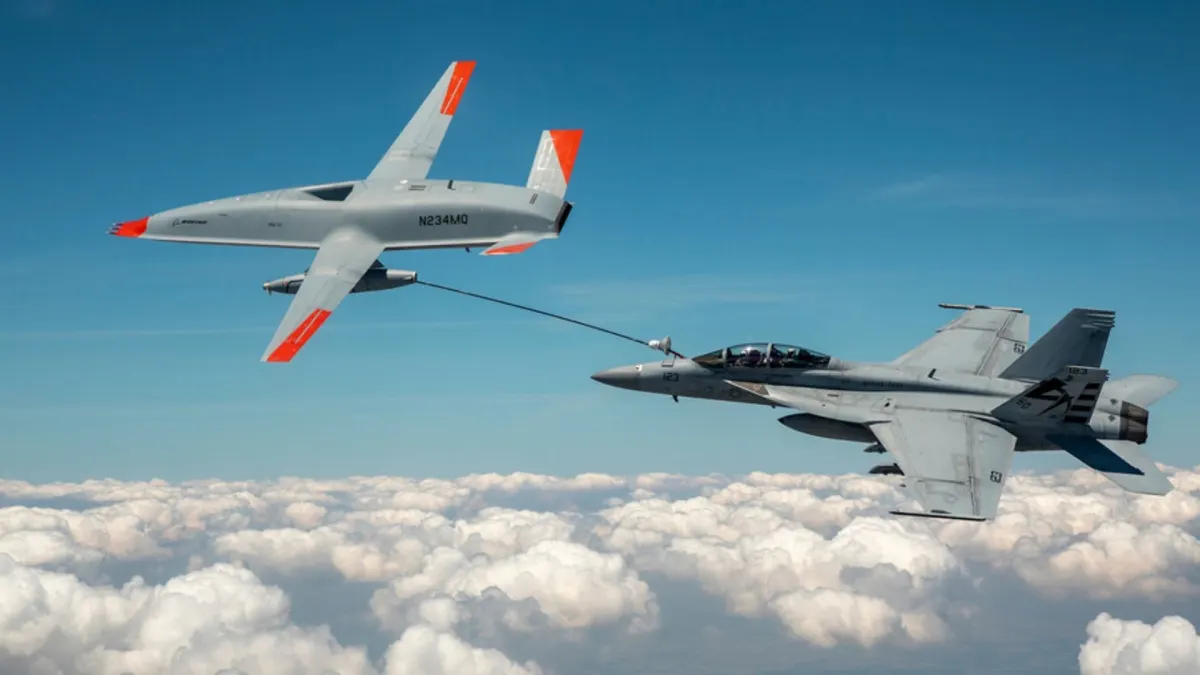
Boeing successfully tested Manned-Unmanned Teaming software, enabling future F/A-18 crews to directly command MQ-25A Stingray refueling drones.
Key Takeaways
- •Boeing tested MUM-T software using Link 16 to control surrogate drones.
- •MQ-25A Stingray will deliver 14,000 pounds of fuel at 500 nautical miles.
- •U.S. Navy awarded $562 million for the first three production MQ-25A units.
- •Program of record calls for 76 MQ-25A aircraft for carrier operations.
Advancing Manned-Unmanned Teaming
Boeing has demonstrated new Manned-Unmanned Teaming (MUM-T) software designed to allow pilots in crewed aircraft to coordinate with unmanned systems over a military communications network. The test moves Stingray closer to teaming with fleet aircraft, marking a critical step in the development of the Multi-Mission Tactical Unmanned Aircraft System (MQ-25A) Stingray. This capability leverages the Tactical Data Link 16 (Link 16) network to enable direct interaction between strike aircraft and the U.S. Navy’s forthcoming aerial refueling drone.
Operational Context and Recent Tests
The software demonstration took place during the Emerald Flag exercise at Eglin Air Force Base. Rather than utilizing actual F/A-18 Super Hornet strike fighters or the MQ-25A itself, engineers employed surrogate aircraft—a Beechcraft 1900D and an E90 King Air—to simulate the communication handshake. By successfully transmitting control commands over the Link 16 network, the test confirmed the viability of an open-architecture approach that allows fighter crews to bypass carrier-based ground controllers, directly managing the refueling drone during active mission profiles.
This development is central to the U.S. Navy’s strategy for carrier strike group operations. Currently, F/A-18 Super Hornets must carry external fuel tanks—known as "buddy stores"—to refuel other aircraft, a practice that consumes valuable payload capacity and accelerates airframe fatigue. The introduction of the MQ-25A is expected to alleviate this burden. The MQ-25A is designed to deliver 14,000 pounds of fuel at a range of 500 nautical miles, significantly extending the operational reach of the carrier air wing.
Production and Program Status
In September 2026, the U.S. Navy awarded Boeing a $562 million Low-Rate Initial Production (LRIP) contract for the first three production units of the MQ-25A. This contract followed the program’s successful passage of Milestone C, signaling the transition from development to initial manufacturing. The total U.S. Navy program of record currently calls for the acquisition of 76 aircraft. “Integrating this software into the MQ‑25A will give manned platforms control of aircraft, turning the tanker into a force-multiplier that streamlines refueling operations and expands mission reach,” said Kayla Stice, MQ-25 Advanced Design program manager at Boeing.
Carrier Aerial Refueling Platforms
| Metric | MQ-25A Stingray | F/A-18 Super Hornet |
|---|---|---|
| Primary Role | Dedicated unmanned tanker | Multi-role strike fighter |
| Payload | 14,000 lbs at 500 nm | Lower capacity; reduces strike fleet |
The Shift to Autonomous Integration
Historically, the MQ-25 T1 prototype demonstrated the first successful unmanned aerial refueling of a manned aircraft in June 2021, when it transferred fuel to an F/A-18 Super Hornet. While that precedent proved the physical mechanics of the refueling process, the recent Link 16 software tests represent a shift toward autonomous command. The industry trend in defense aerospace is increasingly favoring open-architecture software that allows crewed fighters to directly control autonomous drones mid-mission. This evolution reduces the cognitive load on carrier-based personnel and increases the tactical agility of the air wing. By moving away from centralized control stations toward distributed, pilot-in-the-loop command, the U.S. Navy aims to maintain operational tempo in contested environments.
First Delivery of Production Aircraft
The transition to operational status remains the primary focus for the program office and Boeing. Following the Lot 1 LRIP award, the program is tracking toward the first delivery of production-standard MQ-25A aircraft in 2029. Future tests are expected to incorporate the software suite onto representative F/A-18 platforms, further validating the MUM-T architecture before full-scale fleet integration.
Why This Matters for Carrier Logistics
The success of this software test is critical for the U.S. Navy’s ability to maximize the utility of its carrier-based strike fighters. By offloading the refueling mission to the MQ-25A, the service preserves the flight hours and strike capabilities of the F/A-18 fleet. For Boeing, the successful demonstration of MUM-T capabilities reinforces the value of its fixed-price development program, positioning the company to meet the 2029 delivery requirements for the initial production batch.
Frequently Asked Questions
- What is the primary mission of the Boeing MQ-25A Stingray?
- The MQ-25A Stingray is the U.S. Navy’s first operational carrier-based unmanned aircraft, primarily designed to provide aerial refueling to fleet aircraft.
- How does Manned-Unmanned Teaming (MUM-T) benefit F/A-18 pilots?
- MUM-T allows F/A-18 crews to directly command refueling drones mid-flight via Link 16, which increases tactical flexibility and reduces the need for carrier-based controllers.
For global airline trends and commercial aviation news, turn to omniflights.com. Discover how innovation is shaping aviation through aircraft systems, avionics, and digital tools at omniflights.com/technology.

Written by Shashank Shukla
Co-Founder & CTO leading the engineering and AI systems behind Omni Flights. Covers aviation technology, flight safety, aircraft manufacturing, and emerging aerospace developments.
Visit ProfileYou Might Also Like
COMAC C919 Faces Production Delays Amid US Export Curbs
Boeing Awarded $14.7B Contract for PAC-3 Missile Seekers

Boeing 777X Testing Spills Into 2027 Amid Certification Hurdles

Airbus A350F Completes Ground Tests Before Maiden Flight
Airbus Delivers First A320neo From New Tianjin FAL