Army Report: Faulty Black Hawk Caused 67-Death DC Collision

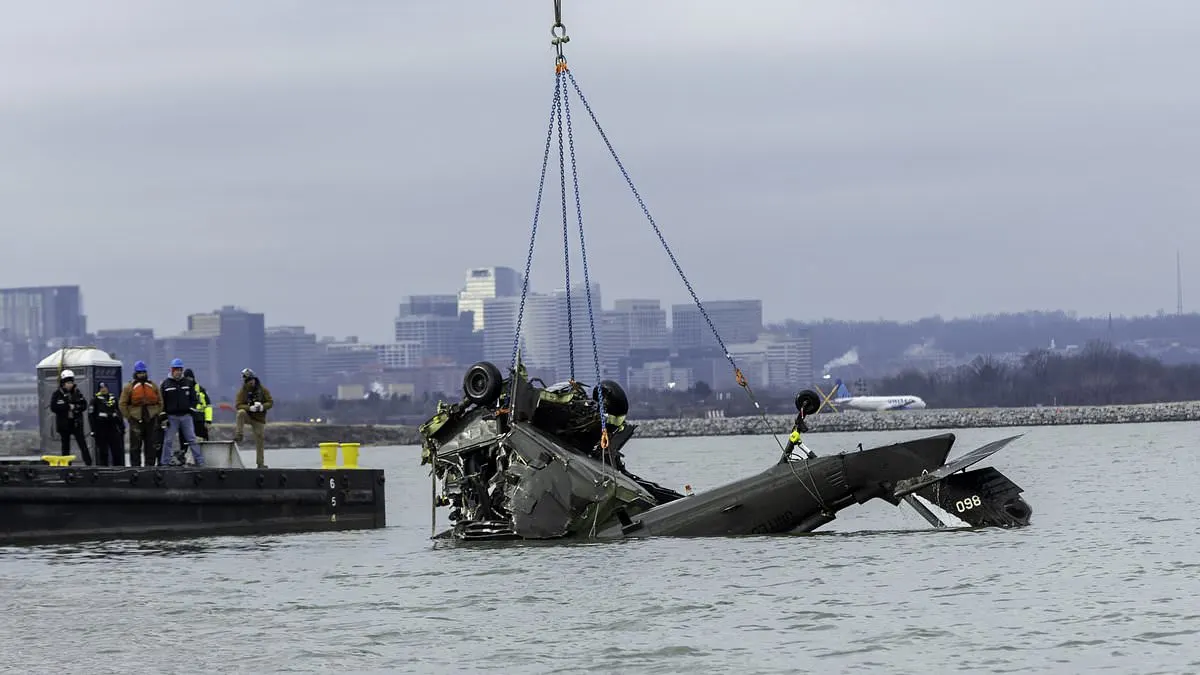
A US Army report confirms that faulty Black Hawk equipment and systemic failures led to the 2025 midair collision that killed 67 people in Washington, DC.
Key Takeaways
- •US Army report cites faulty altimeters as a factor in the 2025 collision.
- •67 people died when a Black Hawk and CRJ700 collided near Reagan National.
- •FAA has prohibited relying on visual separation for DCA approach traffic.
- •NTSB reports 15,000 close-proximity incidents in airspace from 2021 to 2024.
Systemic Failures in the Capital Airspace
New findings from a US Army investigative report have identified critical equipment failures and systemic oversights as the primary drivers of the January 29, 2025, Washington DC midair collision. The incident, which resulted in 67 fatalities, involved an American Airlines (operated by PSA Airlines) CRJ700 (Canadair Regional Jet 700) and a US Army Black Hawk helicopter over the Potomac River near DCA (Ronald Reagan Washington National Airport). This tragedy remains the deadliest commercial aviation accident in the United States in nearly 25 years.
According to the US Army report released in October 2026, military leadership was aware of persistent technical issues regarding faulty altitude-reading instruments on older Black Hawk models but failed to rectify the defects or adequately inform flight crews. The investigation revealed that the helicopter’s altimeter indicated 200 feet, while the actual altitude was 278 feet above the river, a discrepancy that significantly degraded situational awareness during the approach.
Investigative Findings and Airspace Risks
The NTSB (National Transportation Safety Board) finalized its investigative findings in early 2026, which are documented in DCA25MA108.aspx. The report detailed that military and civilian flight paths in the vicinity of the airport were separated by as little as 75 feet vertically, a margin deemed insufficient for safe operations. These findings align with the NTSB's broader analysis of the airspace, which identified systemic design flaws that placed commercial and military traffic in direct conflict.
Beyond equipment failures, the investigation highlighted severe operational breakdowns. At the time of the collision, a single ATC (Air Traffic Control) controller was tasked with managing both the helicopter and fixed-wing traffic, a combination of duties that should have been separated. The NTSB noted that the reliance on visual separation—a procedure where pilots are responsible for avoiding other aircraft based on their own observations—was a critical failure point. In the moments leading to the collision, the Black Hawk crew failed to adjust their flight path despite explicit instructions from ATC to pass behind the descending airliner.
Regulatory Context and Safety Reforms
In response to the accident, the FAA (Federal Aviation Administration) has implemented significant changes to flight procedures around Reagan National Airport. The agency has permanently banned air traffic controllers from relying solely on visual separation for aircraft in the airport's approach path. FAA Administrator Bryan Bedford testified before Congress in September 2026, acknowledging that while initial safety steps have been taken, the agency continues to work toward addressing the remaining recommendations issued by the NTSB.
However, the path to full safety compliance remains a point of contention. The NTSB has reported that the FAA has yet to fully implement one-third of the 33 safety recommendations issued following the investigation. Families of the victims have expressed frustration, arguing that the Army’s report focuses on broad systemic failures rather than holding individual leaders accountable for the known risks that preceded the crash.
Historical Precedents and Industry Trends
The 2025 collision mirrors historical tragedies where congested metropolitan airspace led to fatal encounters. In 1986, the Cerritos midair collision between an Aeroméxico DC-9 and a Piper Archer prompted the mandatory installation of Traffic Collision Avoidance Systems (TCAS) on commercial aircraft. Similarly, the 2009 Hudson River midair collision necessitated a complete restructuring of the Hudson River Special Flight Rules Area. These historical precedents demonstrate that significant regulatory shifts—such as mandatory reporting points and strictly segregated altitudes—are often the direct result of failures in mixed-use airspace management. Data from the NTSB indicates that between 2021 and 2024, there were over 15,000 close-proximity incidents in similar mixed-use environments, highlighting a growing industry challenge regarding controller workload and staffing levels.
Future Regulatory Milestones
The aviation industry now faces a critical timeline for airspace reform. The FAA is expected to complete the implementation of remaining NTSB safety recommendations regarding DCA airspace design between late 2026 and 2027. These changes are intended to provide a permanent buffer between military and commercial traffic, moving away from the manual separation protocols that failed in 2025. Monitoring the progress of these reforms remains a high priority for both the NTSB and congressional oversight committees.
Why This Matters for Aviation Safety
The tragedy at Reagan National Airport underscores the severe consequences of neglecting known equipment and systemic risks in high-density terminal airspace. For the aviation community, the collision serves as a stark reminder that safety margins are only as strong as the weakest link in the chain, whether that is an inaccurate altimeter, an overloaded controller, or an outdated airspace design. The ongoing regulatory response will likely set a new standard for how major metropolitan airports manage the integration of military and civilian traffic, with significant implications for future safety oversight.
Frequently Asked Questions
- What caused the 2025 midair collision near Reagan National Airport?
- The collision was caused by systemic failures including faulty altimeter readings on the Army Black Hawk helicopter, communication breakdowns, and insufficient vertical separation between military and commercial flight paths. Additionally, a single air traffic controller was managing both aircraft types, and the reliance on visual separation proved inadequate in the high-density airspace.
- How has the FAA changed safety procedures following the 2025 crash?
- The FAA has permanently prohibited air traffic controllers from relying solely on visual separation for aircraft operating in the approach path near Reagan National Airport. Furthermore, the agency has implemented permanent restrictions to better separate helicopter traffic from commercial airline flight paths.
From airline operations to fleet updates, commercial aviation news lives at omniflights.com. Follow aviation sustainability efforts, emissions research, and green initiatives in the Environmental section at omniflights.com/environmental.

Written by Shashank Shukla
Co-Founder & CTO leading the engineering and AI systems behind Omni Flights. Covers aviation technology, flight safety, aircraft manufacturing, and emerging aerospace developments.
Visit ProfileYou Might Also Like
Boeing 737-10 Certification Moves Ahead After FAA Review
Airline CEOs Address Flydubai Cockpit Attack Security
Saudia A320 Destroyed in Riyadh Airport Missile Strike
Saudi Arabia Opens Probe Into Flydubai Cockpit Attack

Flydubai FZ1073: Resilience Lessons After Cockpit Attack