American Airlines Gains 3 O'Hare Gates as United Plan Fails

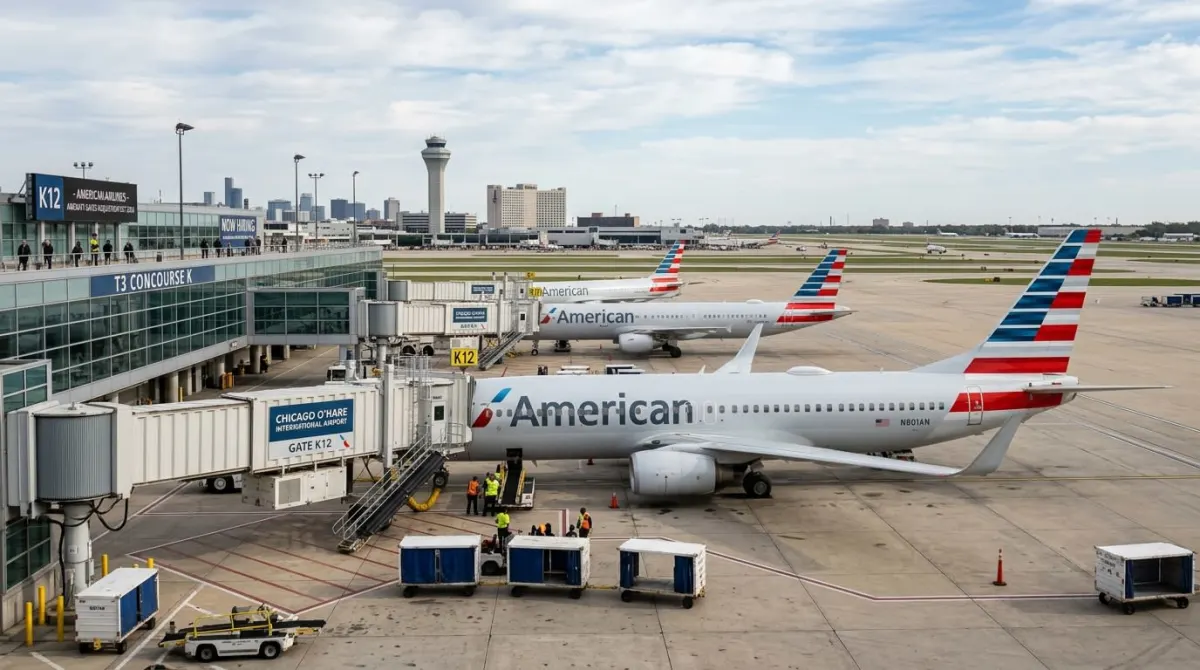
American Airlines will regain three gates at Chicago O'Hare this October after FAA flight caps thwarted United's attempts to expand its market share.
Key Takeaways
- •American Airlines gains 3 gates at O'Hare, reaching a total of 66.
- •United Airlines' gate count drops from 95 to 91 this October.
- •FAA flight caps at 2,708 daily operations blocked United's expansion plan.
- •O'Hare gate allocation is governed by the 2018 AULA 'use it or lose it' rule.
American Airlines O'Hare Gates Expansion
American Airlines will officially regain three gates at Chicago O'Hare International Airport (ORD) in October 2026, marking a significant shift in the competitive landscape of the dual-hub facility. This development follows the annual gate reallocation process finalized by the Chicago Department of Aviation (CDA) on May 29, 2026. The move increases American’s footprint to 66 total gates, including two assets acquired from Spirit Airlines, while United Airlines will see its gate count drop from 95 to 91 units.
The reallocation is a direct consequence of the 2018 Airline Use and Lease Agreement (AULA), which governs gate frontage based on prior-year airline departure activity. Under this 'use it or lose it' formula, airlines must maintain consistent flight volumes to retain their assigned facilities. The 2026 outcome represents a sharp reversal of the October 2025 reallocation, during which United gained five gates while American lost four, a shift that previously triggered unsuccessful litigation from the Fort Worth-based carrier.
The Role of FAA Flight Caps
United’s strategy to secure its gate dominance involved a plan to flood the airport with additional scheduled flights throughout 2026. However, this effort was effectively neutralized when the Federal Aviation Administration (FAA) instituted and extended strict daily flight caps at ORD to manage severe congestion. The Operating Limitations at Chicago O'Hare International Airport, an order establishing scheduling limits, constrained operations to 2,708 flights per day between June and October 2026. By limiting the total number of departures, the FAA prevented United from generating the necessary flight volume to satisfy the AULA requirements for gate retention.
According to Cirium schedule data, United operated an average of 541 daily departures from O'Hare in 2025, compared to 412 for American. Despite this volume gap, the regulatory intervention has created a hard ceiling on expansion. While United CEO Scott Kirby stated during the Q4 2025 earnings call that the airline would add as many flights as required to maintain its gate count, the FAA’s operational mandate prioritizes air traffic control efficiency and safety over individual carrier growth strategies.
O'Hare Competitive Dynamics
This ongoing turf war highlights the intensifying competition between legacy carriers at major hubs. United reported earnings of approximately $500 million at O'Hare in 2025, while American experienced a similar financial deficit, illustrating the high stakes involved in securing gate access. For corporate travelers, the result is a sustained, hyper-competitive environment as both airlines fight to capture market share. The FAA’s intervention, while operational in nature, has become a decisive factor in the commercial battle, effectively capping the ability of dominant carriers to squeeze rivals through sheer schedule density.
What Comes Next: The 2027 Regulatory Horizon
The implementation of the 2026 gate reallocation is scheduled for October. Looking forward, the industry is tracking the expiration of the current FAA flight caps, which are set to remain in effect until October 30, 2027. The status of these limitations post-2027 remains a critical milestone for both airlines as they plan their future schedules. The CDA will continue to monitor departure activity under the AULA framework, with the next annual reallocation cycle expected to be heavily influenced by whether the FAA decides to renew or relax the current scheduling limitations at ORD.
Why This Matters for Hub Competition
This gate shift underscores the volatility of the O'Hare operating environment, where regulatory constraints can rapidly alter the competitive balance between major airlines. For aviation professionals, the situation serves as a primary case study in how infrastructure limitations and government intervention can override aggressive corporate expansion strategies. As long as O'Hare remains at or near capacity, the 'use it or lose it' mechanism will continue to drive intense, often litigious, competition for gate access.
Frequently Asked Questions
- Why did United Airlines lose gates at Chicago O'Hare?
- United Airlines lost gates because the FAA implemented daily flight caps at O'Hare, which prevented the airline from operating enough flights to satisfy the 'use it or lose it' requirements of the 2018 Airline Use and Lease Agreement.
- How many gates will American Airlines have at O'Hare in October 2026?
- American Airlines will have a total of 66 gates at Chicago O'Hare International Airport following the October 2026 reallocation, which includes three gates regained from the city and two acquired from Spirit Airlines.
Access up-to-date commercial aviation news and airline industry developments via omniflights.com. Discover how innovation is shaping aviation through aircraft systems, avionics, and digital tools at omniflights.com/technology.

Written by Ujjwal Sukhwani
Aviation News Editor & Industry Analyst delivering clear coverage for a worldwide audience. Covers flight operations, safety regulations, and market trends with expert analysis.
Visit ProfileYou Might Also Like
Emirates May Convert 35 Boeing 787s to 777X Jets
American Airlines JFK Routes Expand in 2027 Schedule Shift

Emirates Launches Helsinki Flights With New A350 Service

Saudia Group Prepares Major Aircraft Order for 2031-2040
JetBlue Secures 22 LaGuardia Slots in $58.5M Spirit Deal