AAIB Report Cites Pilot Error in Kozhikode 737-800 Overrun

Co-Founder & CEOAviation News Editor delivering trusted coverage across the global aviation industry.

India's AAIB report on Air India Express 1344 cited pilot error for the fatal Kozhikode crash, also highlighting systemic failures at the airline.
Key Takeaways
- •Attributed the fatal crash to pilot error, specifically an unstabilized approach with a tailwind.
- •Identified systemic safety failures at Air India Express and inadequate runway safety infrastructure as major contributing factors.
- •Resulted in 43 safety recommendations, prompting renewed calls for EMAS installation at India's tabletop runways.
- •The Boeing 737-800 overrun killed 21 of the 190 people on board after plunging 110 feet into a gorge.
The final report from India's Aircraft Accident Investigation Bureau (AAIB) on the fatal crash of Air India Express Flight 1344 has attributed the probable cause to pilot error, citing the flight crew's failure to adhere to established protocols during a landing in adverse weather. The accident, involving a Boeing 737-800 at Kozhikode's challenging tabletop runway on August 7, 2020, resulted in 21 fatalities and has intensified scrutiny on both airline safety culture and airport infrastructure in India.
The investigation's findings underscore the critical importance of stabilized approaches, particularly in demanding conditions. According to the AAIB report, the primary cause was the "non adherence to SOP by the PF (Pilot Flying), wherein, he continued an unstabilised approach and landed beyond the touchdown zone... in spite of Go Around call by PM (Pilot Monitoring)." This conclusion points to a breakdown in Crew Resource Management and highlights a steep cockpit authority gradient that may have prevented the First Officer's call for a go-around from being acted upon. The report also emphasized that "the role of systemic failures as a contributory factor cannot be overlooked," implicating a deficient safety culture at the airline.
Accident Details and Investigation Findings
Operating as a Vande Bharat Mission flight, the aircraft, registered VT-AXH, was repatriating Indian citizens from Dubai. It attempted to land at Kozhikode International Airport (CCJ) during heavy monsoon rains. The investigation revealed that the aircraft touched down at approximately 4,438 feet on the 8,858-foot-long Runway 10, well beyond the designated touchdown zone. The landing was executed with a significant tailwind component of 15 knots, further increasing the required stopping distance on the wet runway.
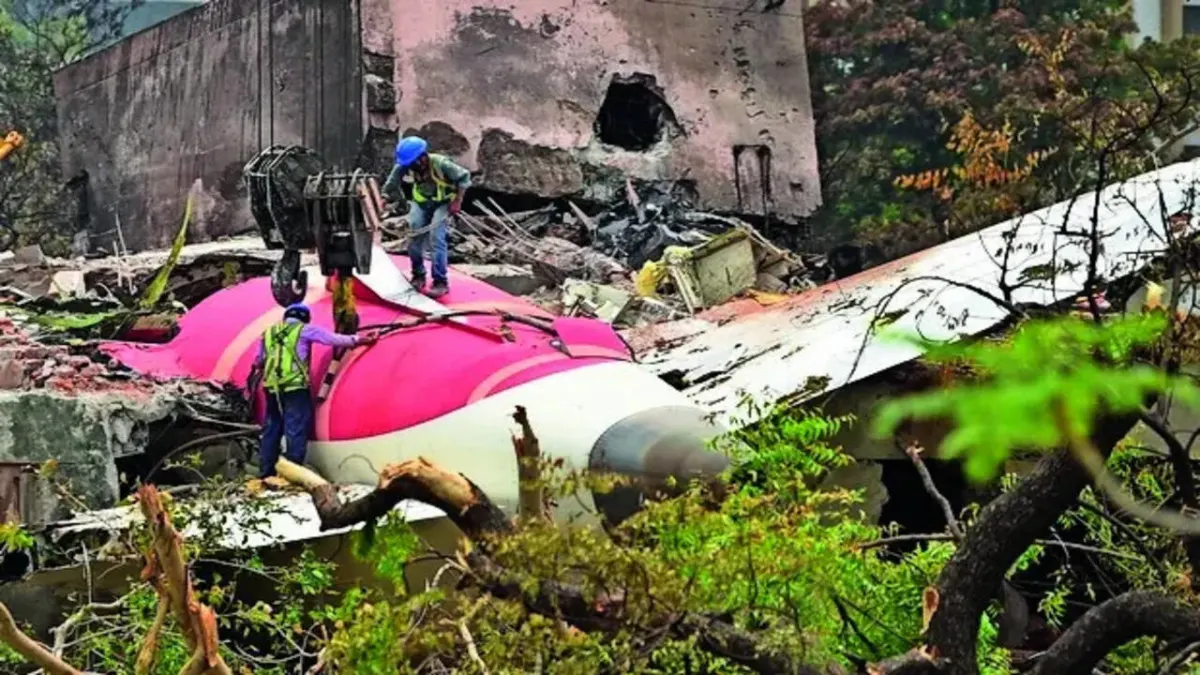
Unable to stop on the remaining tarmac, the 13.7-year-old aircraft overran the end of the runway, broke through the perimeter wall, and plunged approximately 110 feet into a gorge, splitting the fuselage into multiple sections. Of the 190 people on board (184 passengers and 6 crew), 21 lost their lives, including both pilots.
Regulatory and Airline Impact
The AAIB's findings placed significant pressure on multiple stakeholders. Air India Express faced severe regulatory scrutiny from the Directorate General of Civil Aviation (DGCA) over its safety culture, training programs, and the systemic failures cited in the report. The event also cast a spotlight on the Airports Authority of India (AAI), which came under intense pressure to fund and install Engineered Materials Arrestor Systems (EMAS) at tabletop runways across the country. The DGCA itself was criticized for what some observers described as lax oversight and a failure to fully enforce safety recommendations issued after a similar crash a decade earlier.
A History of Tabletop Runway Dangers
The Kozhikode tragedy is hauntingly similar to a previous accident. In May 2010, Air India Express Flight 812, also a Boeing 737-800, overran a tabletop runway in Mangalore, India, resulting in 158 fatalities. That investigation also pointed to pilot error during an unstabilized approach. The incident led to a series of recommendations for improving safety at such airports, including the implementation of EMAS, but many were not fully implemented due to cost and logistical challenges. The 2020 crash underscores the tragic consequences of these unaddressed risks. The Kozhikode incident was also preceded just months earlier by the Pegasus Airlines Flight 2193 crash in Istanbul, where another Boeing 737-800 overran a wet runway and fell down an embankment.
Kozhikode Runway Safety Deficiencies
Tabletop runways, which are located on a plateau or hilltop with one or both ends adjacent to a steep drop, present unique operational challenges. The lack of overrun space makes stabilized approaches and precise touchdowns critical. A comparison highlights the safety margin deficiencies at Kozhikode at the time of the accident.
| Metric | Kozhikode Runway 10 | ICAO Recommended Standard |
|---|---|---|
| RESA (Runway End Safety Area) | 90m | 240m |
| Arrestor System | None | EMAS Recommended |
Technical Analysis
The Air India Express Flight 1344 accident serves as a critical case study demonstrating that pilot error rarely occurs in a vacuum. It is often the final link in a chain of systemic and latent safety deficiencies. The repeated pattern of unstabilized approaches leading to overruns at Indian tabletop runways—first in Mangalore in 2010 and then Kozhikode in 2020—points to a persistent gap between regulatory recommendations and operational reality. The resistance to installing costly infrastructure like EMAS, as noted by analysts, in favor of administrative solutions like re-designating runway lengths, highlights a structural tension between safety investment and budget constraints. This accident indicates that without mandated, engineering-based safety solutions and a robust enforcement of airline SOP, these high-risk environments will remain vulnerable to human factors.
What Comes Next
In response to the crash, the AAIB issued 43 safety recommendations aimed at Air India Express, the DGCA, and the AAI. The DGCA has since mandated comprehensive reviews of operational procedures, crew training, and infrastructure at all tabletop airports in India. A renewed and more urgent push is underway for the installation of EMAS or other equivalent arrestor systems at Kozhikode, Mangalore, and other similar runways. These measures are subject to regulatory approval and funding allocation, but the political and public pressure following the Flight 1344 accident has created new momentum for their implementation.
Why This Matters
The Kozhikode crash report is a stark reminder of the unforgiving nature of aviation operations in challenging environments. It highlights how a breakdown in crew discipline, coupled with pre-existing infrastructure and organizational weaknesses, can lead to catastrophic failure. For the global aviation industry, it reinforces the critical need for regulators to not only issue recommendations after a tragedy but to rigorously enforce their implementation to prevent history from repeating itself.
From airline operations to fleet updates, commercial aviation news lives at omniflights.com. For airline finances, mergers, and industry strategy, visit the Business category at omniflights.com/business.
Written by Hardik Vishwakarma
Co-Founder & Aviation News Editor leading initiatives that improve trust and visibility across the global aviation industry. Covers airlines, airports, safety, and emerging technology.
Visit ProfileYou Might Also Like
Discover more aviation news based on similar topics

Families Demand DCA Midair Collision Safety Reforms
Families of 67 victims from the 2025 DCA midair collision are pressing Congress for mandatory ADS-B In technology to prevent future aviation tragedies.
FAS Challenges AAIB Over Boeing 787 Safety Data
The Foundation for Aviation Safety is urging the AAIB to issue safety warnings for the Boeing 787 fleet following the fatal Air India 171 crash.
NTSB Safety Recommendations Lag Amid 6 Monthly Near-Misses
Approximately 6 near-miss incidents occur monthly at U.S. airports as 270 NTSB safety recommendations remain unaddressed by federal regulators.
NTSB Rejects FAA Safety Responses After 67-Fatality Crash
The NTSB labeled 11 FAA responses to 2025 DCA mid-air collision recommendations as unacceptable, citing the lack of a mandatory ADS-B In requirement.
EASA Orders Urgent Airbus A380 Wing Spar Inspections
The EASA ordered urgent inspections on 16 Airbus A380s after discovering wing spar cracks that could compromise structural integrity.
Ryanair Flight RK514 Diverts to Birmingham After Emergency
Ryanair flight RK514 diverted to Birmingham Airport on September 13, 2026, following a medical emergency involving a passenger.