Emirates Resumes Flights to 100 Destinations From Dubai Hub

Aviation News Editor & Industry AnalystAviation News Editor & Industry Analyst delivering clear coverage for a worldwide audience.

Emirates has resumed flights to 100 global destinations from Dubai following the partial reopening of regional airspace by the UAE's GCAA.
Key Takeaways
- •Resumed flights to 100 destinations after UAE airspace partially reopened.
- •Followed a GCAA-mandated airspace closure on February 28, 2026, due to regional conflict.
- •Offered free rebooking options for passengers affected by the widespread disruption.
- •Prioritized clearing stranded transit passengers at Dubai International Airport (DXB).
Emirates has resumed a significant portion of its flight schedule, now operating to 100 global destinations from its hub at Dubai International Airport (DXB). The service restoration, confirmed on March 12, 2026, follows the partial reopening of regional airspace, which was temporarily closed by the UAE's General Civil Aviation Authority (GCAA) on February 28, 2026, due to escalating regional conflict.
The disruption grounded a substantial part of the carrier's fleet and caused significant passenger backlog at DXB, one of the world's busiest international hubs. In its operational update, Emirates strongly advised passengers not to travel to the airport without a confirmed booking and to monitor its website for the latest flight status. The airline has prioritized clearing the backlog of stranded transit passengers, a critical challenge for its hub-and-spoke model.
Operational and Passenger Impact
The GCAA directive to temporarily close the UAE Flight Information Region (FIR) was a precautionary measure in response to regional military activities. Upon the partial reopening in early March, Emirates initiated a phased resumption of services. According to an airline spokesperson, the carrier is aiming for a return to 100% of its network within days, contingent on continued airspace availability and operational stability.
For passengers, the impact was immediate and widespread. The sudden closure affected tens of thousands of travelers, particularly those in transit at DXB. In response, Emirates implemented a flexible travel policy, allowing free rebooking for travel until April 30, 2026, for tickets issued between February 28 and March 31. This move aligns with a broader industry trend of airlines waiving fees during geopolitical airspace closures to manage customer relations and operational chaos. High-severity impacts were felt by travel agencies and tour operators, who were forced to process mass rebookings and refunds. The disruption also delayed shipments of critical cargo, including perishables and pharmaceuticals, due to reduced belly-hold capacity.
A Pattern of Regional Disruption
This incident is not without precedent in the volatile Middle East. In April 2024, the 2024 Middle East Airspace Closures during an Iran-Israel escalation resulted in the temporary closure of airspace in Jordan, Iraq, Lebanon, and Israel. This caused massive flight diversions and cancellations for carriers operating in the region, a pattern that directly mirrors the current situation's impact on Gulf carriers. Similarly, in January 2020, following Iranian strikes on U.S. bases in Iraq, widespread rerouting around Iranian and Iraqi airspace by global carriers became necessary. These historical events underscore the persistent vulnerability of Middle Eastern aviation to sudden geopolitical shocks, forcing carriers and regulators like the GCAA to develop robust crisis management protocols.
Operational Resilience Tested
The phased resumption of services by Emirates highlights the practiced resilience of major hub carriers in the face of crisis. The airline's focus on clearing the transit passenger backlog and implementing flexible booking policies demonstrates a strategic approach refined through previous regional disruptions. The ability to restore service to 100 destinations in under two weeks suggests a high degree of operational agility. However, as noted by aviation security experts, while airlines push for a swift return to normalcy to mitigate financial losses, the underlying regional volatility means the airspace remains subject to sudden closures. This dynamic places a premium on real-time threat assessment and conservative operational planning.
Path to Full Resumption
Looking ahead, Emirates and the GCAA are working towards a full return to normal operations. An Emirates spokesperson confirmed the airline is expected to return to 100% of its network capacity by mid-March 2026. This milestone is subject to the GCAA's continued assessment that the airspace is safe for commercial traffic. The GCAA has emphasized that airspace safety and UAE sovereignty are its absolute priorities in managing the situation. The full resumption will depend entirely on the evolving security landscape in the region.
Why This Matters
This event underscores the critical link between geopolitical stability and the operational viability of global aviation hubs. For airlines like Emirates, whose business model relies on the seamless flow of transit traffic through DXB, sudden airspace closures represent a significant systemic risk. The incident demonstrates the importance of sophisticated crisis response mechanisms and highlights the ongoing challenge of operating long-haul networks through a strategically vital but often volatile region.
From airline operations to fleet updates, commercial aviation news lives at omniflights.com. Stay informed on aviation incidents, investigations, and best practices in the Safety category at omniflights.com/safety.
Written by Ujjwal Sukhwani
Aviation News Editor & Industry Analyst delivering clear coverage for a worldwide audience. Covers flight operations, safety regulations, and market trends with expert analysis.
Visit ProfileYou Might Also Like
Discover more aviation news based on similar topics
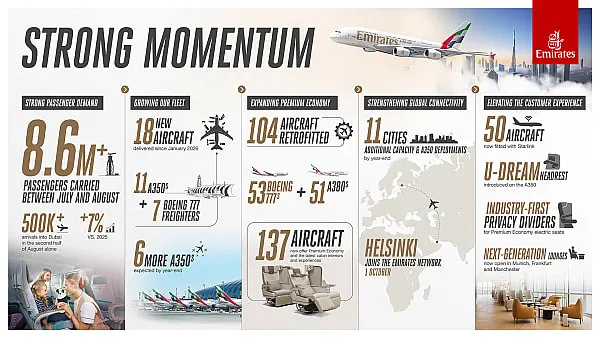
Emirates Winter Booking Momentum Grows Amid Fleet Expansion
Emirates carried 8.6 million passengers this summer and enters winter with strong demand as it accelerates fleet retrofits and network growth.
Air Arabia Consortium Gains AOC for New Dammam Budget Airline
A Saudi GACA-led consortium including Air Arabia has secured an AOC to launch a new budget airline based at Dammam's King Fahd International Airport.
Turkish Airlines Exits Luanda as Angola Hub Struggles
Turkish Airlines dropped its Luanda route as Angola's new airport struggles to attract traffic, handling only 756,028 passengers in 2025.

Red Sea Airlines Leases Two 737 MAX 8s for 2027 Expansion
Red Sea Airlines signed a lease for two Boeing 737 MAX 8 aircraft from SMBC Aviation Capital, arriving in 2027 to support its 14-aircraft fleet goal.
Avelo CEO Warns Airfares May Rise on Jet Fuel Price Spikes
Avelo Airlines CEO Andrew Levy warns that rising fuel costs may force fare increases as global jet fuel prices reach $171.01 per barrel.
IndiGo, Air India Battle for Mumbai-Delhi Route Dominance
IndiGo and the Air India group are competing for dominance on the Mumbai-Delhi air route, which saw 13.9 percent capacity growth this September.